
Environmental groups and labor respond to Governor McKee's push against renewable energy and energy efficiency
"I believe [Dan McKee]’s going to roll back on a lot of these things because, honestly, I think he got some bad advice because the numbers don’t work," said IBEW Local 99's Joe Walsh.

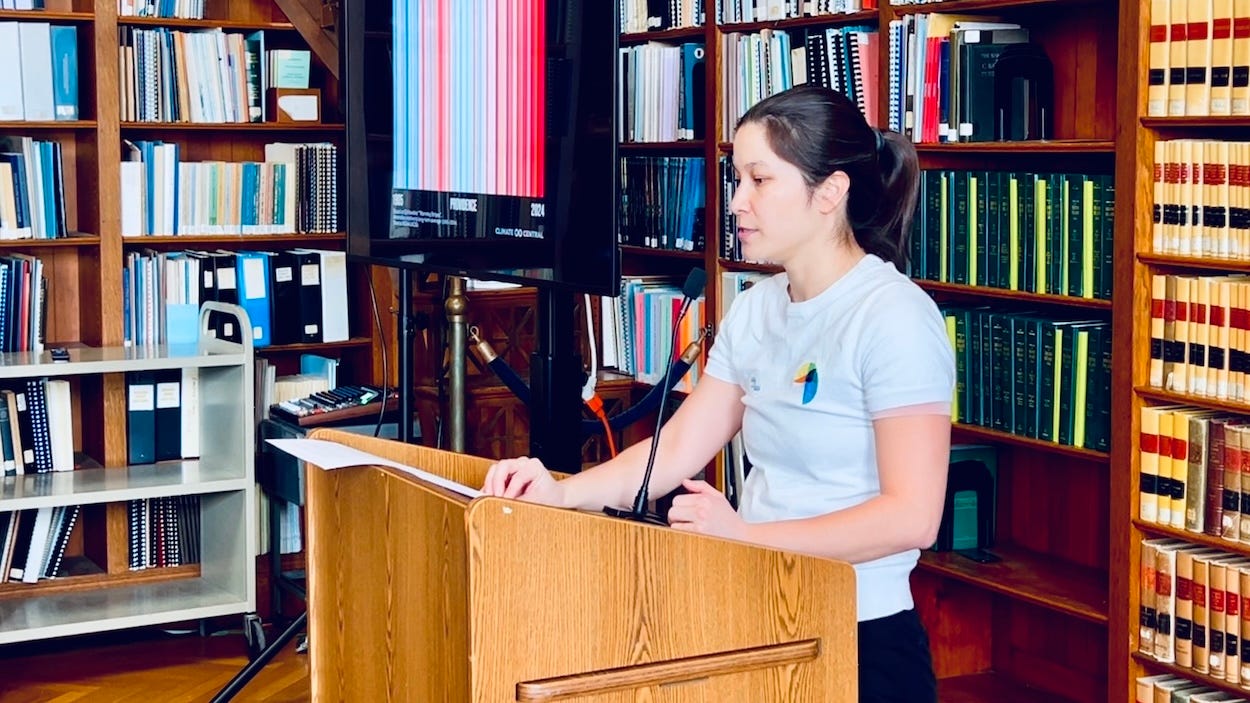
Environmental advocates, state legislators, and labor union leaders spoke out at a State House press conference to oppose Rhode Island Governor Daniel McKee’s budget proposals and executive order on clean energy. The event was sponsored by Acadia Center, Climate Action Rhode Island, and the Green Energy Consumers Alliance.
“Slowing the transition to clean local renewables is a shortsighted plan that doesn’t address the long-term energy affordability and undermines Rhode Island’s economic competitiveness and clean energy future,” said Emily Howe of Clean Water Action. “The investments we make today in energy efficiency make homes more comfortable, use less energy, and reduce energy demand, resulting in lower costs for all rate payers.”
Acadia Center’s Emily Koo put it bluntly: “Cutting clean energy doesn’t protect Rhode Island rate payers. It protects an outdated energy system and keeps us dependent on dirty, expensive fossil fuels. These so-called state mandates, like our renewable energy standard and the charges that support renewable energy and energy efficiency programs, help reduce the largest and fastest-growing component of your bill: supply and delivery costs. It’s a glaring omission to report clean energy costs while ignoring all cost savings, one of the primary reasons for undertaking the energy transition in the first place. Clean energy isn’t at odds with affordability. It’s essential to it.”
The Governor’s bad policy decisions around renewable energy and energy efficiency programs did please at least one group in Rhode Island: Senate Republicans.
“Senate Republicans warned these mandates were unaffordable, we debated the adverse effects on ratepayers on the Senate floor, we have submitted legislation to increase transparency on utility bills, and to fully repeal costly mandates,” said Senate Minority Leader Jessica de la Cruz. “It is good to know the Governor supports our advocacy and, at long last, realizes the detrimental effect of the policies he has historically championed. Now is the time to put partisanship aside and correct the failed policies that have given rise to some of the highest electricity rates in the country.”
“Rhode Island’s mandates on renewable energy rely heavily on taxpayer-funded subsidies. Those costs are borne by ratepayers across all socio-economic backgrounds and present significant financial challenges for businesses and the economy,” said Senate Minority Whip Gordon Rogers. “If the governor’s efforts to solve problems he helped create do not include a full repeal of mandates and a significant reduction in taxpayer subsidies, then he is gaslighting the people of Rhode Island – it’s just too bad that gaslighting can’t be used to heat and power our homes.”
Still, there are signs that the Governor may already be backing away from some parts of the executive order he signed the day before.
“I believe the governor’s listening. I really do,” said Joe Walsh, Business Manager of IBEW Local 99. “I think he made some decisions that he may not have had all the information on, and I think he’s rethinking it. I want to make sure we don’t give him a bad name on this because I know for a fact that he believes in renewable energy. He wants better-paying jobs, wages, and benefits. That’s what he wants. He didn’t take any direct action against the environmental community or me, it’s just bad policy that he needs to work out, and I think we’re going to get there…”
Here’s the video:
Emily Howe, state director for Clean Water Action: We’re united in saying that clean energy is affordable energy. Slowing the transition to clean local renewables is a shortsighted plan that doesn’t address long-term energy affordability and undermines Rhode Island’s economic competitiveness and clean energy future. Natural gas prices will continue to be volatile, and gas infrastructure projects are contributing to today’s high energy bills.
At the same time, the impacts of the climate crisis are already here. Severe weather events are expensive, and it’s false to say that we can’t afford a transition to renewable energy. We can’t afford not to.
Governor McKee, you often talk about your coaching days. Coach, the clock is running out. Whose playbook are you using? Are you team Rhode Island, looking to make energy cleaner and more affordable, or are you going to continue to use the alt-right MAGA playbook? The ball is in your court, and you’re going to be taking the last shot. We’re asking you to lead the way before the clock runs out.
The investments we make today in energy efficiency make homes more comfortable, use less energy, and reduce energy demand, resulting in lower costs for all rate payers. Local renewable energy projects diversify our energy portfolio, reducing our reliance on volatile fossil fuel prices. These projects provide access to affordable electricity and family-sustaining jobs.
Emily Koo, Senior Policy Advocate and Rhode Island Program Director for Acadia Center: Cutting renewables and energy efficiency is not the answer to Rhode Island’s rising energy costs. With this budget proposal, Governor McKee continues to pin the blame for escalating energy prices on the very tools that serve to protect Rhode Island rate payers from volatile supply costs and rising delivery costs - much larger portions of our bill. I’m here to outline the three most egregious provisions in Governor McKee’s budget proposal.
First, it levies a substantial, punitive grid access fee and lowers compensation rates for large renewable energy projects, signaling that Rhode Island is closed to clean energy business. The retroactive nature of the changes to both existing and new net metering systems would have a severe chilling effect on the industry as a whole. This will drive the solar industry out of the state. A range of virtual net metering customers, including municipalities, hospitals, colleges and universities, and housing authorities, would lose substantial value from pre-negotiated discounted electricity, and, in many cases, taxpayers would bear the brunt of that loss.
Second, the budget proposal delays and weakens Rhode Island’s leading renewable energy standard (RES), prolonging our dependence on dirty, expensive fossil fuels. Delaying the renewable energy standard undermines the linchpin of achieving the state’s emission reduction mandates and renders the climate act and the recent 2025 climate strategy obsolete.
Third, the budget caps Rhode Island’s cost-effective energy-efficiency programs at $75 million per year, 48% below the five-year average. These are programs that have delivered deep, lasting savings for Rhode Island. These programs are required to show, and they do, that their benefits outweigh their costs. Throughout the last annual energy efficiency planning process, Acadia Center, the stakeholder Energy Efficiency Council, a large group of legislators (thank you all who signed onto that letter), and other local, regional, and national organizations spoke out against reducing energy efficiency investments and explained why that’s bad for Rhode Island rate payers.
I want to clarify that all parties involved in that proceeding did not support the reduction. The Energy Efficiency Council advocated for greater savings in its intervention before the Public Utilities Commission (PUC), but ultimately, a $93 million budget was approved following the regulatory review. That reduced budget was $93 million. The cap is proposed at $75 million. While we opposed the budget reduction, the outcome shows that the regulatory process is working and that an arbitrary cap is neither necessary nor future-proof.
The cheapest megawatt is the megawatt we don’t use, often called a “negawatt.” Energy efficiency directly lowers bills by reducing demand and suppressing prices across the region. By pinning the blame on state mandates and taxes, Governor McKee’s budget ignores the benefits of clean energy and the primary drivers of energy costs.
Cutting clean energy doesn’t protect Rhode Island rate payers. It protects an outdated energy system and keeps us dependent on dirty, expensive fossil fuels. These so-called state mandates, like our renewable energy standard and the charges that support renewable energy and energy efficiency programs, help reduce the largest and fastest-growing component of your bill: supply and delivery costs. It’s a glaring omission to report clean energy costs while ignoring all cost savings, one of the primary reasons for undertaking the energy transition in the first place. Clean energy isn’t at odds with affordability. It’s essential to it.
Representative Lauren Carson (Democrat, District 75, Newport): I’ve been working on my comments for you for a couple of days, and as I came up here, I read an article in the Providence Journal that appears to have just been published, claiming that the Act on Climate is due for a rewrite. [Behind a paywall] I think that is the fight here, ladies and gentlemen. We can discuss all the other issues. We can discuss net metering. We can discuss the energy standard, but the Act on Climate is really the fight that we’re in, and I’m going to ask you to stay focused on that particular aspect of this debate as we go forward.
The Speaker of the House asked me to make remarks on his behalf1:
“Five years ago, we made history by passing the Act on Climate, a bold, science-based commitment to cut our carbon emissions and confront the crisis head-on. And that was not just legislation, that was a promise. A promise to our children, our coastline, our economy, and the community’s most vulnerable, to the consequences of a warming planet. Let me be clear: we must keep the promise in the Act on Climate. The women and members of the House Environment Committee are fully committed to this. They are working very hard day and night, and I can tell you we meet frequently on this.”
But there is a reality here: the world around us is shifting. The crisis has not only accelerated, but it’s also made our mission urgent. We are seeing the emergence of fossil fuel agendas at the national level and are returning to the same shortsighted policies. Today, we face the rollback of the 2009 Endangerment Finding, which the Supreme Court ruled on in 2007, directing the Environmental Protection Agency (EPA) under the Clean Air Act to address climate change. That is coming tomorrow from the Trump Administration. Today, the federal government is taking more drastic steps to eliminate a key tool the EPA uses to substantiate the reality of climate change. And today, Trump has appealed court decisions on offshore wind.
That is what we’re up against. That is the reality of this political world right now, because here’s the truth: Rhode Island has led with some of the toughest climate standards in the country. We’ve proven that small states can think big. This moment demands courage, clarity, evaluation, and continued action. We know that the solar industry has brought millions of dollars in investments. We know that supply and transmission costs account for 70% of our utility bills, and that net metering programs save universities, nonprofits, and municipalities real money. But I’m prepared to have hard conversations about this because that’s what’s demanded of us right now: about how we meet our goals and where we’re falling short. We have to have these hard conversations without abandoning our goals.
We’re going to face very difficult decisions in the weeks ahead. They need to be based on science. We deserve accurate modeling and reports that incorporate built-in deadlines so we can monitor our progress toward the 2040 Act on Climate goals. We can discuss the shorter-term goals, the 2030s, but the 2040 goals seem most at risk at this time. If we don’t meet those targets, the state is subject to citizen lawsuits under the Act on Climate, and it’s irresponsible for policymakers to expose Rhode Island to such liabilities. I propose that any action taken this year include a legislative-mandated review of any new policies we’re developing by 2030 to assess their effectiveness, as new policy changes are likely coming. We need to confirm they’re working so we can make adjustments in the future.
Our investments in renewables cannot be reduced or eliminated. If we extend the renewable energy standard and modify net metering, we still need to ensure we bring more renewable energy into the system. That is the goal.
I want to discuss affordability briefly. Utility bills are rising. Over the next three to four weeks, as my constituents receive their utility bills, my phone will start ringing, and they will want answers about why it’s so high. We’ve had zero-degree weather. We’ve had several terrible snowstorms. People are concerned about this. I have a responsibility to 14,000 people in the City of Newport to address their utility bills, don’t forget that. But as Emily said, we have a bold idea: climate responsibility and affordability are not in conflict. In fact, clean energy can lower costs over time. Can we get there doing nothing? Can we get there if we lose to the ideas that we’re seeing right now?
No.
We must pursue policies that are both ambitious and accelerate decarbonization while protecting the everyday consumer. Reviewing our ambitious policies is not a step backwards by any stretch of the imagination. We’re in a situation where we have to review these things, but, as the Speaker of the House always says, if we don’t get a seat at the table, we’re going to be on the menu. There’s no doubt in my mind about that.
We must also acknowledge that we’re not alone in this fight. We’re in New England. We must recognize that we share our energy supply with our neighbors in other states. Perhaps we need to deepen our collaboration with our neighboring states. As we do this, we must measure our progress accurately. If there are policy changes, we must continually measure progress to ensure we’re on track to meet the Act on Climate targets. How far have we come? Where are the gaps? How can we innovate faster?
I know many of you likely disagree with the EC4’s strategic plan. Many of you wanted it to go further, but this is what we got. This is the plan. This was the first deliverable of the Act on Climate. They had to produce a strategic plan to meet the goals by December 2025. Read the law. They did it. This is what we got. This is the plan. Use the plan to the best of your ability in every place. Legislators, put it in every bill that you write. Remind people that this is required by law.
I’m going to be introducing a bill to mandate that the State of Rhode Island meet its own obligations under the Climate Act. State institutions, departments, commissions, and quasi-publics are required to comply with the Act on Climate’s standards and implement the strategic plan. We must lead by example. That is one step we can take to reduce our carbon footprint. Another step we can take to reduce our carbon footprint is to finally get building decarbonization over the line.
The next five years will be critical. We have an ongoing fight over wind. We have the Trump Administration for the next three years. We have challenges right in Rhode Island, where these things are being debated. We have to face the reality of these things. But above all, we must protect the Act on Climate, no matter how we negotiate through these very choppy waters. I encourage you to remain active, participate in decision-making, and be thoughtful in your recommendations as you respond to the policies around us.
Senator Alana DiMario (Democrat, District 36, Narragansett, North Kingstown, New Shoreham): I represent about 30,000 people in my District. I also pay an electric bill every month. How many of you here pay an electric bill every month? How many of you are here to advocate for something that is going to make that bill go up? Anybody? No, not one hand. Everyone is committed to keeping affordability front and center for our constituents, community members, and ourselves.
My colleagues and I in the General Assembly have no greater responsibility than to ensure we meet our constituents’ needs and create opportunities for them to thrive, and affordability is part of that. We had a robust Senate Finance Committee hearing last night. We had environmental advocates, labor representatives, and industry representatives come together to say, “Yes, affordability, but this is not the way.”
This is not the first time my colleagues in the House and the Senate have considered ways to reduce energy costs while staying true to our commitment to both energy efficiency and the renewable energy standard. My colleague, Senator Samuel Zurier, is leading a commission to evaluate the strategic plan for the climate act and how we can best align budget investments and policy initiatives to support that goal. Senator Susan Sosnowski, chair of the environment committee, is also leading a renewable energy study commission, which is examining whether there are opportunities to refine policies to stay focused on the goal of the renewable energy standards without sacrificing affordability. That work is ongoing, and we take that work very seriously.
I want to take a moment to highlight energy efficiency: as noted earlier, the kilowatt-hour that is never used is both the cheapest and the greenest. We need to protect the energy efficiency program because it has not yet realized its full potential. Some of our most vulnerable ratepayers, who are not homeowners, do not take advantage of energy-efficiency benefits because they don’t own their homes. We have not yet figured out a way to ensure those benefits reach all rate payers, and I want us to stay committed to that rather than back off on investments in that space.
I also believe the governor’s initiative was well-intentioned. We all want to see bills go down. Last night, on the finance committee, I asked, “Roughly per household, what cost relief would we see if we passed all of the initiatives in the governor’s budget?” The answer was between $ 15 and $25 in monthly savings per household.
I’m not going to discount that impact, but when we look at what the reality of the bills that people are paying, I don’t know that the return on investment makes up for the bill that’s going to come due when we defer investments in building renewables.
I appreciate the difficult environment that the federal administration’s actions are creating for us here. Representative Carson did a great job of outlining some of the challenges we’re facing, but I want to return to a couple of points: The 100% Renewable Energy Standard and the Act on Climate were passed before federal incentives were available for those programs.
We can’t back off on this and lose the momentum and progress we have made, which will result in a larger bill to meet our goals later and worse environmental consequences for not pursuing them now. It’s important to stay centered on the idea that none of us are here advocating for these things because we want to make things more expensive for Rhode Islanders. The message of staying true to our environmental, renewable energy, and true energy affordability goals for Rhode Islanders is the same, and that is what we’re all here to advocate for.
Joe Walsh, Business Manager of the International Brotherhood of Electrical Workers (IBEW), Local Union 99: We’ve been working hand in hand with the environmental community for years. In fact, we spent three years working on the Solar Siting bill, where labor, environmental activists, and industry came together to decide we wanted to stop clear-cutting forests and installing solar panels everywhere. We didn’t want to stop the business; we just wanted to make sure we found better, more reliable ways to do it, rooftops, brown fields, things like that. I’m very fortunate that the developers I work with were into that. They weren’t forced - they came to the table, did everything they needed to do, and eventually, after three years, we got that bill passed. We’re pretty proud of that.
I represent 1,000 IBEW members and 300 retirees, but in reality, I represent 1,000 ratepayers and another 300 ratepayers at home. I’m more of a data guy than anything else. I’m not a scientist, but based on a quick review, we currently have the fourth-highest energy rates nationally. In 2015, we had the fourth-highest rate in the country, a year before virtual net metering took effect. We had about 19 megawatts online in 2015. We have 746 megawatts online today. I don’t see the correlation.
Dan McKee is a friend of mine, and we have a strong working relationship. I met with him on this several times, and I believe that he’s going to roll back on a lot of these things because, honestly, I think he got some bad advice because the numbers don’t work. We know that this country and this state have an insatiable appetite for energy. We know we can’t continue doing what we’re doing. If you go out west, they’re going to start popping more coal plants in, right? And unless we’re going to reopen the Garden City coal mine, which has been closed for about a hundred years, it’s probably not going to happen here.
I see no rollback in our ability to use renewable energy. Whether it’s wind or solar or hydrokinetics or whatever it’s going to be, those projects have to continue. I don’t believe the governor understood the impacts of that. We recently completed a large-scale solar project on Robin Hollow Road. The developer on that project paid an interconnection fee for that project. Everybody thinks that developers are out there and making a ton of money, and they’re driving around in Mercedes-Benzes every day. That’s not necessarily true. When they build an array, they have to deal with the utility. They receive a price from the utility based on the interconnection fee. That one, I believe, was $16 million. The grid access fee is effectively charging you, again, for something you already paid for. It doesn’t make much sense, and honestly, I don’t think the governor knew that, I really don’t. I think he’s getting a much better understanding of that now, and changing…
Again, if you want to look at the renewable energy credits or any of that stuff, what’s different today than 2015, when we’re still at the same place, nationwide, in our utility costs? What is it? I also have an electric bill. Mine’s over 500 bucks a month. It’s a lot of money, and I would like to see a reduction, but not by eliminating renewable energy.
We’re getting beat up by DC on this. Joe Biden included strong provisions in the Inflation Reduction Act, which significantly expanded solar energy. Now you have a president who doesn’t like it, doesn’t appreciate it. He’s entitled to his opinion, but when it starts to impact us, the people who do this work, the people who pay the bills, and how we want to manage our state, that’s when it becomes our problem.
Even though the IBEW and the Building Trades in general take the position of “all of the above” in power energy construction, whether it’s gas or nuclear or whatever, we take that position. It doesn’t mean that’s what we want to do. It means that’s where the jobs are, and that’s how we meet our needs. Rhode Island doesn’t have an appetite for a new pipeline. Rhode Island doesn’t have the appetite to expand the Burrillville power plant. So what are you going to do? Have bicycles like on Gilligan’s Island, generating your own electricity?
The Act on Climate is aggressive, but the goals must be met because nothing is changing. Every time you upload one of your grandkids’ pictures to the cloud, every time you take that low-resolution picture of your dessert, that takes energy, and this is how it gets done. And if we’re not going to provide for that power, where do you think it’s going to come from? It’s not going to come from anywhere else. We’re not building new power plants. I’m not saying I wouldn’t want to. I’m just saying we’re not. Renewables are our path forward, and we have to find a way to meet those goals.
And I’ll say it again: I believe the governor’s listening. I really do. I think he made some decisions that he may not have had all the information on at the time, and I think he’s rethinking it. I want to ensure we don’t give him a bad name on this, because I know he wants to transition to renewable energy and better-paying jobs, wages, and benefits. That’s what he wants. He didn’t take any direct action against the environmental community or me. It’s just bad policy that he needs to work out, and I think we’re going to get there.
The governor is doing a lot of research. He’s going to figure it out, and with the people in this room offering their advice to him, I think he’s going to get it.
Nicole Verdi: I’ve worked in clean energy for over a decade. I had the privilege of serving in Governor Gina Raimondo’s Administration and as Counsel to Senate President Ruggerio, working along with many of the folks in this room to build and strengthen Rhode Island’s clean energy policies. Later, I worked for Ørsted, the global leader in offshore wind and developer of the Revolution Wind Project, which will deliver clean energy to power more than 350,000 Rhode Island homes.
During that time, I was proud to point to Rhode Island as a national leader, a state that understood how clean energy, affordability, and economic growth can all work together. I’m here today because Rhode Island is at risk of repeating the very kind of politics we condemn when it comes out of Washington. Recently, the Trump Administration moved to freeze the Revolution Wind project. Governor McKee stood shoulder to shoulder with labor leaders, environmental advocates, and the Rhode Island delegation to condemn it. He called it reckless. He said, “You cannot change the rules in the middle of a project and put jobs and investment at risk.” He was right.
But now the governor is advancing the same type of policy here at home through Article 11, a policy that uses affordability to justify undermining renewable energy. A policy that changes the economics after projects are already built and financed. A policy that undercuts Rhode Island’s ability to attract businesses, create jobs, and compete with neighboring states for long-term investment. When a state changes the rules midstream, businesses take notice.
After reviewing the executive order published on Monday, I appreciate the governor’s willingness to reconsider the Article 11 solar provisions and to work collaboratively with stakeholders. That willingness matters: stability, predictability, and trust are essential for Rhode Island communities, employers, and public entities that rely on consistent energy policy. That is why the budget provisions, as originally proposed, are so concerning. Today, I work for Nugent Capital Management, a Rhode Island-based solar and clean energy investment firm. Nugent has developed two solar projects in Rhode Island, both exactly where policymakers and planners have told developers to build. One is on a landfill, and one is on a rooftop. These are the right projects in the right places, built the right way with union labor.
And like many net metering projects, they do more than generate clean energy. They deliver real bill savings to schools and municipalities. Just like similar projects across the state, this project supports hospitals, universities, and community organizations. These savings help keep taxes down, tuition manageable, and public budgets stable.
In its current form, Article 11 puts all of that at risk. The proposed grid access fees and cuts to net metering rates are not only harmful going forward but also retroactive. They’ve changed the rules after projects are already built and financed. If enacted, our projects would no longer be economically viable. And we’re not alone. I have spoken with many developers since this budget was released, and many operating solar projects will not survive if this budget is passed. This doesn’t just hurt developers; it hurts every public and nonprofit customer counting on those savings.
What makes this especially troubling, as many of the amazing speakers and leaders in this room have said tonight, is that these provisions are labeled as affordability. Honestly, that claim doesn’t hold up. Rhode Island’s electric bills are high because New England is overly dependent on natural gas. When gas prices spike or winter demand surges, families and businesses pay the price. Clean energy is part of the solution, not the problem.
Affordability is not achieved by penalizing local renewable generation. That approach actually makes the problem worse. We need more local energy sources. If we want relief, we need to focus on what actually drives costs. That means serious oversight of utility spending. It requires faster approval for in-state generation and storage, reducing our exposure to volatile fuel prices. It requires a rate design that rewards reducing demand when electricity is most expensive.
I love this state. I built my career here, and like all of you, I want Rhode Island to remain a place where businesses can invest with confidence, where workers can build careers, and where communities can count on stable, clean, and affordable energy. Trading long-term affordability and local clean energy for short-term outcomes is an expensive and risky choice.
Rhode Islanders deserve better, and we’re respectfully asking the governor and the General Assembly to remove these provisions from the budget.
Emily Howe: A couple of weeks ago, we held the ECRI coffee hour here, and Speaker Shekarchi said we need to get organized and ensure people hear our voices. Thank you to everyone who testified last night or wrote letters.
I’m now again asking you: Let’s get organized.
Let’s make sure we write letters, make phone calls, host house parties, and maintain momentum. We need to continue upward and maintain a positive trend.
I made my best guess as to where the Speaker’s words ended and Representative Carson’s remarks began.
I was at a hearing recently in front of Senators Rogers and De La Cruz. Niether have a clue. Not only is renewable energy cheaper than gas, but if we allow the roll back of clean energy standards and the Act on Climate we shall see Rhode Islanders become sicker, more heat deaths, and the disintegration of our economy. The only prosperous economic future for Rhode Island is a clean energy future in which we focus much more attention on climate and reduce inequality. Higher taxes on the rich and lower emissions are the way to go. That McKee is starting to listen to reason, and beginning to understand that he missed the boat on his executive order is a good thing. I do not think the budget is going to look like what he proposes, because what he proposes will destroy the economy.
I sure hope that Joe Walsh is correct that Governor McKee will see that he got bad advice and change this shirt-sighted proposal which, essentially, erases any chance we have at meeting the necessary goals to curb climate change.We need to be investing in affordable, clean, renewable energies. And that does not include nuclear as has slipped into the proposal as greenwashed “low-emission resource.” Instead of cutting investing in real renewables, we should be tripling our investment as they did in China where we saw in 2024 that their addition of wind and solar added enough electricity in 5 months to their grid that equaled what electricity was used in California that same year ( including nuclear!) We can get all the energy we need from wind and solar… we don’t need nuclear fission power with its radioactive nuclear waste!! Take nuclear out of this budget! Too expensive and too dangerous!! Costs billions!