
Your state constitutional rights are devoid of enforcement power
“As the law currently stands, many constitutional rights exist without a meaningful way to enforce them. A right without a remedy is not truly a right..."

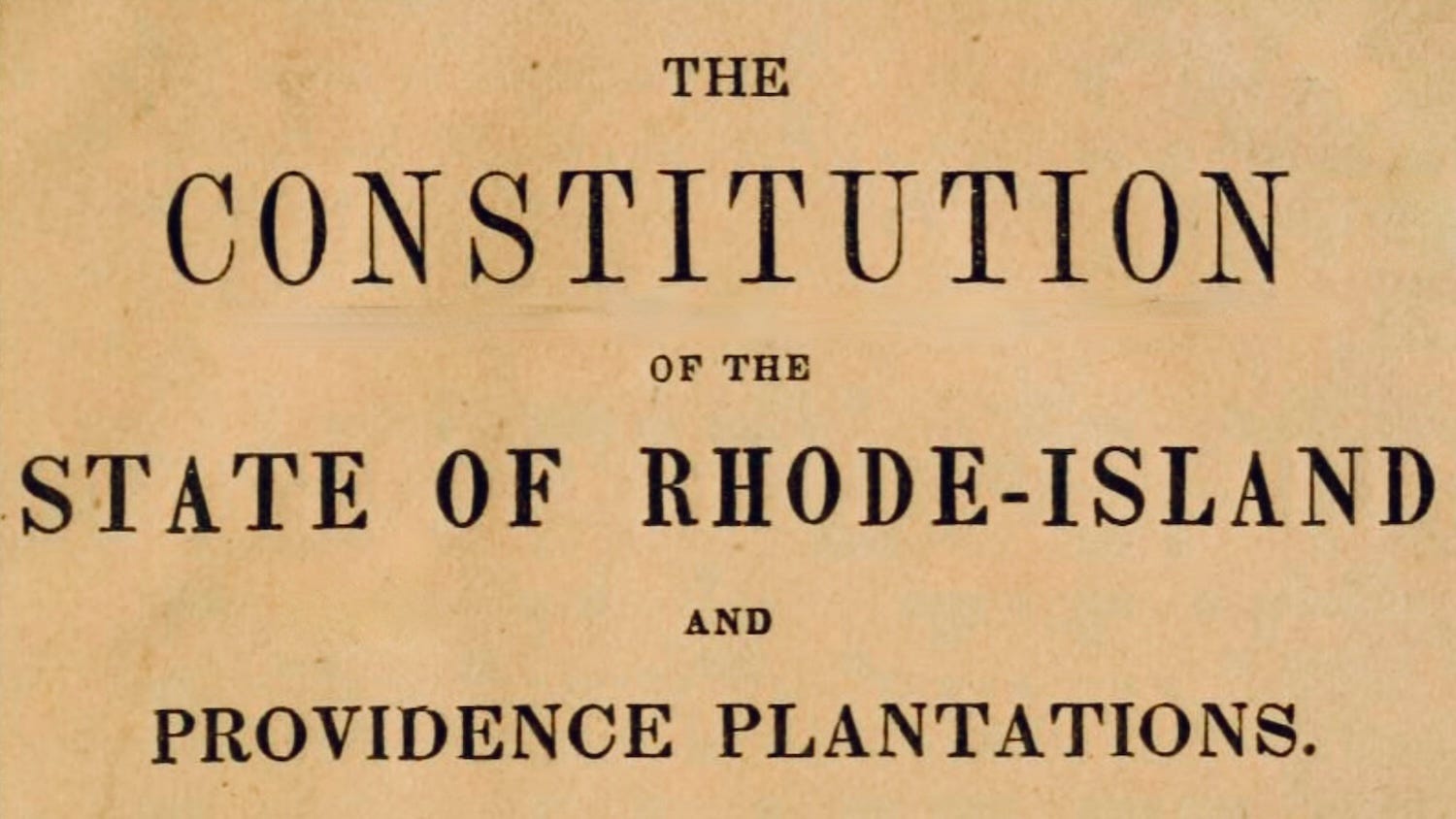
What if I told you that since 1998, the rights enumerated in the Rhode Island State Constitution are merely words on paper, little more than suggestions or aspirational ideals, and that you have no way of civilly enforcing those rights?
[Note: This piece is greatly indebted to those who submitted written testimony in favor of passing this bill. I’m not a lawyer, so their reasoning and words were essential to my understanding.]
In 1998, the Rhode Island Supreme Court ruled in Bandoni v. State that there is no right of action in the Rhode Island State Constitution unless the right is self-executing. (A self-executing law is automatically enforced when certain conditions are met.)
In the sole dissenting opinion in Bandoni, Justice Robert Flanders wrote that the ruling threatened “our rights to free speech, free association, free assembly, petitioning the government, due process, equal protection, legal counsel, freedom of religion, just compensation, trial by jury, and any other rights in the constitutional pantheon.” In 2008, Marty Moran, writing in the Roger Williams University Law Review, wrote that the decision “continues to astound the mind and shock the collective conscience of those deeply concerned not only with the rights of crime victims in Rhode Island, but more importantly, with the Supreme Court’s exceedingly myopic view of its own power and function as the protector of the State Constitution and of the sacred rights enumerated therein.”
Bills in the House and Senate this year (H7352/S2607) seek to remedy this issue, 35 years too late. As Attorney Danilo Borgas writes in their written testimony to the House Judiciary Committee in favor of passing these bills, “As the law currently stands, many constitutional rights exist without a meaningful way to enforce them. A right without a remedy is not truly a right.
“It would never occur to a member of the public that the rights enumerated in our state’s framing document are devoid of enforcement power. After all, what would be the point?” wrote Monica Teixeira de Sousa, a law professor at Roger Williams University School of Law, in their written testimony. “And the Rhode Island constitution agrees; its plain text states that ‘every person within this state ought to find a certain remedy, by having recourse to the laws, for all injuries or wrongs which may be received in one’s person, property, or character.’”
Some would argue that the federal government has a right of action when a person’s rights under the United States Constitution are violated, but the Rhode Island Constitution provides broader and additional protections in certain areas, such as shoreline access, which is protected in the state constitution but is nowhere to be found federally. Further, the federal basis for suing for federal constitutional violations has been undermined by the United States Supreme Court for decades. It rests solely on a federal statute that could be easily repealed, and one need look no further than reproductive rights, the Voting Rights Act, and the behavior of ICE to see that our civil rights mean little to the current regime in Washington.
The purpose of the Rhode Island Civil Rights Enforcement Act (RICREA) is to, among other things, address issues of law enforcement accountability in Rhode Island by creating a state-based right to sue government agents and/or entities, whether municipal, state, or federal, for violations of rights guaranteed by the Rhode Island Constitution. If passed, the RICREA would provide a right to sue for violations of the Rhode Island Constitution where one currently does not exist, including the ability to sue federal government agents, like ICE agents, as well as local and state police, for such violations. As masked ICE agents murder Americans like Renee Nicole Good and Alex Pretti, RICREA is especially needed.
The bill applies to all government agents, so the federal courts are less likely to strike it down, as happened in the U.S. District Court for the Central District of California in U.S. v. California, which struck down the California state law banning ICE agents from wearing masks. The court decided that, since the law targeted only federal agents and not all law enforcement, it violated the Supremacy Clause, which has been interpreted to mean that federal law takes precedence over state laws, and that states cannot directly order the federal government to change its actions or legally nullify federal laws.
There is some opposition to the proposed legislation. The Rhode Island League of Cities and Towns is concerned that preserving our constitutional rights “could lead to an unpredictable and potentially excessive volume of litigation” and “may place significant financial and administrative strain on cities and towns across the state.” In other words, they want to be sued for violating our civil rights.
Attorney Richard Sinapi anticipated the League’s objections. “Passing this bill will not lead to a flood of lawsuits,” wrote Sinapi in his testimony. “We know this because there was no ‘flood of lawsuits’ during the nearly three decades when Rhode Islanders had an implied right of action to seek relief for a violation of their civil rights—this bill merely restores this lost right to seek a remedy. This bill will have zero budgetary impact if the Government and its agents merely conform their conduct to the law.” Further, continued Sinapi “under this bill, law enforcement and every governmental agent would retain the protection of all existing immunities from liability, including qualified immunity as well as the protection of state and municipal employees and agents of full indemnification for any civil liability for their official actions as is currently provided under R.I. General Law.”
Passing this law, like passing state-level protections for abortion rights and the Voting Rights Act, is essential. What is our General Assembly waiting for?

We have the right to shut up and do what we are told, as long as we go along to get along, If not, we get crucified. There are no rights in RI, this is a slave state. There is no tweak to fix this shithole.