

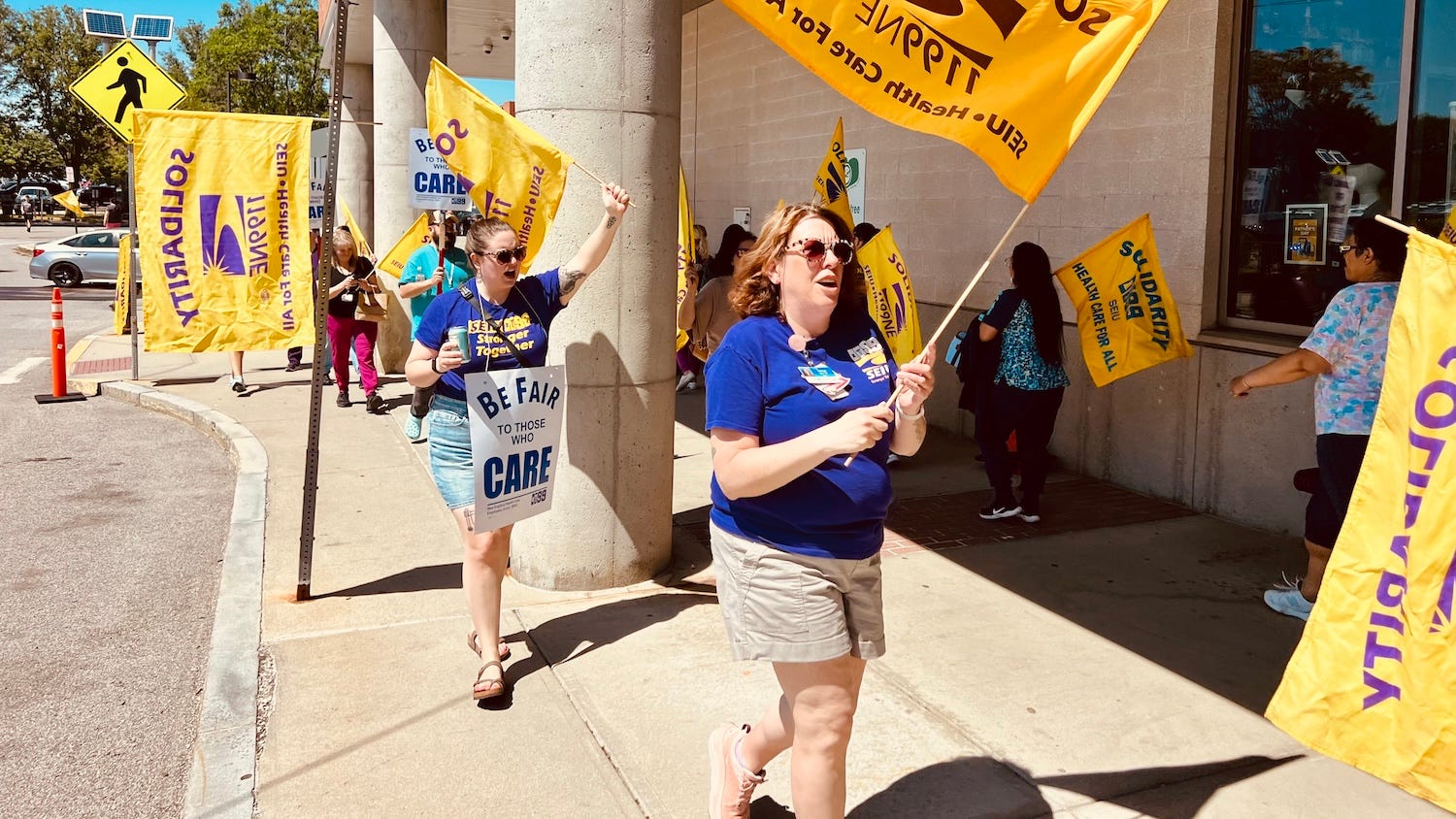
“At the end of 2024, over 2,000 Women and Infants frontline staff settled a strong contract that raised wages, secured healthcare, and improved training,” said Mary Murphy Walsh, elected lead organizer at Women & Infants Hospital. “But since then, it has been a constant battle to have the employer follow that contract. We’ve faced layoffs, a difficult-to-roll-out Epic, and the continuation of the same issue that has, time and again, forced caregivers to this picket line: our staffing crisis.”
Frontline union caregivers at Women & Infants held a press conference on Wednesday to demand greater transparency in how Care New England spends public tax dollars amid a chronic staffing crisis that spans the hospital system. Caregivers will call for the passage of the Hospital Safe Staffing Study Commission (S2258/H7031) sponsored by Senator Melissa Murray (Democrat, District 24, Woonsocket, North Smithfield) and Representative Deborah Fellela (Democrat, District 43, Johnston), who would hear from hospital workers and patients, review staffing and safety data, and make recommendations on how to tackle the staffing crisis.
Here’s the video:
“A Women & Infants administrator recently announced to a room of delegates and me that the hospital is not creating any additional staff positions to cover increased workloads until fiscal year 2027 due to budgetary constraints,” continued Mary Murphy Walsh. “Hours later, the news hit that they were terminating 30 administrative positions. Again and again, they used financial scarcity as the reason for refusing to invest in more staff. This argument would be more credible, though, if we had not also learned that, in 2024, Care New England paid former CEO James Finale $1.5 million in retirement benefits.
“But their scarce tactic did the trick. In the latest House budget proposal, hospitals are set to receive nearly $29 million in Medicaid funding along with a Medicaid reimbursement rate increase - and we’re all for that. What we don’t support is not having any idea of how hospitals are spending that money. It’s called accountability, and we need it.
“That is why, today, we are calling for the passage of the Hospital Safe Staffing Study Commission, which would give frontline staff and patients a chance to understand how hospital administrators make staffing and spending decisions.”
“On Tuesday of last week, we were in a meeting with our hospital administrator and were informed that they would not be creating any additional full-time staff positions until the next fiscal year, despite identified needs for them,” said Colleen Hoover, an administrative assistant at Women & Infants. “What’s more, despite the current short staffing, they plan to rely on current staff to pick up overtime to fill the gaps. You can imagine our frustration since we’ve been raising staffing concerns for years. I’ve worked at the hospital for 20 years, and I’ve been in my current job for the past five. I’ve watched the healthcare crisis in real time and felt its effects. Last year, the hospital consolidated my position after several clerical staff members were laid off and another unit was added to my responsibilities. I owned 40 hours a week before, and I still own 40 hours, but the additional unit added a part-time job to my existing workload.
“Much of my job involves coordinating with several units, including purchasing, supply chain, IT, and maintenance, to ensure that the nurses have what they need so they can focus on patient care. Because of this consolidation, it’s become much harder to do my job at the level that it requires. In the past, I could identify problems ahead of time. I could catch them before they happened. Now I’m often reacting to them instead of preventing them. There’s rarely any downtime. Some days, it’s late in the afternoon that I realize I haven’t had time to eat.
“Many staff members have already left for less stressful jobs. I don’t want to leave. I love my job, but burnout and frustration are growing.
“Hospitals rely on many roles that often go unseen - support staff, housekeepers, dietary workers, CNAs, secretaries - every role matters and healthcare truly takes a village. But to maintain this village, we need support, respect, and intervention by our elected leaders to hold management accountable. That’s where the Hospital Safe Staffing Study Commission comes in. We know that the commission isn’t a cure-all for the hospital’s problems, but it’s an important first step toward creating dialogue and greater accountability. Our patients deserve that and so much more, and so do we.”
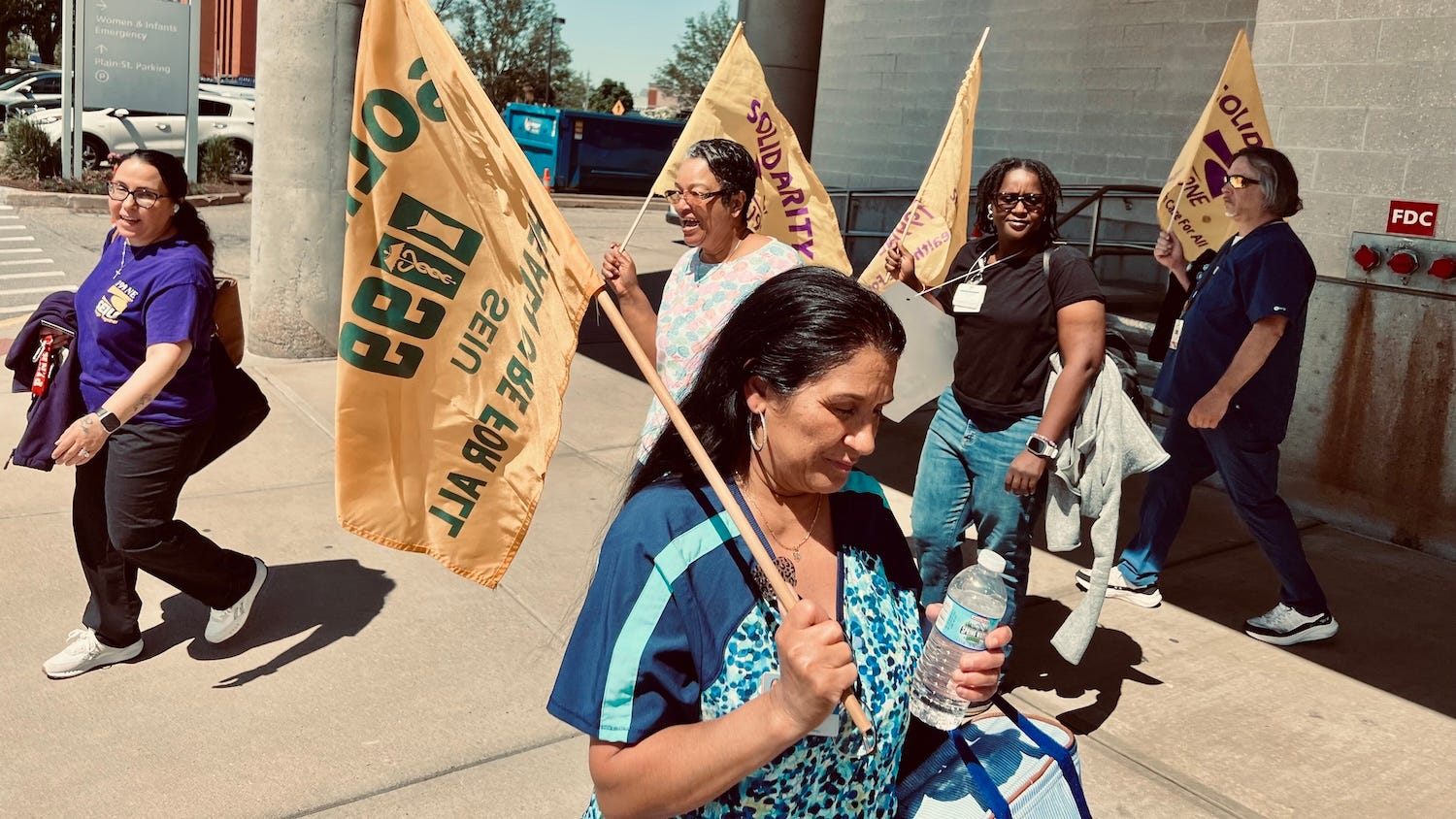
“We are here to once again talk about the staffing needs here at the hospital,” said Cassie White, a nurse on the mother-baby unit. “I want to focus on three words:
“Transparency. Rhode Islanders deserve more transparency from Care New England. Recently, Michael Wagner, President and CEO of Care New England, spoke about the millions of dollars in losses the organization incurred. The people of Rhode Island should know that those are projected losses relative to what Care New England thinks it should be making. People should know that, historically, at this point in the year, the books have shown a loss, and we typically make it up for the rest of the year. Why does Care New England cry broke to the public when we keep paying former CEO James Finale, who hasn’t been with Care New England since 2022, well over a million dollars each year?
“They have spent who knows how much money on unnecessary rebranding of the hospital while we struggle every day with the purposeful chaos of not knowing whether we have enough staff to care for our patients over the next four hours. Rhode Islanders and the government should pay attention to Care New England and how it’s spending its money. We should all be concerned about our hospital and its financial decisions because we see that impact every day in our work.
“On my unit, nurses are assigned four couplets, but in reality, that’s eight patients. As we know, babies are often overlooked in the staffing standards when they’re developed. In addition, twin deliveries are not factored into acuity, despite being among the most complex. That’s nine patients.
“When we are rushing, the likelihood of medical errors grows significantly. And if I worry after 13 years of service, imagine what a new nurse feels. I often leave my shift thinking about the patient I couldn’t prioritize or the patient who didn’t get the care they deserved. Do you guys think that’s right? Neither do I.
“Let’s talk about accountability, our second word. We need more of that. That’s why we’re calling on the General Assembly to pass the Hospital Safe Staffing Study Commission. Our morale is at a all time low and too many nurses are leaving. How is that good business? The answer is it’s not. Recently, I testified in support of the Safe Staffing Study Commission. This would give hospital workers and patients a chance to hear from the administrators exactly how they’re spending your public funds. The latest state budget proposes over $26 million in hospital funding, along with a Medicaid increase. But until we create more accountability, hospitals can spend that money however they want, including our million-dollar golden parachute payments, and not directly on patient care.
Now for the last word, the word you didn’t hear about: Hope. We do this work because we care about our patients. Many of us, including myself, have been patients ourselves, or someone we love has. We know that listening to the voices of the frontline workers is vital to solving the staffing crisis. I hope that the Safe Staffing Study Commission passes, leads to the conversations and accountability we need, allows us to have our voice at the table, and directly impacts Rhode Islanders for the better.
Lastly, I’m sure you’re aware of the recent turnover in this hospital administration. I hope that the toxic behavior of staying silent and the lack of collaboration go away with them. I hope the new administration sees this picket as an opportunity not just to hear us, but to listen, understand, and collaborate to make this hospital the best it can be. I hope for the future of Care New England and for the future care of the people in Rhode Island.
“Not surprisingly, the hospital association opposes the creation of the Hospital Safe Staffing Study Commission,” noted Mary Murphy Walsh. “Why? Because they don’t want more transparency on how they spend our tax dollars.”
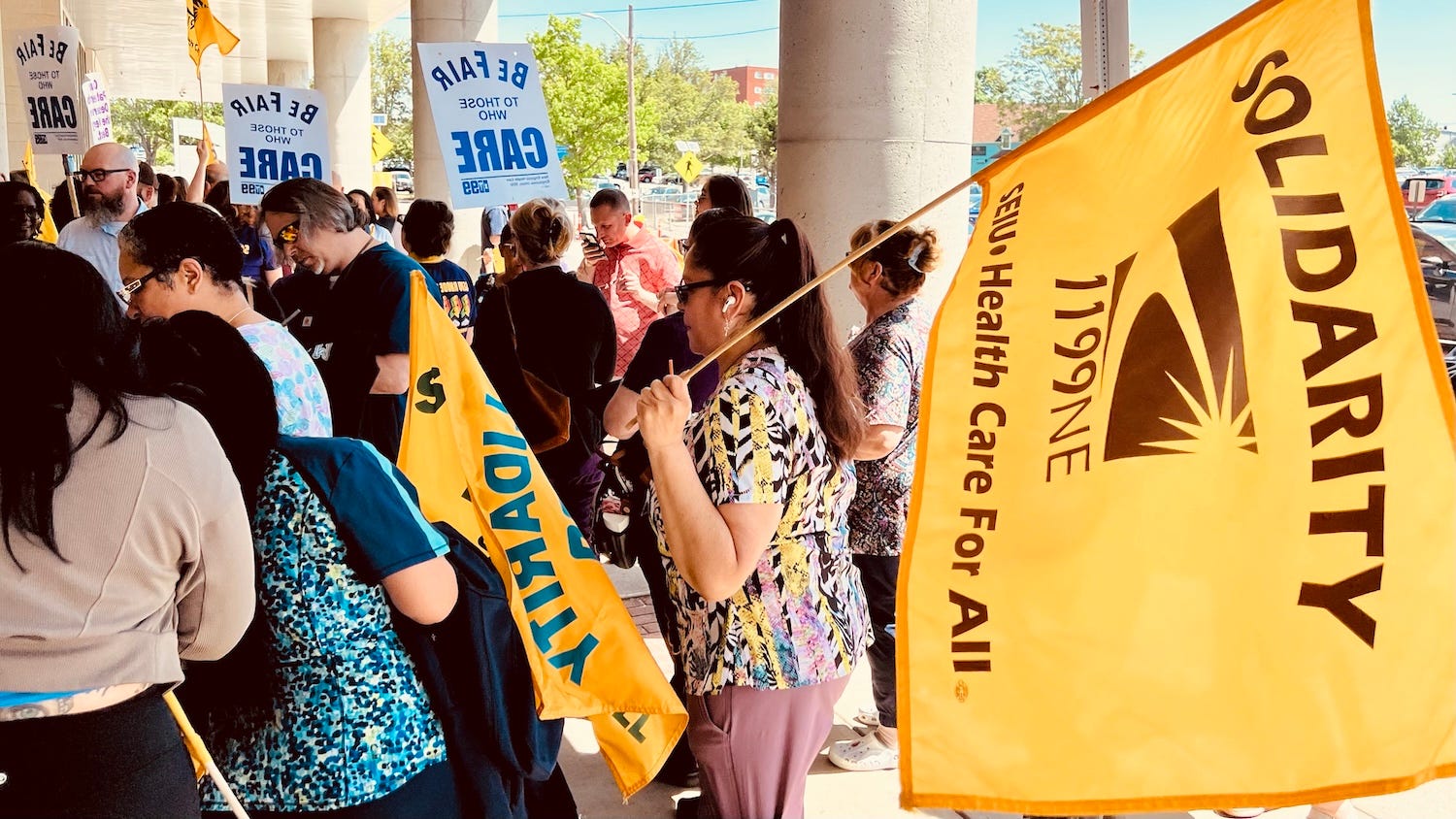
“I’m one of the transporters at Women’s Hospital,” said Monica Silva, a Transporter at Women & Infants Hospital. “Those of you who do know me know I’m usually pretty vocal when it comes to transport issues, so it might come as a bit of a shock that I’m also very nervous to be up here speaking right now. But the reason I decided to speak today is that I’ve heard from my fellow transporters that we are all feeling the same thing: overwhelmed, frustrated, and more often than not burned out by the end of a shift.
“About two and a half years ago, I became the hospital’s first transporter. Before that, I worked in housekeeping. When I took this position, I expected training, guidance, and support as I stepped into a role involving patient care. Instead, I walked into a brand new department with no training, guidance, or clear standards. I was told, ‘We’ll figure it out.’
“But these aren’t boxes we move. These are patients. Real people with real lives, and ‘we’ll figure it out’ is not a plan when patient safety is involved. Rather than standing by and hoping for the best, I took initiative. I shadowed transport staff at another hospital, which had nine transporters on staff that day. I also took it upon myself to develop standards for new hires to follow. Yet, since day one, support has been missing.
“Today, there is still only one transporter scheduled per shift who serves multiple units across the hospital, even though the role has expanded far beyond the original surgical unit. We transport five to nine units every day. One person cannot meet that demand. Patients wait too long, staff are overwhelmed, concerns are raised, and too often dismissed with, ‘You’ll figure it out.’
“Departments tell us they are short-staffed and need help moving patients immediately, but again, I’m one person. How can one person solve staffing shortages across an entire hospital? This is one of our biggest struggles every day. We explained that we are busy and overwhelmed, unable to handle the current workload and demands of our department, yet all we receive is pushback and increased requests instead of solutions.
“Care New England must stop treating frontline staffing like an afterthought. Invest in training and staffing; stop forcing workers to skip breaks and carry impossible workloads while leadership continues to prioritize cuts over care. Because safe patient care doesn’t happen by accident, it happens when hospitals invest in people doing the work.”
“For such a critical part of patient care, it is deeply troubling that the transport position is so understaffed,” added Mary Murphy Walsh. “Patient throughput is a major issue in hospitals across the state. Rhode Island tied with Massachusetts for being the third-longest average emergency room wait in the United States, with patients waiting an average of three hours and 40 minutes. What’s more, Rhode Island hospitals have the highest average occupancy rates in the nation at 88%. Despite that, Women & Infants refuses to share its census data with the union. What are they hiding? The staffing crisis is not limited to Women & Infants. It’s across the entire hospital system. Workers are struggling with the same pressures.”
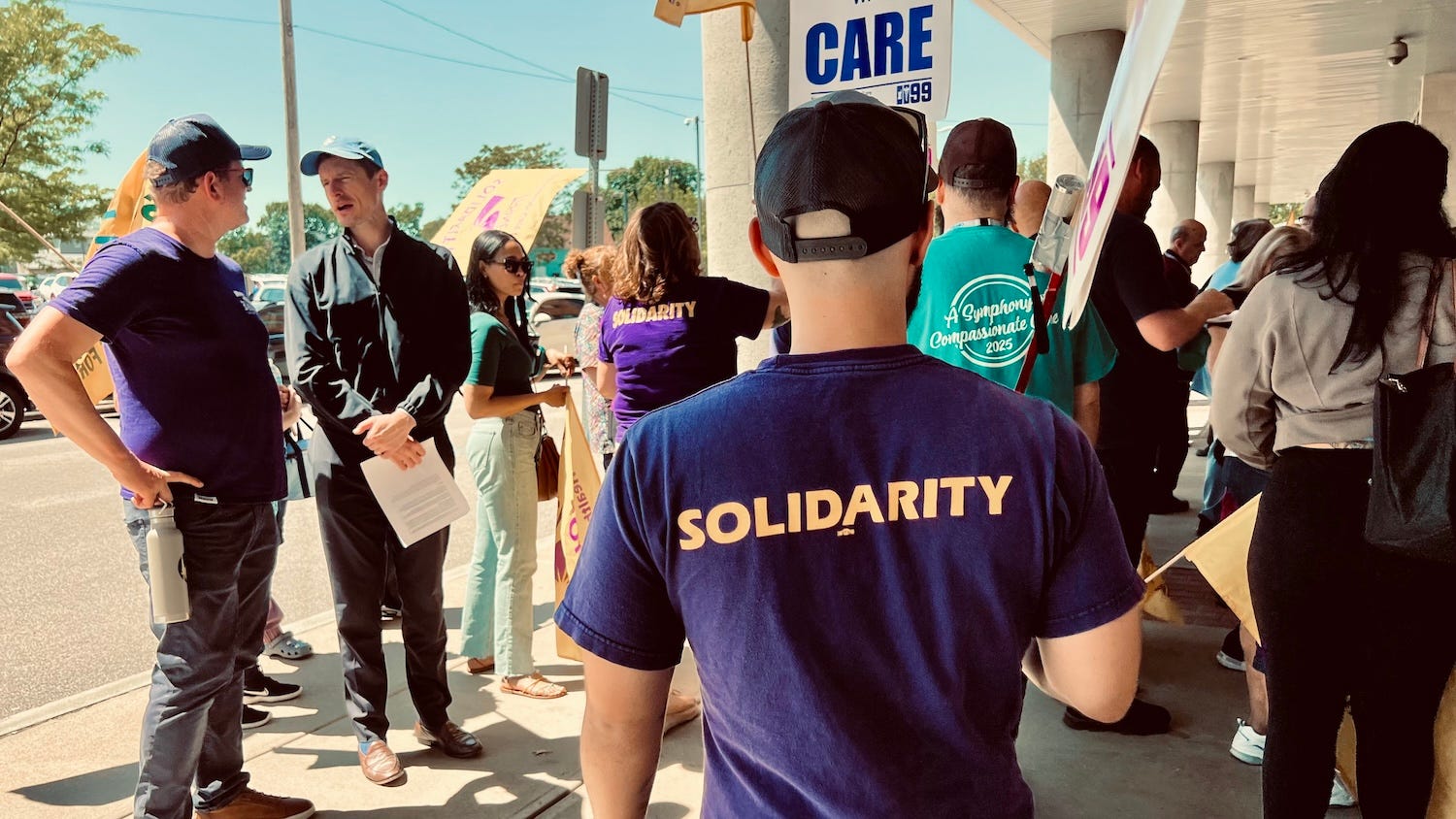
“I want to echo what our members have said here today,” said SEIU 1199 NE Vice President Jesse Martin. “I also want to thank Speaker Christopher Blazejewski and Senate President Valerie Lawson for taking the words of workers at the State House for what they are: A reflection of what care looks like in Rhode Island hospitals.
“We have invested in this state over the last five plus years, over half a billion dollars to improve our healthcare system - and we fully support funding healthcare - but what are we getting in return for that investment? We’re getting massive CEO golden parachutes. Someone who ran Care New England into the ground has received over $3.5 million in additional pay for zero work. Do any 1199 members or any hospital workers in the state get paid for doing nothing? No. That would be great if working people could get paid for doing nothing. The only people who get that privilege in this state are healthcare CEOs, and when 70-80% of the care delivered in this state is paid for through Medicaid and Medicare public dollars, that’s wrong. When Care New England eliminated 30 executive positions, it saved $10.5 million. That’s half of their budget issues. Well, lay off another 30. Then maybe you’ll solve all the budget issues, right?
“When times are tough on the units in this hospital, I don’t hear from our members that their directors put on gloves, scrubs, and get into the patient’s room to help people out. Maybe they don’t remember what it’s like to give care at the bedside. Maybe they don’t remember what it’s like to feed people a decent meal - on time and hot.
“We all go through life understanding that we’re going to get sick and need healthcare, and expecting to grow our families. The experience of giving birth is a unique one in healthcare. When you don’t have enough nurses, CNAs, unit secretaries, patient transport staff, dietary staff, housekeeping staff, laundry staff, engineering staff, and HIM coders, the system falls apart.
“We look forward to the passage of the Safe Staffing Study Commission tomorrow in the Senate and the House, and getting to a place where we’re having an honest discussion about what it’s like to work and receive care in Rhode Island hospitals and where those hundreds of millions of dollars have gone, and where they should go.
“They should go to frontline staff and create the positions necessary, not waiting to fill jobs later. We need to fill jobs now, not next week, not six months from now.
“It is a human right to be able to look your employer in the eye and demand dignity. That’s what we believe in our union. It’s an inherent human right. It’s also a right for a patient to ask, when they’re getting care, ‘Are there enough nurses on shift today? Are there enough CNAs on shift today?’
“I hope, as we move forward in the new world with the Safe Staffing Study Commission to hold CEOs accountable, that the public joins us in discussing what the real problems are in Rhode Island hospitals.”
Sounds like something that should be done already!
From an SEIU 1199 press release:
Frontline SEIU Hospital Caregivers Applaud Unanimous Passage of The Hospital Safe Staffing Study Commission
The Rhode Island House of Representatives and Senate unanimously voted to create the Hospital Safe Staffing Study Commission (Senator Melissa Murray (S2258) and Representative Deborah Fellela (H7031). For months, frontline hospital workers who are members of SEIU 1199NE have been advocating for its passage, turning out in force to testify in April and holding a press conference on Wednesday at Women & Infants Hospital.
“This is a great day for our patients and the thousands of frontline caregivers across the state who have worked for years to make our hospitals safer. We are grateful to Senator Murray, Representative Fellala, and all the leaders in the House and Senate who passed this law to create more accountability and open discussion between nurses and hospital leadership. Ultimately, we all want the same thing: safe and healthy outcomes for our patients. Working together, I believe we can find solutions that prioritize patient safety and support the nurses who care for them every day.” - Cassie White, Registered Nurse at Women & Infants Hospital in the Mother-Baby Unit
The Study Commission - which does not require a signature from Governor McKee - will include hospital workers, patient advocates, the Hospital Association of Rhode Island, the Department of Health, the Attorney General’s Office, an organization of nurse leaders, an expert in workforce development, and labor representatives. Its functions include:
-Listening to hospital workers and patients
-Reviewing staffing and safety data
-Hearing from hospitals about staffing decisions
-Recommending next steps to the General Assembly
For years, frontline caregivers have been speaking out against chronic understaffing that affects their ability to deliver safe, high-quality care across units and departments. In 2023, nearly 1,400 Women & Infants staff (95% of voters) voted no confidence in their employer’s handling of the staffing crisis. In April, 2025, Butler workers initiated what became the state’s longest hospital strike, citing dire workplace safety concerns stemming from short staffing.
“Staff shortages - and the dangerous conditions they create - were among the driving forces that prompted our three-month strike. I personally experienced a serious injury when my unit was extremely acute, and staffing levels were unacceptably low. Staff and patient safety should be non-negotiable and the bare minimum expected. But there has been very little accountability in determining current staffing ratios because hospitals were not breaking any laws. The Staffing Commission is vital to creating a safer environment for frontline staff and our patients.” - Beth Iams, Activities Coordinator, Butler Hospital
Effective January, 2026, The Joint Commission, which accredits every hospital in Rhode Island, has identified nurse staffing as a national performance priority tied to hospital accreditation. The Hospital Staffing Commission is a key component of ensuring accountability in implementing these performance standards.
“Safe staffing is preventative care for our population. As lactation consultants, education is critical to our work supporting new mothers and babies. I am very hopeful this forum will ultimately lead to better care and support for our patients and more meaningful communication with our employer. Change will not happen overnight, but every constructive conversation brings us one step closer to building a hospital that our patients, families, and staff deserve.” - Nancy Chandley-Adams, Lactation Consultant and Registered Nurse, Women & Infants Hospital.
District 1199 SEIU New England represents 29,000 health care and service workers in Connecticut, Rhode Island, and Southeastern Massachusetts. In Rhode Island, 1199 SEIU NE represents 7,500 members.1199 SEIU NE is affiliated with the Service Employees International Union (SEIU) – a union of over 2 million members across the United States, Puerto Rico, and Canada.