
The Save RIPTA Coalition releases its “Service Cuts Impact Report”
These cuts make getting an education much harder for students like me,” said Chrys Santos, a sophomore at Blackstone Academy Charter School, “who now have to struggle to get to and from school..."

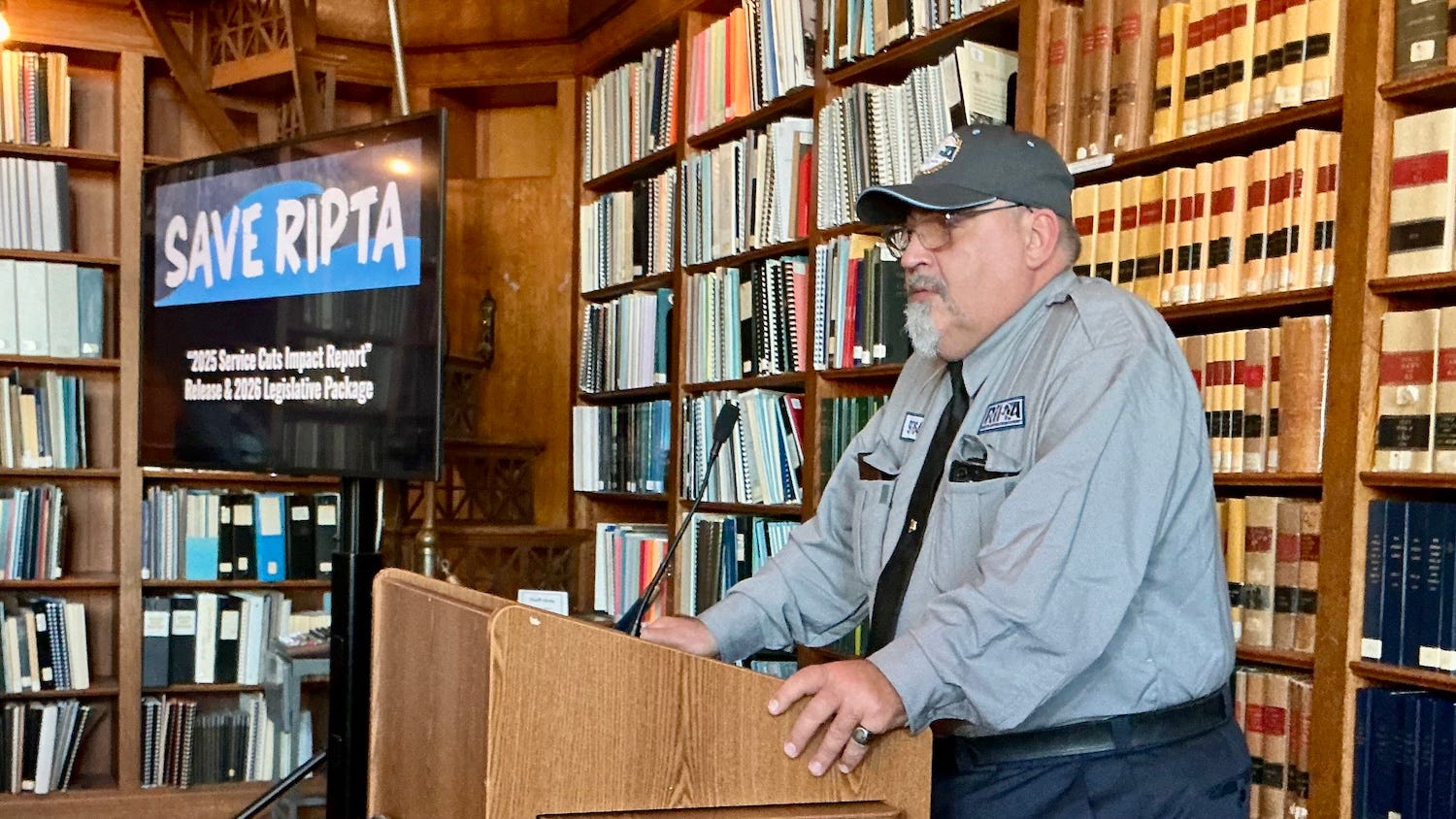
“We’re here to work towards a better Rhode Island and save RIPTA,” said Liza Burkin, Board President of the Providence Streets Coalition and an organizer with the Save RIPTA campaign. “Last year, we did not fully save RIPTA. We fought the entire session. We fought all summer against the proposed service cuts, but they still happened…
“For the past three months, since the service cuts took effect, we have been collecting stories from riders and drivers and gathering as much data as possible to produce the 2025 Service Cuts Impact Report... It’s 14 pages detailing the impacts of these devastating service cuts, which have reduced service across RIPTA’s system by 15%, including a 13% reduction on weekdays, 20% reduction on Saturdays, and 22% reduction on Sundays.”
Burkin was speaking to a packed room at the Rhode Island State House library. The report was authored by a consortium of public transit academics and professionals affiliated with Providence Streets Coalition, Brown University, Transit Matters, and Amalgamated Transit Union Local 618.
Here’s the video:
2025 Service Cuts Impact Report
The report presents the Save RIPTA Coalition’s findings on the sweeping impacts of the September 2025 service cuts resulting from Rhode Island Public Transit Authority (RIPTA)’s budget deficit at the conclusion of the 2025 legislative session. The report finds that across the fixed-route system, year-over-year ridership fell sharply by approximately 12.1% (125,000 trips) in November following the largest service cuts in RIPTA’s history. As a result, it now costs 29% more per hour to deliver bus service than before the cuts.
“Some of the high-level stats are that frequency dropped from 33 to only 21 out of RIPTA’s 63 routes,” said Burkin. “So only about a third of the routes are now running at least at RIPTA’s minimum standard frequency, which is hourly, seven days a week. That means two-thirds of RIPTA’s routes do not run at the minimum standard frequency, and we wonder why we can’t grow ridership. We wonder why RIPTA is struggling.
“Frequency is the key to growing the system. Frequency is the core. You need to go to the bus stop and understand that another bus will arrive; it won’t be 90 minutes. Frequency, we heard from riders, is a devastating impact of these cuts.
“We’re grateful to have saved most jobs at RIPTA; however, because overhead is the same and we’re running fewer service hours, each service hour now costs almost 29% more. I think that’s the opposite of what people are trying to achieve when they say RIPTA should be more efficient,” said Burkin. “It doesn’t sound very efficient to me.”
The report also illustrates the consequences that RIPTA riders and workers are now suffering. Through rider and employee surveys and ridership data obtained via public records requests, the Save RIPTA Coalition’s publication illustrates the wide-ranging toll that cuts to bus service have had on the traveling public. Riders have lost their jobs and been forced to work fewer hours; lost access to educational opportunities and been chronically late to school; and are cut off from religious, commercial, and civic engagement – especially on weekends. Drivers are being forced to handle overcrowding, running behind schedule, having less recovery time between routes, and are physically and mentally overwhelmed.
Representative Karen Alzate (Democrat, District 60, Pawtucket, Central Falls) and State Senator Mark McKinney (Democrat, District 30, Warwick) are introducing legislation to close RIPTA’s budget gap.
“These cuts are devastating for our community,” said Representative Alzate. “Public transit is a lifeline, and we must invest in restoring and growing RIPTA so families, workers, and seniors aren’t left behind.”
“Before the cuts, from January 2024 to September 2025, 81% of RIPTA routes saw ridership gains,” said State Senator McKinney. “After the cuts, 75% of routes lost ridership, and no route with weekday service cuts saw an increase. So RIPTA riders and workers are feeling the pain and consequences of this, and the greatest pain is being felt by some of the most vulnerable folks in Rhode Island.”
Legislative Agenda
Burkin also presented the Save RIPTA campaign’s legislative priorities for the 2026 session of the General Assembly.
Allocate $5 million to restore the cuts.
Increase RIPTA’s share of the highway maintenance account to 20%. “It is currently at 10%,” noted Burkin. “We went up from 5% to 10% last year. In Congress, since 1982, the roads-and-bridges-to-public-transit split has been 80/20. Last year in Rhode Island, we were still at 95/5. We wonder why our public transit system is not robust, active, and thriving. It’s because this is a formula funding mechanism that needs to change. We can at least get to 20%. This is one of our very top priorities.”
“Almost nothing has done more to impact a nationwide disinvestment in public transit than Uber and Lyft,” noted Burkin. “Another top priority is the reallocation of the ride-share sales tax. If you take an Uber or a Lyft in Rhode Island, you pay 7% sales tax on that ride. That 7% sales tax currently goes into the general fund. We believe it should go to RIPTA, specifically to RIPTA’s paratransit programs. Uber and Lyft are often not ADA-accessible. They’re often not an accessible option for paratransit users forced to use RIPTA’s program. RIPTA’s paratransit programs are among the most expensive it operates. They’re also among the most important programs, so we believe the 7% sales tax we’re already collecting should be allocated to the statewide paratransit program.
The Commuter Transportation Benefits Act would “take a step toward having our partners in the private sector, our largest employers, help us grow ridership by offering public transit as a benefit to employees, just like they offer parking,” said Burkin. “It could look like pre-tax benefits, or it could be like what almost all of our colleges and universities do: a free transit pass. We’re asking our largest employers to step up and help us grow ridership by offering public transit as a viable option for their employees.”
Transit Master Plan Bond referendum: “If you are a RIPTA rider, you know that shelters throughout the state are in rough shape,” said Burkin. “You know that many bus stops, especially outside the urban core, lack crosswalks - this is a huge part of our pedestrian fatality crisis - and you know that when you’re in a bus, you’re stuck in traffic just like everyone else. We need to start building transit priority into our streets. That means dedicated bus lanes and bus-on-shoulder operations, such as what is happening on 146 right now, which is great but needs to be expanded. We need to speed up the bus to make it a faster, better option for more people. We need to maintain passenger facilities better.”
Update the fare technology: “We also need to update our fare technology very badly,” said Burkin. “We need to make it easy to pay. In New York and Boston, you can pay with a credit card, which is what we need to do here, so it’s easier to take the bus. This requires capital funding, so we’re proposing a bond referendum to put a bond measure on the November ballot.”
Car inspection fee increase: “The base cost to get your car inspected has not gone up in about 15 years,” said Burkin. “We believe that it is time, especially with the elimination of the car tax statewide, for drivers also to put more money into the transportation system. This would go to the highway maintenance account, not directly to RIPTA, but we hope to get 20% of the highway maintenance account.” (See Item 2 above)
RIPTA board restructuring: “If you have been following the Save RIPTA campaign closely, you know that one of the few public opponents of some of our funding bills last year was the RIPTA board chair,” noted Burkin, not mentioning DOT Director Peter Alviti by name. “This is a conflict of interest because RIDOT (Rhode Island Department of Transportation) and RIPTA often compete for the same funding. This is not a personal attack on anyone. This is simply saying that having the RIDOT director, whoever that person is, serve as the RIPTA board chair was a poor policy in 2023. The director of RIDOT clearly has a lot of work to do that doesn’t require lengthy monthly board meetings.
The motor fuel tax: “Because the gas tax increased by two cents last year, RIPTA’s share rose from 26% to 29%, but it’s still not indexed to inflation, so over time that share will decline, as it did when it first took effect,” said Burkin. “It was at 30%, and over time it fell to 26. That’s another reason RIPTA has been systematically underfunded: chronic systemic issues like this. It is encouraging that we received revenue from the gas tax, but we need to ensure we maintain the same percentage going forward and that it is indexed to inflation.”
“If we do all of these things, we can set RIPTA on a path to real expansion and usefulness for more Rhode Islanders,” said Burkin, wrapping up.
Testimonies:
George Alves, a 13-year RIPTA driver and ATU Local 618 steward:
“I’m a 13-year veteran at RIPTA. These service cuts place undue strain on my coworkers and me, not only by pressuring us to drive faster than we should, but also by reducing our recovery, bathroom, and eating time. Any time leftover is gone. Not only that, our interaction with passengers is turn-and-burn. We no longer have time to slow down and let people get on their own pace. There’s been an increase in incidents, and it’s become very stressful to work because the pressure is always on to go faster, do more, and get more done in the same amount of time. We have the jobs we had before the cuts; you have the same job, same pay, and one additional trip. That means less time for us.
“This crunch of the job was laid on our shoulders... We’re still out there doing that. Just to let you know about RIPTA and me: When my family immigrated here in ‘78, we were completely dependent on the bus system. My parents went to work, and I went to school. I am a 13-year veteran of RIPTA, but I’ve been involved with RIPTA for a long time, and these cuts set us back. Any vision that anybody has for the future of this state has to include RIPTA.”
Chrys Santos, a Blackstone Academy Charter School student:
“Last year, I was able to wake up at six and still get to school on time. Sure, it was a little stressful to rush to the bus stop, and all that, but my grades would remain somewhat intact. Earlier this week, I woke up just after 6:15 and arrived at school an hour and a half late. I missed two of my morning classes, and my grades in Spanish and algebra declined by 5 points. That might not seem significant to someone looking in from the outside, but when my grades determine my eligibility for honors classes, scholarships, and self-confidence and all that, it carries a weight that’s way bigger than just a report card.
“After a while, the exhaustion of having to take RIPTA has stopped feeling temporary, and it’s something that I carry with me throughout my life because it’s hard to worry about school when you’re still cold from having to wait 30 minutes to get onto the bus in the morning, or you’re worried about making it home safe and on time. Other factors, including RIPTA budget cuts, have affected me and many other students. Many of my classmates rely on public transportation to get to and from school. When transportation becomes unreliable, it disrupts our schedules. It limits our opportunities.
“Now that it’s winter, the weather has gotten very cold, as I’m sure all of you know, and I’ve gotten sick more times than I can count waiting for the bus. Due to budget cuts, arriving at Kennedy Plaza later than usual isn’t an option for many of us. I either have to wait 20 to 30 minutes in this temperature, or arrive at school almost an hour and a half late. When taking the bus to extracurriculars and sports, it’s a similar story. Whether it’s rain or snow, waiting for more than 20 minutes in the dark isn’t anyone’s idea of fun or safety, especially in downtown or in pitch-black Pawtuckett.
“I can’t imagine my younger brothers having to take the bus in the future and having to deal with the same conditions that we deal with now, or even possibly worse ones. It scares me to think that by the time they’re old enough, these conditions and RIPTA might just be fully gone, and they might not have as many options as I’ve had with my education. If access to education is determined by how early you can wake up or how long you can stand out in the cold, we’re failing the students who actually need the most support.”
ABOUT SAVE RIPTA:
Save RIPTA is a broad coalition of community organizations, labor unions, legislative champions, and everyday Rhode Islanders who are calling upon our state leaders to save and expand RIPTA in our next state budget. The Coalition is organized by the Providence Streets Coalition, a 501(c)(4) social welfare organization.
If we cannot keep RIPTA strong and growing, we cannot keep Rhode Island strong.
Thank you for your work, Steve. I always turn to you to get in-depth reporting. I only wish there were many of you.
Would you consider writing something about Seven Stars and the impending strike? I remember somewhat vaguely that this is the second time with these owners that workers were ready to strike. I'm sure you got their email claiming some awfully high numbers. I'd like to know: at $27 an hour, how much of that is tips they have factored in, per high? How many hours a week is it? If it's all so rosy, why the vote to strike? Thanks so much.