

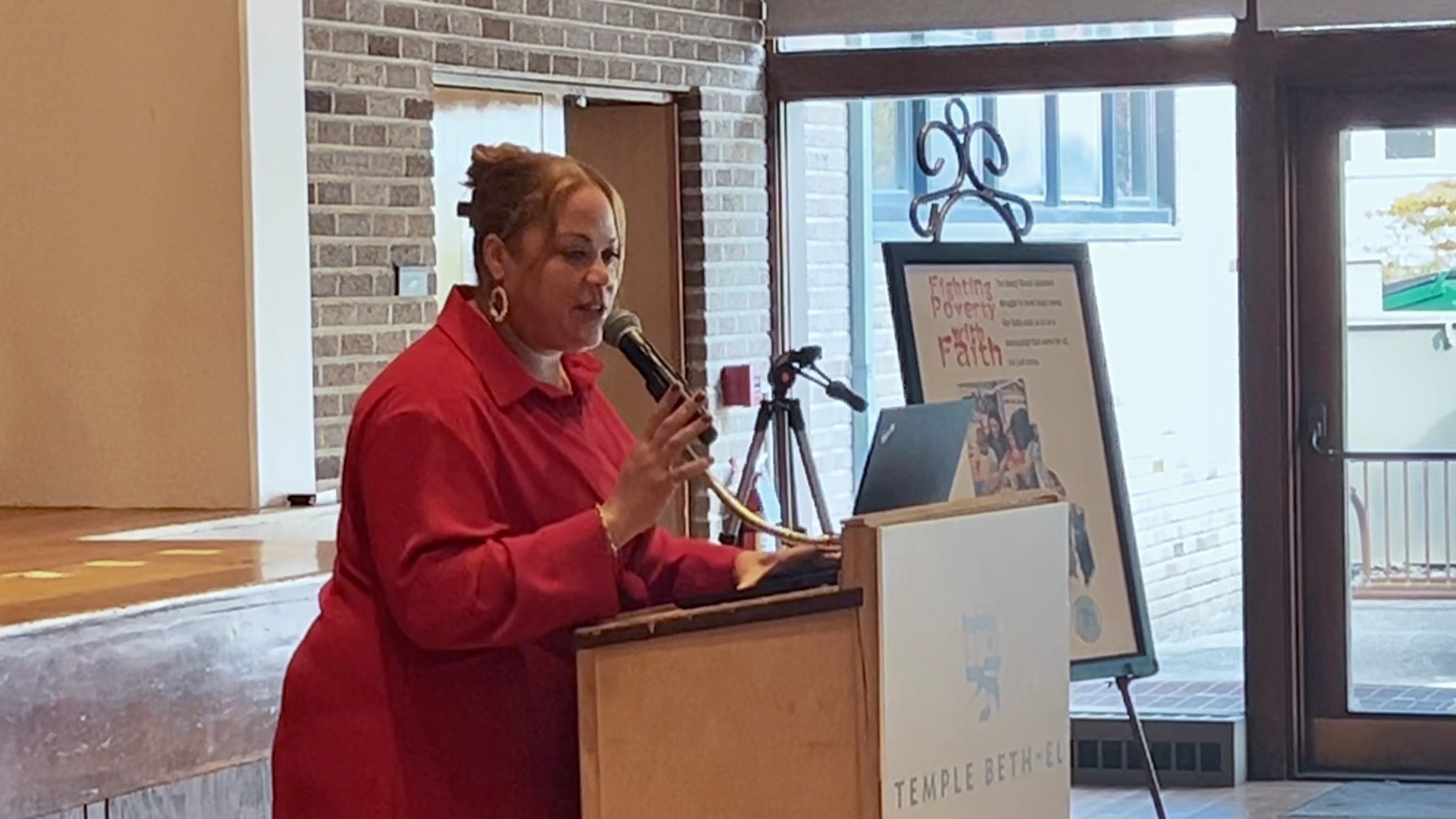
The Rhode Island Interfaith Coalition to Reduce Poverty held its Root Out Poverty Conference last Monday, and keynote speaker Nina Harrison, Policy Director at the Economic Progress Institute, presented stark data on poverty in Rhode Island and the Trump Administration’s policy choices that are driving it higher.
Here’s the video and transcript:
“I hope that my presentation will be the most depressing part of the morning, meaning that everything else will be up from here. Because, as Alicia mentioned, the reports all say the same thing: too many people are struggling. So we’re going to talk about poverty this morning, and one of the first things I want to talk about is: How do we measure poverty? Because depending on how you measure it, it can sound like a mild problem or a really serious one.
“One way the federal government measures poverty is through the Federal Poverty Line, which determines financial eligibility for federal, state, and local assistance programs like Medicaid, CHIP, SNAP, Head Start, and healthcare subsidies. If this is how the federal government measures poverty and determines eligibility for assistance, then we should hope it is the most accurate measure. Unfortunately, it is not.
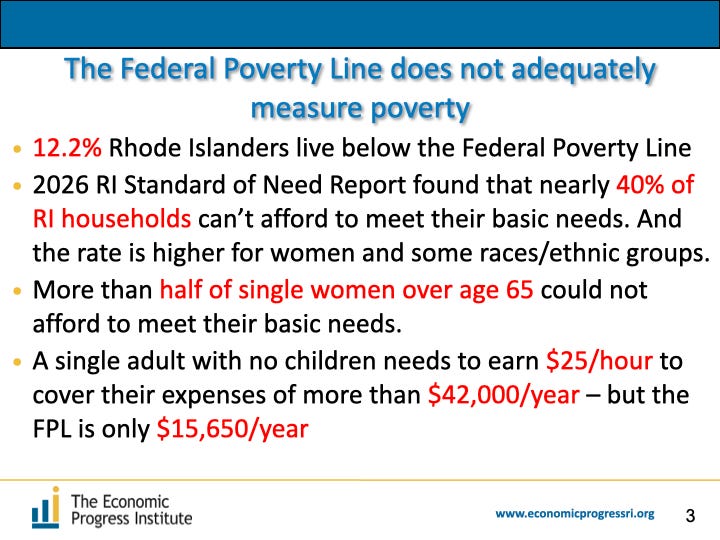
“The federal poverty line does not adequately measure poverty. According to the federal poverty line, 12.2% of Rhode Islanders live below it. However, EPI’s 2026 Rhode Island Standard of Need report found that nearly 40% of Rhode Island households cannot afford to meet their basic needs, so you can see there’s a huge gap between 12.2% and 40%, and that rate is higher for women and some races and ethnic groups in the state.
“For example, more than half of women over 65 who are single heads of household could not afford to meet their basic needs. That was a scary one to hear. And a single adult in Rhode Island with no children needs to earn $25 an hour to meet their basic needs, not vacations and new cars, just the bare necessities. That’s more than $42,000 a year. They’d have to earn more than that to cover those $42,000 a year in expenses.
“If you look at the federal poverty level for a single adult with no children, the federal poverty line is $15,650 a year. So again, there is a huge gap between what the federal government considers poverty and what we know to be necessary to make ends meet in Rhode Island.
“What does this look like for a family of three, a single parent with two children? Take Veronica and her two children. One is in daycare, and one is in elementary school. She needs to earn more than $111,000 a year to meet their basic needs. Meanwhile, the federal poverty line for her family is only $26,650 a year. There’s an enormous gap between what the federal government considers living in poverty and what it actually takes to be able to pay your bills and put food on the table in this state.
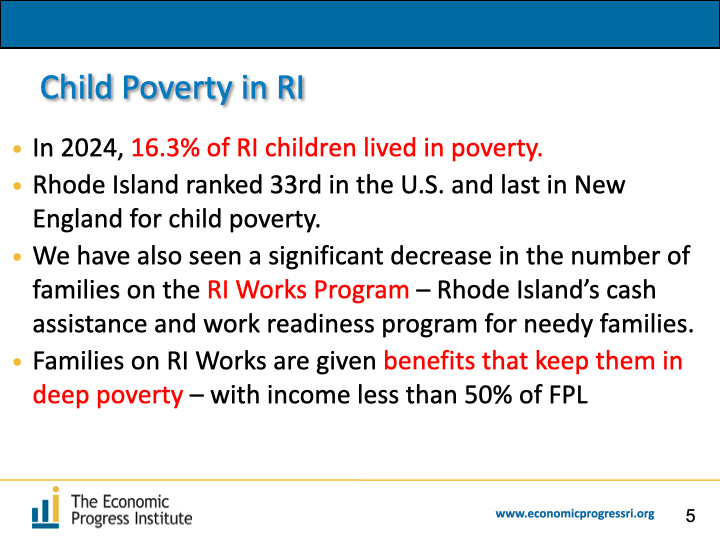
“If we talk about child poverty in Rhode Island, in 2024, according to the Rhode Island Kids Count Factbook, 16.3% of Rhode Island children lived in poverty, which ranked Rhode Island 33rd in the country and last in New England.
“I think we can do better.
“We’ve also seen a significant decrease in the number of families on the Rhode Island Works Program. Right now, we don’t have a clear explanation. It’s down almost a third in the past year and a half, and it’s not because people need less help. We’ve heard the statistics: people are struggling, so we have to figure out why, despite people needing a significant amount of help, we are seeing fewer people on the Rhode Island Works program, Rhode Island’s cash assistance and work readiness program for needy families.
“I also mentioned that we use the federal poverty line to determine who’s eligible for help. Even when we determine they’re eligible for help, the Rhode Island Works benefits we provide still don’t bring them up to the federal poverty line. It puts them at less than 50% of the federal poverty line, which is the definition of deep poverty. We’re choosing to give people benefits that still keep them in deep poverty. We can do better than that.
“Nelson Mandela said, ‘Like slavery and apartheid, poverty is not natural. It is manmade, and it can be eradicated and overcome by the actions of human beings.’ We are the human beings here, and there are many more of us helpers in this state.
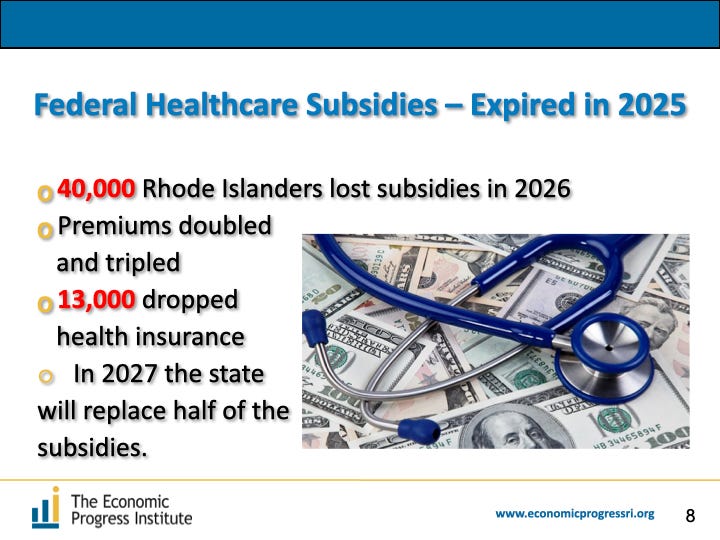
“Poverty is not natural. Federal policy choices right now are making it harder than ever to meet basic needs. For example, at the end of 2025, Congress allowed healthcare subsidies to expire for 40,000 Rhode Islanders, and their premiums doubled and tripled on average. For many of us, if our bills suddenly doubled or tripled, we couldn’t afford them, so 13,000 Rhode Islanders dropped health insurance because they could no longer afford it.
“I do have some good news: this year, the state passed a law to replace half of those subsidies for half of the people who lost them. So in 2027, 20,000 Rhode Islanders will be eligible for those healthcare subsidies again because the state stepped up and took action, and because many people in this room advocated for the state to do the same.
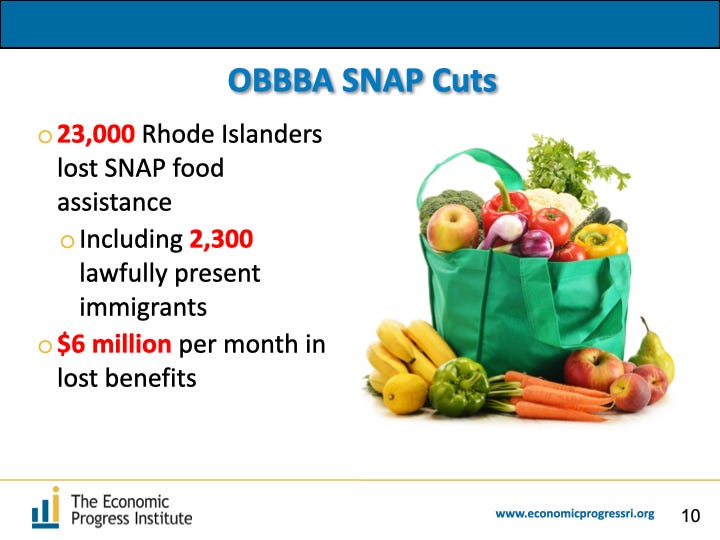
“Then, in July 2025, the One Big Beautiful Bill Act cut more than $1 trillion in SNAP and Medicaid funding, shifting resources from the poorest Americans to the richest. They literally made these funding cuts to pay for tax breaks for the rich. What does that mean for Rhode Islanders?
“It means that, since July 2025, 23,000 Rhode Islanders have already lost their SNAP benefits, including many, many children, and 2,300 lawfully present immigrants who lost benefits as well. That amounts to six million dollars a month that isn’t in these families’ pockets, isn’t going into grocery stores, and isn’t helping them feed their families.
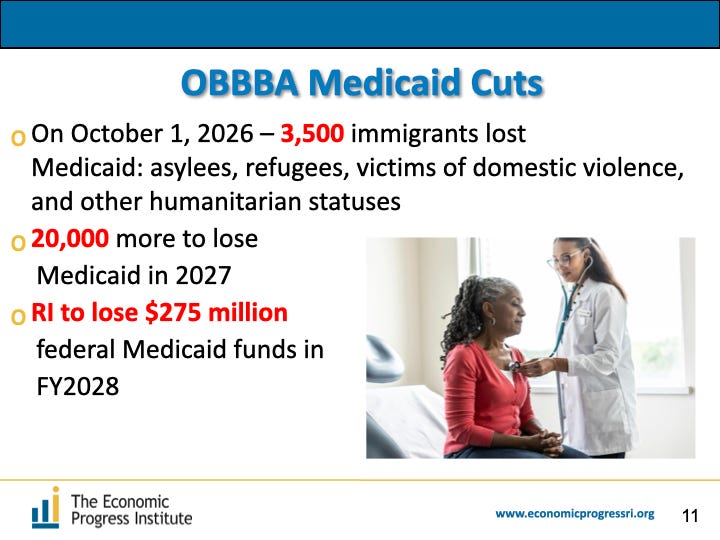
“For Medicaid, the One Big, Beautiful Bill Act means that just this month, on October 1, 3,500 of our immigrant neighbors in this state who are lawfully present lost Medicaid eligibility. We expect 20,000 more to lose Medicaid in 2027. That’s not my number; that is the state’s own projection. In 2027, new administrative and work requirements will take effect, and the state expects 20,000 people to lose health insurance as a result.
“I mentioned the federal government cut more than a trillion dollars in SNAP and Medicaid funding. That means, in the next fiscal year, Rhode Island will lose $275 million in federal Medicaid funds. We all know we could use those healthcare funds in this state, so what does that look like for a family that may be affected by these benefit cuts?
“Meet Maria, Francois, and their two children, refugees from the Democratic Republic of Congo. SNAP and Medicaid helped Maria and Francois meet their family’s needs, but in February, because of the One Big, Beautiful Bill, they lost their SNAP benefits, which is the equivalent of almost $5,000 a year in assistance.
“This month, on October 1, Maria and Francois lost their Medicaid coverage because of their immigration status. That’s almost $9,000 in annual healthcare costs. Their children will keep health insurance, fortunately, because in Rhode Island we Cover All Kids, regardless of immigration status, as long as they’re financially eligible, so we are doing better in that regard. We can do better by the parents too, because for this family, these benefits represent a loss of almost $14,000; $14,000 that they will have to come up with if they want to keep eating and treating their medical conditions.
“At the Economic Progress Institute, we like to say poverty is a policy choice, and we can all agree we need to make better choices. In the face of such monumental challenges, we must have the courage, faith, and fortitude to create a society where people have freedom and equal rights, where we exalt kindness and empathy, where everyone has enough to eat, a safe place to live, access to quality health care, the means to take care of their children, and to age with dignity.
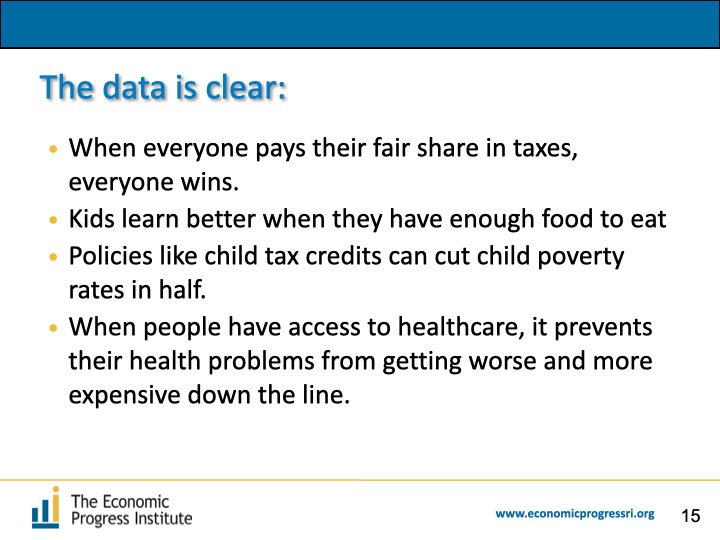
“I don’t have to convince you all; I’m preaching to the choir to some degree, but the data is clear: When everyone pays their fair share in taxes, everyone wins. Kids learn better when they have enough food. Policies like child tax credits can cut child poverty rates in half. Another bit of good news: this year Rhode Island created our first-ever state child tax credit, which will help parents meet their basic needs by putting a little extra money back in their pockets from their taxes. If we invested more in that, we could make an even bigger dent in child poverty in the state.
“The data also shows that when people have access to healthcare, it prevents their health problems from getting worse and more expensive down the line, so investing in people and human dignity is not just the right thing to do; it’s almost always a good investment.
“I’ve laid out a lot of challenges, but I know that we are up to the task of tackling them. They might seem impossible or insurmountable, but I think many people know that history has shown us we can accomplish impossible things, or seemingly impossible things. We can outlaw slavery and racial segregation. We can make sure everyone has access to the right to vote. History has shown us that we need to protect those victories; we need to keep fighting, not only to protect the victories we’ve already won, but to make progress towards the goal of everyone being able to live with dignity. I look forward to continuing to do that work with all of you.”

I really appreciate the work of the EPI and other organizations fighting poverty. But for about 30 years I have been convinced that we cannot end poverty by public assistance, as critical as it is, we have to change how we do economic devleopment so that we are building up our lowest income communities instead of just giving money to rich folks, mostly to do things that that we do not need to have done, like build weapons, and thereby perpetuate incoe inequality. Our economic development activities are one of the key ways to create greater equality and reduce the harms in our communities like air pollution., both of which contribute to less poverty.
The rolling climate catstrophe, and the polluting that creates it are part and parcel of the econoic devleopment machine that makes everything worse. I will be giving a workshop on Zoom Monday November 9 at 3 PM where I will discuss these issues. All are welcome
Longtime Rhode Islander Greg Gerritt has been a staple in the state’s climate conversations for decades. He is the author of a new book, “Economic Development, Climate Justice, and Prosperous Communities”. Greg has been studying how the RI economy could react to the climate crisis in ways that improve community prosperity. RI’s strategy to address climate change needs to be multifaceted and Greg’s work ties together many key elements of the conversations we are all having about climate change across RI.
A Conversation About Economic Development, Climate Justice, and Prosperous Communities with Greg Gerritt
Monday, November 9th @ 3:00PM (Virtual)
Join Zoom Meeting
https://us02web.zoom.us/j/83196361164?pwd=CcW3fRBCJvGM0i64HKTMGNsm86r5t8.1