
Phil Eil: Public testimony overwhelmingly supports bills that seek to more strictly regulate the Wyatt or to banish ICE
"Instead of taxing the city of Central Falls with this financial, emotional, and moral burden, Rhode Island must end the practice of immigrant detention and shut down the Wyatt..."

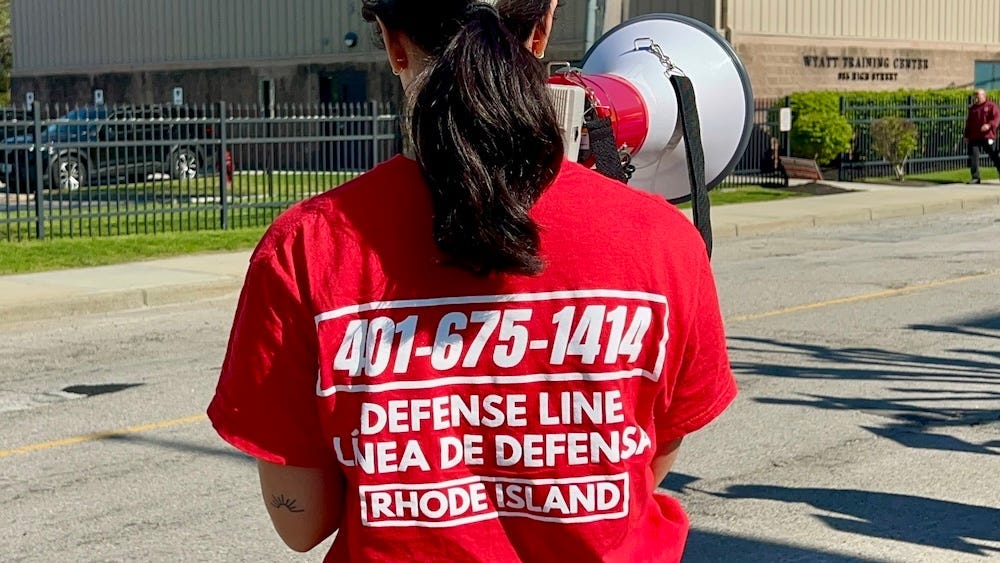
Nearly every year since 2019, Rhode Island legislators have introduced bills that would affect the operations of the Donald W. Wyatt Detention Facility in Central Falls. Some bills have sought to revoke the facility’s tax-exempt status. Others have called for twice-annual safety inspections. Many bills have aimed to slow, stop, and/or prohibit the facility from holding detainees for Immigration and Customs Enforcement. (ICE is the Wyatt’s second biggest client, after the U.S. Marshals Service.) None of the bills has passed.
In the current legislative session, there are sibling bills aimed at the Wyatt: House Bill 7436 and Senate Bill 2278.
The bills would bar any state or municipal entity from entering into, or renewing, a contract used to hold people for civil immigration violations. The only facility currently engaged in such a contract is the Wyatt, which is operated by the Central Falls Detention Facility Corporation, a publicly-owned, non-profit entity with a board of directors appointed by the mayor of Central Falls.
Both bills were introduced in January. A hearing for HB 7436 took place in March in the House Judiciary Committee. A hearing on SB 2278 was held yesterday, May 5, in the Senate Judiciary Committee.
Since ICE’s controversial return to Wyatt in 2019, the agency has maintained a steady presence there. In 2025, the average number of ICE detainees remained above 100 throughout the year. And, according to the Warden’s Report at the latest CFDFC board meeting in late April, the ICE-detainee population at Wyatt was 102.
This year’s Wyatt-related bills have – as in previous years – prompted folks from across the state to weigh in via written testimony. The letters and emails come from people in all corners of the state. Most were written in English, though some are in Spanish. The writers range from high schoolers to retirees. The messages, like testimony in previous years, are overwhelmingly in favor of bills that seek to more strictly regulate the Wyatt or to banish ICE.
If you have time, you can peruse all of this written testimony – more than 90 letters and emails for the House bill, 61 for the Senate bill – at the websites of the House and Senate Judiciary Committees.
But I have included below a few excerpts that reflect what our neighbors are saying about ICE and the local maximum-security facility that holds people for the agency.
EXCERPTS FROM WRITTEN TESTIMONY ABOUT HOUSE BILL 7436:
Lynn Gamwell wrote, in part:
We can not in good conscience support the unfair and often inhumane treatment of immigrants in Rhode Island under ICE, DHS, and our federal government. Please stand on the side of justice and due process for all people.
Helen Grundman wrote, in part:
I’m writing as a U.S. born daughter of an immigrant. I’m so glad that my father, whose family came here to escape Hitler, did not live to see his country locking up other immigrants for simple, civil immigration infractions. We may not be able to change this practice, but we certainly do not need to take part.
James Brcak wrote, in part:
As a child/adolescent clinical psychologist who works in a Providence-based school, I have witnessed the growing anxiety and sense of dread held by children who fear for their safety and the safety of their families due to the rampant abuses by ICE in our communities.
One specific example of these abuses involves a recent ICE incident in Providence, which traumatized both our students and school staff. On January 22, 2026, an armed ICE traffic stop took place just outside of our school. Several unmarked vehicles pulled over a car on Broadway. Armed officers got out of their vehicles and drew weapons on the car, yelling at its driver and attempting to break the window. The cars all then sped off down the side streets. As a school we contacted the police, thinking it was a police pull-over, only to learn the police did not have any information about the incident and suggested it might be ICE-related. Our school had no means of knowing whether the surrounding area was safe in order to allow students out of the building. Clinicians had to intervene with students and families who feared for their safety.
This is just one example of how state support of ICE contracts in our community leads to abuses not only in our detention centers, but on our streets.
Roopa Duvvi wrote, in part:
I write to you as a first-year medical student at the Warren Alpert Medical School who is strongly considering staying in Rhode Island to train and practice as a primary care provider. I care deeply about supporting the health and safety of Rhode Island communities. Ending immigration detention in the state is essential to doing so.
Rose Catania wrote, in part:
Economically speaking, no city should rely on prisons and detention centers as a form of development. Moreover, the Wyatt is actually a financial burden to Central Falls as it doesn’t pay property taxes! A business, or group of small businesses, on that land would bring in more money for the city.
EXCERPTS FROM WRITTEN TESTIMONY ABOUT SENATE BILL 2278:
Yvette Nachmias-Baeu wrote, in part:
Please do everything in your power to protect innocent immigrants from the grip of ICE. What is happening around the country to people is shameful and we are all burdened by the complete lawlessness of their actions.
Tatiana Rothchild wrote, in part:
The experiences of violence, abuse, and exploitation shared by those in detention centers across the U.S. are no surprise to anyone familiar with a rent-seeking model of detention, where quotas drive violent treatment and unlawful detainment, and fast expansion incentivizes cost-cutting measures and human rights violations. The Wyatt Detention Center is a prime example of this, where detainees have reported medical neglect, unsafe water leading to health issues, and sexual assault; where the management itself admits to incredibly high prices for basic necessities, like hygiene products, clean water, and communication with family; where one of our immigrant neighbors was killed due to medical neglect and the ICE contract terminated as a result; where detainees have conducted a hunger strike since restarting its migrant detention.
Rock Singewald wrote, in part:
I witnessed the ICE raid in Warren, RI this past Veteran’s Day, and I was appalled by the actions of the masked federal agents as they chased and grabbed a local worker from his car and took him away without a judicial warrant, leaving his disabled car in the middle of the street. The agents drove around the area for hours in a reckless manner and acted more like kidnappers than law enforcement officers as they told members of the community who were watching and filming that they didn’t need a warrant to detain someone.
I believe the tactics employed in Warren and in other RI communities by immigration enforcement agents demand that we make a commitment to safeguard the rights and safety of all Rhode Islanders, regardless of immigration status, by upholding the fundamental principles of equal treatment, due process, and civil liberties under the law.
Sydney Goldman wrote, in part:
It doesn’t have to be this way. Instead of taxing the city of Central Falls with this financial, emotional, and moral burden, Rhode Island must end the practice of immigrant detention and shut down the Wyatt.
Nadia Gonzales wrote, in part:
The Wyatt Detention Center is not just a building. It is a place where families are separated, where immigrants, many of them with no criminal record, are treated as if they have no value. It is a place that represents pain, uncertainty, and forced silence.
I have spoken with people who have been there. People who were detained on their way to work, while caring for their children, or simply living their daily lives. What happens inside Wyatt does not only affect those detained, it impacts entire communities. Children are left without their parents. Mothers don’t know if they will see their children again. Families lose their stability overnight.
The contract with ICE allows this system to continue. A system that criminalizes migration and profits from human suffering. Our community is not a business. Our people should not be used to fill beds in detention centers.

 | A guest post by
|
ICE is a criminal organization that shold be abolished and Wyatt should also be closed down.