
Interview: Jason Knight is running for Attorney General
"AG is not an entry-level position. We need to have somebody who has a deep wealth of experience inside the office ... and has a track record for making Rhode Island government work for the people..."

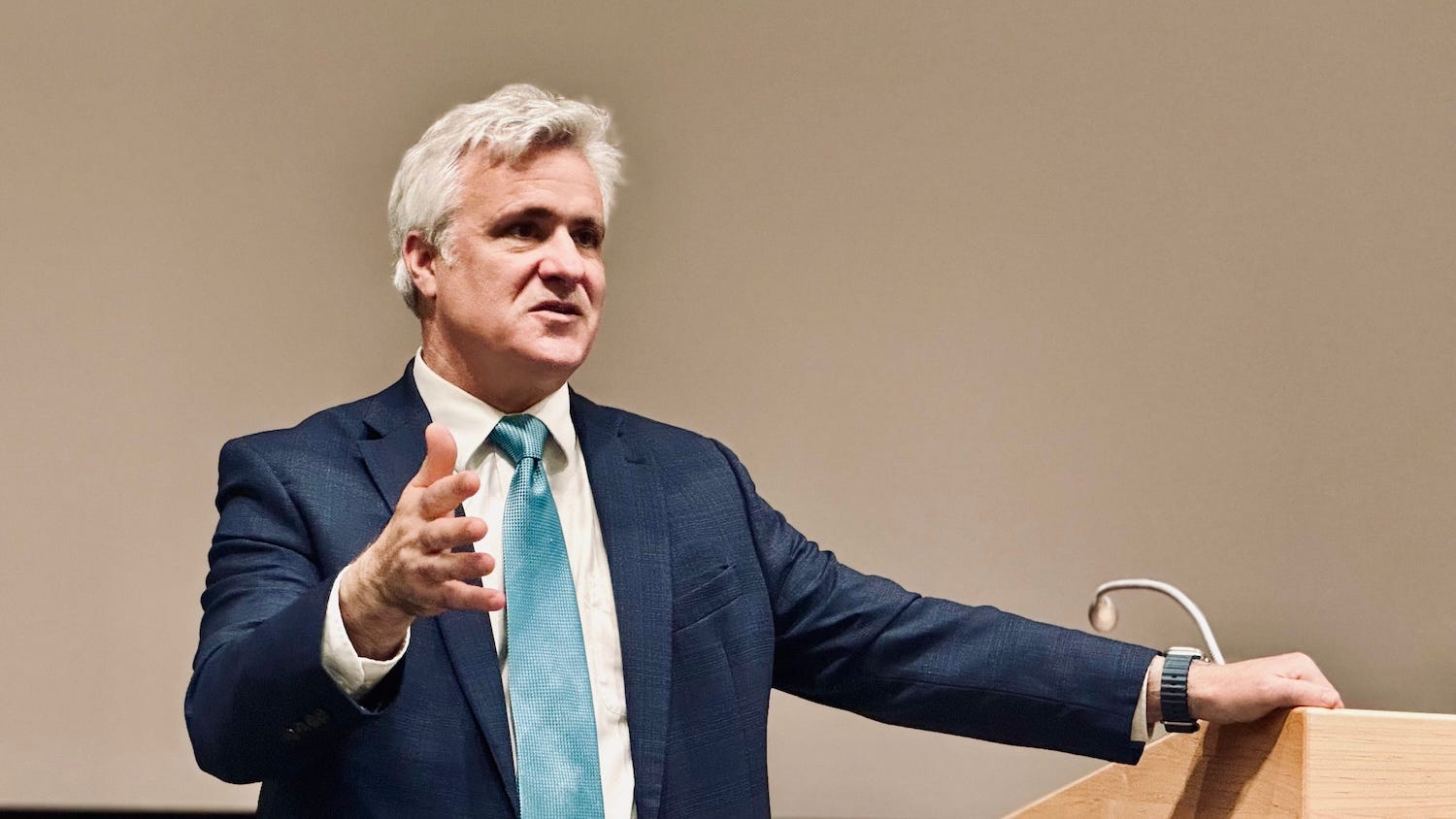
Jason Knight is a lawyer and member of the Rhode Island House representing District 67 (Barrington and Warren) since 2016. During his time in office, he has cosponsored bills to codify Roe v Wade and ban assault weapons, among other gun safety bills. He is finishing up his last term in office to run for Attorney General, looking to claim the seat being vacated by Peter Neronha, who is term-limited.
We spoke over breakfast at Brickway On Wickenden. Sydney Keen, Knight’s campaign manager, was also present.
Steve Ahlquist: You’re running for attorney general. What made you decide to do this?
Jason Knight: In everything I do, I want to include a public service component. As a prosecutor, I served at the pleasure of the Attorney General’s office, stood up for victims, and put bad guys in jail. As a criminal defense lawyer, I play an important role in the courthouse, keeping the government honest when it acts unlawfully or unconstitutionally against any particular defendant. As a state representative, I enjoyed shaping public policy in the State House. This is a confluence for me: I’m looking for a professional change. I’m looking for a way to combine the public service work I’ve done into a broader role, and the attorney general slot fits the bill perfectly. I think that I’m uniquely qualified for it because of my time in the legislature, my time as a prosecutor, and the accomplishments that I’ve had.
It seems like a natural fit - we’re going to have an election to find out - but I don’t think there’s a better candidate, more uniquely qualified for the job.
Steve Ahlquist: You mentioned a professional change. Can you say more about that?
Jason Knight: I’ve been in private practice for 16 years. When you’re dealing with crime and criminal law for that long, it’s not a pretty business. I’m engaged with it, but I want to be engaged differently, in a bigger picture kind of way. I’ve seen too many guys on the revolving door to jail, and I think the AG can do something about it, but I don’t see anyone else talking about it. It’s something I’d really like to take on. If I’m fortunate enough to be elected attorney general, part of my work will be to improve our criminal justice system.
Steve Ahlquist: When you’re talking about the revolving door, are you talking about post-release help for those leaving prison?
Jason Knight: Roughly 70% of all the guys who come out of the ACI - and they’re mostly guys - go back in. The state has some work to do to drive that number down, and I think we can. The AG should be front and center in that conversation because the AG’s number one role is public safety. There’s a lot of other stuff going on at this time in our history, particularly around holding back the Trump policies, which the AG should absolutely be doing, but you can never lose sight of the AG’s public safety role.
Steve Ahlquist: I know that past AGs have pushed back against post-release things like automatic expungement for past cannabis convictions. Are you talking about things like that, or is there more we should be doing?
Jason Knight: There’s a whole menu of things. In a perfect world, offenders don’t offend. If they offend once, in a perfect world, they don’t offend again. Make no mistake, when it comes to criminal justice, there are times when you have to go to the part of the toolbox that has the biggest hammers, but there are a lot of times you don’t. There’s a touchstone in federal sentencing law that encapsulates the philosophy we should have around criminal justice: “We should do what is sufficient but not more than necessary to correct the underlying behavior.” Sometimes that’s a big jail sentence. There’s no way around it for certain crimes. When it comes to recidivism, one of the things the government can and should provide on the back end of a crime for someone who is paying their debt is to improve stability in that person’s life.
What is it to be rehabilitated? It’s someone ready to live their life according to society’s rules. When we break it down into its parts, they’re stable in their housing, financial situation, and their relationships. We must try to create the conditions in which they don’t reoffend. Of course, we can’t solve all those problems, but we can help out with a couple of them. We can do some basic stuff. We can have an expungement policy that balances the need for the public to know about someone’s history (the public-safety part) against the fact that it’s super hard to get a job with a criminal record these days. We need to balance those two ideas when someone leaves prison, instead of just handing them a bus ticket to Kennedy Plaza.
Steve Ahlquist: Right now, that seems to be the process.
Jason Knight: Maybe that person should get a cell phone with a case and a data plan, right? We can do that for everybody coming out of prison for less than the cost of sending them back. There are more in-depth measures, such as transitional housing. Our recent conversations in our public space have focused on housing for the last few years; this is part of that.
Steve Ahlquist: The stuff you’re talking about, like stable housing and access to jobs, is becoming scarce for people who haven’t just left prison.
Jason Knight: Yeah. Nothing’s perfect, but we should never give up. From the AG’s perspective, this is not about doing it just because you should. The AG should wake up every day and ask, “What is my office doing to ensure public safety? Are we doing enough?” This is an area in which we can improve.
Steve Ahlquist: Do you think having been on both sides of the courtroom, prosecuting and defending, gives you more insight into this? As far as I know, the other people running have only been on one side or the other.
Jason Knight: It does give me more perspective. Most of the conversations in this attorney general’s race have been focused on Washington, Trump’s policies, and the civil stuff, but the AG needs to be able to walk and chew bubblegum at the same time. Having someone up there who is well-versed in the criminal justice world from both sides is super important. I know there are candidates in the race who talk a lot about the jail time they handed out or how many thousands of cases they prosecuted, but that’s only half of the formula. I’ve sat with victims whose families have suffered horrific crimes, but I’ve also sat with the accused and the guilty. I know the court from all angles, so when there’s an important decision that comes along in criminal justice land that the AG and only the AG can make (for instance, a life without parole case), I’m going to bring that nuanced perspective to the issue.
Steve Ahlquist: Since we’re talking about this, let me bring up Mario’s Law, named for Mario Monteiro, a man who was serving a life sentence without possibility of parole for a crime committed when he was 17. The law allowed those convicted as juveniles a chance at parole. Attorney General Neronha fought against this from the beginning.
Jason Knight: I supported Mario’s law. I can’t remember the chapter verse because it was a few years ago, but big picture, Mario’s law says that if your offense occurred before age 22, you get a shot at parole. I think that’s the right way to go. There are terrible offenses committed by people under 22 that deserve society’s disapproval. Some people are dangerous at that age, but balance that against the fact that nobody’s brain is fully developed by then, and people do change after that age. Giving someone a shot to go before the parole board and make their case makes sense.
Steve Ahlquist: Our current attorney general opposed that law and the release of Monteiro to the bitter end. He went to court to argue that “Mario’s Law” did not apply to the person the legislation was named after, and Monteiro was released only after the AG lost its court case.
Jason Knight: Well, there’s true public safety, and there’s reflexive public safety. “Lock them up and throw away the key” is reflexive. We need individualized decisions, taking into account individual histories, and balancing them against the families who have been hurt by these crimes, right? I’m concerned that Rhode Island has a little bit of a truth-in-sentencing problem. We have to consider that when we consider public policy changes.
[Note: “Truth in Sentencing (TIS) laws require people to serve a certain percentage of their sentence (for example, 80%) behind bars,” writes Families Against Mandatory Minimums (FAMM). “This greatly limits and prevents both the individual and the correction system’s ability to reduce time in prison through good behavior and completion of rehabilitative programming. TIS laws may sound appealing, but in reality, they make communities less safe by taking away a vital corrections tool, increasing recidivism, and wasting resources on unnecessary incarceration – money that can’t be spent preventing crime.”]
Jason Knight: We can’t throw away the tools we have to acknowledge when someone might be wrongfully convicted or when there’s a problem with how their case was handled. We can’t throw away our post-conviction relief system. We can’t throw away our parole system, but we have to be mindful that there’s another side to this conversation from the victim’s point of view. Families deserve justice. The AG does not represent the victims or their families, but their views need to be acknowledged when seeking justice.
Steve Ahlquist: There’s a large number of people in Rhode Island who are on probation, technically still in the custody of the ACI in one way or another, on probation. If you talk to people from DARE (Direct Action for Rights and Equality) and other advocacy groups, you’ll quickly learn about the racial bias in the system. What are your thoughts on that?
Jason Knight: Human beings run the justice system. I’m not going to stand here and say that there’s no racism in the justice system. I think there absolutely is. I’ve never seen overt and explicit racism, but you see implicit stuff all the time.
Rhode Island did have a problem with extraordinarily long probation sentences. When I first started, it was not uncommon to get 10-15 years’ probation for something serious. I think the courts got the memo on that a few years ago, but it’s taken a while for that to percolate out. I don’t get the sense that we hand out extraordinarily long probation sentences anymore. The courts want to keep it at like three to five years, and in my experience, that’s what they’ve been doing. It’s going to take some time for that to work its way through the system. I have to give credit to the Committee on Racial and Ethnic Fairness in the Courts. They’ve prompted a lot of conversations inside the courthouse among the people who wear the robes that I think we needed.
Steve Ahlquist: The community groups that I tend to work with most are very interested in making the 364 bill happen. What are the chances of it happening this year?
Jason Knight: I think the chances are good for 1,001 reasons, but it’s not a slam dunk. I don’t want to get too much into the inside baseball of the general assembly, but I support the bill as written. We should pass it today because Rhode Island’s been on the receiving end of this ICE craziness. To be candid, federal law is supreme over state law. There’s not a ton the state can do to push back against ICE because, if there were an easy answer, let’s face it, you would have seen it in New York, Minnesota, or California.
I feel so bad for those people in Minnesota who suffered at the hands of this army that invaded their city.
Steve Ahlquist: I thought they accounted themselves well.
Jason Knight: They did, but you’ll notice that there was no easy fix. The state couldn’t just snap its fingers and boot ICE out of town or make them conform to the Constitution. And let’s be clear, they need to conform to the Constitution. But there are some things our general assembly can do immediately to make ICE more accountable and reduce the number of people subject to ICE enforcement by making small, somewhat technical, tweaks to state law. The 364 falls into that category. It’s simply shaving one day off the maximum sentence for misdemeanors. That is it. It’s one day. It makes almost no difference to actual public safety for Rhode Islanders, but what a difference one day makes in ICE enforcement because of how federal law is drafted.
This is the goalpost. We can pass it today. We could pass the bill to keep ICE out of courthouses, and that is actually one area where state law can overcome federal law, for 1,001 technical reasons we don’t have to get into. We could pass a mask bill requiring law enforcement agents to remove their masks. There’s a question as to whether that would hold up in federal court, but we are at the point in this process where the niceties of the relationship between the federal and state governments have long gone out the window. Even if it has a decent chance of getting tossed in court, we should do it as a protest vote so that the state of Rhode Island is on record opposing the racist policies that ICE is currently engaged in under the Trump administration.
Steve Ahlquist: I’ve always wondered: why are the courts so involved in helping the legislature craft law? It seems to me more than just “Here’s some fine-tuning in the language.” It’s more like, “We won’t approve of the legislation unless it is written the way we say.” Writing legislation is up to the General Assembly, and not the job of unelected judges. I’m thinking of the Rhode Island Uniform Parentage Act, which was badly needed legislation that was rewritten to satisfy the whims of some random family court judge before passage.
Jason Knight: The fact of the matter is that the General Assembly is pretty deferential to the courthouse. First of all, it’s a separate branch of government, so how the courts interact with the general assembly is up to them. They can choose whether to send a letter. More often than not, when I’ve seen the judiciary letter come through that’s commenting on a proposed change in the law, it’s of a technical nature, such as “If you do this, it’s going to cause us to have to adjust our administrative systems in a certain way.” That’s fine, I want to hear, as a legislator, that it’s going to cost more money to do whatever these changes are. Sometimes we get letters where you can tell the author is philosophically opposed to the change we’re talking about, and that’s a harder conversation, but it’s always the General Assembly’s prerogative to push through the will of the people. I can only speak for myself when I talk about what level of deference I give to the court system as a legislator.
Steve Ahlquist: It sometimes feels like the courts are getting in the way of better policy and not always for justifiable reasons.
Jason Knight: And sometimes there’s a legitimate issue around the separation of powers. There are a ton of bills that try to tell the court what to do in particular situations, but the fact of the matter is that the courts are a separate branch, and their job is to resolve cases and controversies. Just as the General Assembly can make its own rules about how it runs its own show, the court system can make its own rules, particularly when it comes to the core tasks of fact-finding, sentencing, and fashioning remedies to controversies. Sometimes, in the General Assembly, there’s a bill that clearly invades the court’s powers. In that case, when they push back, I think we should listen.
Steve Ahlquist: To change it up, I want to talk about the Access to Public Records Act (APRA) and the Open Meetings Act (OMA). These rights are very important to me.
There’s a fairly decent bill to update the Access to Public Records Act...
Jason Knight: I’m the House sponsor.
Steve Ahlquist: It hasn’t passed yet. Why?
Jason Knight: It’s Louis DiPalma’s bill, on the Senate side. He’s been working on it longer. I defer to him. I know that he’s working on it, but I think that the governor’s office has 1,001 objections. I don’t know the current state of negotiations on the bill. On the House side, there’s maybe one or two things that could be tightened up, but I think it’s really close to being ready for prime time, and I’d like to see it get us over the line as soon as possible. I know what the governor’s objections are. They strike me as a whole lot of arguments that boil down to, “This bill’s going to make us change the way we do things, and it’s going to be hard for us to adapt.”
And my answer is, “Well, the public has a right to know.” Our current Access to Public Records Act is too often used to keep vital information away from the public, and that needs to change. And I know I’m talking to a journalist.
Steve Ahlquist: You are, and I guess this is the place where you might say I’m very biased, but I believe that the McKee administration does, in fact, use the current law to keep vital information away from the public.
I’ve got hit with $1,000+ bills, which, since I can’t afford that, effectively means I can’t get the information, and my investigation is dead.
Jason Knight: I’m not going to comment on the governor’s decisions in this realm because I’m not intimately involved in those decisions, but I will say that there are people out there, not you, but there are people out there who wake up and file an ARPA request.
Steve Ahlquist: I know some people seem to abuse the system.
Jason Knight: It turns vexatious at some point.
Steve Ahlquist: I can think of some examples.
Jason Knight: There’s something the governor’s office should welcome in the new legislation. There’s a provision in there to account for people who abuse the process, which we don’t have right now. It’s a balanced bill.
Steve Ahlquist: The attorney general has a key role in overseeing the Access to Public Records Act and could issue rulings that make it easier and cheaper for the public to obtain documents.
Jason Knight: I think the attorney general should support public disclosure. Remember, the attorney general is the people’s lawyer. It’s not the governor’s lawyer, not the speaker’s lawyer, it’s a people’s lawyer. We have a Public Records Act for a reason, so we should have a policy that favors disclosure, but we must stay within the established legal boundaries. If the established law provides a facially legitimate out for the government official to avoid disclosure, the general may be constrained; but if we can tilt the law towards disclosure, then that’s the law the attorney general will prosecute.
Steve Ahlquist: Aside from criminal justice, the attorney general’s office has several other functions. The current attorney general has done some work on the hospitals, consumer protection, and civil rights. What are your thoughts on that? How do you balance an office that has limited resources?
Jason Knight: I applaud Peter Neronha for thinking creatively about how to make the office better serve the people of Rhode Island, and I appreciate the changes he’s made to what he calls the Public Protection Bureau. I think of it as boosting the public advocacy role of the Attorney General and asserting the idea that the Attorney General is the people’s lawyer and can serve the people when and how the Attorney General sees fit. Some statutory rules help that process along, consumer protection, Medicaid fraud, Hospital Conversions Act, that kind of thing, but to be part of the conversation in a more affirmative way is good for Rhode Islanders. It brings another voice to the conversation, and whatever the topic is, it’s not just the governor and the general assembly beefing with each other.
On the resource management question, that’s what you’re hiring for in an AG. You’re not hiring a lawyer to do a lawyer’s work. There are candidates in this race who talk about the nuts and bolts minutiae of the Public Protection Bureau’s actions and their role in it. That’s fine. That’s not what the AG’s doing. The AG is a lawyer and leader, and they must decide how to allocate the office’s resources to accomplish today’s important missions. Public protection, on the civil side, is certainly one of them. Public safety, on the criminal side, is one of them, and the needs change day to day, but there are a couple of needs there over the long term.
I think the next attorney general should embrace Peter’s changes, but it’s going to be their mission to figure out how to sustain it going forward because I hear the office is super stretched. It takes a lot of time to turn around a lot of work, and we need to figure out how to make this new approach sustainable.
Steve Ahlquist: Without requesting much more money from the General Assembly…
Jason Knight: When I’m elected, I’m going to be up there asking for more money for lawyers and staff, but there’s only so much money in the till. I want a bigger piece of it, but I understand it can’t be unlimited.
Steve Ahlquist: What are the new areas that the AG needs to be worried about?
Jason Knight: I think the areas are pretty consistent. What you’re doing in those areas changes. The attorney general absolutely needs to be on the lookout for consumer protection. Environmental protection is so important. I know the attorney general is involved in discussions about the Coastal Resources Management Council (CRMC) and what we should do with the agency. I’m firmly with Peter in saying it needs to be professionalized and turned into a component of the Department of Environmental Management (DEM).
Something in the air right now that is going to become core is calling out internet companies whose out-of-state actions affect people in-state, and holding them to account to the community for their actions. It’s going to be a big challenge for the next AG. You only need to look at the current litigation over Facebook and Instagram’s harm to kids to know that’s coming. You need only look at the internet company’s ability to evade state law to know there’s a problem, because we have people who are deeply engaged in our communities, and they’re not accountable to the community.
This is the next chapter in the internet’s development. I’m old enough to have been around in the days of CompuServe. I remember when email was black-and-white text on the screen. I’ve seen the dot-com bubble, the rise of the smartphone, and all the stuff that brought us here today. A lot of it’s good, but a lot of it is deeply harmful, and as a society, we’ve given internet companies a pass in favor of developing the business side of the internet, promoting its growth, but that can’t go on forever. In ways large and small, they need to account for themselves here in Rhode Island. That’s going to be a challenge for the next AG. It comes up in all walks of life: civil and criminal, and it’s a big conversation.
Steve Ahlquist: Related to that is privacy and information rights.
Sydney Keen: He has a bill protecting medical information...
Jason Knight: This is a perfect example. The bill reads complicated, but the idea is that if you’re a business that has a product that collects data related to reproductive rights or gender affirming care, data that we know is being targeted by bad-faith actors out of state, but not protected by HIPAA because you’re not a medical provider - think the menstruation tracker on an Apple Watch - we’re going to set up some rules about how that data is handled and what is disclosed to the people who own that data. That’s a bill I have today. It’s a modest bill, but it’s an important one. This is the kind of thing I’m talking about. It’s the wild west of data. Maybe that’s how I should boil it down: the wild west of data is going to be a problem for the next AG.
Steve Ahlquist: Just figuring out who owns and controls the data is an issue.
Jason Knight: It’s the subject of ongoing litigation in criminal law land because there are Fourth Amendment issues, and the courts are deeply involved. There have already been a few cases. Traditionally, if I have something private and disclose it to you, I lose my privacy interest in it. So what happens when you’re a person engaged in committing a crime, and your cell phone gives up the location data to the provider of the cell phone service, say Google or AT&T? That dynamic can play out a thousand different ways. The question is, are there Fourth Amendment issues if the government seeks that data without a warrant?
Steve Ahlquist: I prefer warrants in almost every case.
Jason Knight: Under the old thinking, if I gave you my data, you would own it. There’s no expectation of privacy in the data I gave you; therefore, when law enforcement wants it, you’ve got to give it up. The new thinking, which is interesting, is that since phones and computers are so integrated into our lives, should we lose all our privacy protections merely by using a device that, increasingly, you have to use to get along in private life?
Steve Ahlquist: People think of their phones as extensions of their brains. We don’t think of them as separate.
Jason Knight: Right. The Supreme Court has issued a few decisions that grapple with these issues. Sometimes they go one way, sometimes they go the other. It’s going to be part of our ongoing conversation, and internet companies are deeply involved in it.
Steve Ahlquist: I want to ask about the Cannabis Control Commission (CCC). You voted for the cannabis bill that made social equity licenses possible, but in three years, we haven’t issued a single social equity license, and as a result, the people pursuing them are out millions of dollars. And when those companies start to fold, big cannabis companies will be able to snatch up their leases on buildings that have all been pre-vetted, resulting in a massive upward transference of money from those seeking social equity licenses to very rich and powerful cannabis retailers, which seems very much racist to me, and perpetuates some of the worst failings of the war on drugs.
Do you have any thoughts on that, given that you were a legislator who seemed to think it was a great idea at the time?
Jason Knight: It is terrible and frankly just an example of Rhode Island’s bad old ways that the cannabis commission couldn’t stand up a market under these conditions and still hasn’t done it to this day. It is emblematic of the kind of poor government service that Rhode Islanders have come to expect from their government over the years. Frankly, it’s a reversion to the old ways. It’s a complete failure of our government to make the social equity thing happen for the people who invested money in the idea that when the general assembly says we’re going to have a recreational cannabis market, it would actually appear in a reasonable amount of time.
Steve Ahlquist: Over three years!
Jason Knight: It’s not as spectacular as the broken bridge on interstate 195, but the failure of government comes from the same set of failings: a lack of urgency, opaqueness around government operations, a lack of accountability by any one human being for the failure, and a penchant for government actors and the executive to throw up their hands and say, “What are you going to do? Government is slow” when bad things happen. I’m astounded by the fact that we’re still here in this day and age.
Steve Ahlquist: I’m dealing with the governor’s office right now on an APRA request for documents that have to do with the CCC’s failure, and I’m going to be hit with a gigantic bill for it.
It’s no secret that AG Neronha and Governor McKee do not get along.
Jason Knight: Something we’re hearing from the voters is that they appreciate there is somebody who’s unabashedly on their side. They want to see that in an attorney general, and that’s what they’re going to get with me for sure. We also hear some discomfort with the fact that branches of the Rhode Island government can’t seem to get along, and that it has become personal. They definitely don’t like that. This is where I would have a different approach, not that we’re going to play softball or anything like that, but we have to be cognizant of the fact that the attorney general needs to be the grown-up in the room, and act accordingly, for the benefit of all Rhode Islanders, even if you’re engaged in a very significant disagreement with some other branch of government.
Steve Ahlquist: Is that a lawyer thing? You expect the AG to be more professional and above the fray?
Jason Knight: I think it’s a lawyer’s thing. In my own practice, criminal law covers some of the ugliest behavior imaginable. We’re all human beings trying to navigate this mess. It really makes a difference when we are thoughtful about our personal composure and try to be as professional as possible, without pulling our punches or obfuscating the truth.
People want to see government actually work and solve problems, and the sideshows that can occur when people get into conflict are just unnecessary distractions.
Steve Ahlquist: Being attorney general is an administrative/executive job. Being a legislator is very different. Is legislative experience an advantage for the new job?
Jason Knight: It can only help when your attorney general has a deep understanding of how other portions of the government operate. I know, in a very deep and fundamental way, that the general assembly has a short attention span. It’s just the nature of the beast. I know it because I serve there.
If you, as attorney general, want to redirect the general assembly’s attention to a particular issue because you see it as a looming public problem, there’s a way to have that conversation that accounts for the shortcomings in how the general assembly does its operations, but also addresses the realities of those operations. You can’t know that unless you’ve been there. You just can’t.
It’s in the public’s interest to have someone in the AG slot who understands how the other branches work in a meaningful way. There are candidates in this race who will talk about having served two governors and three attorneys general, but I think if you’re going to know anything, it should be about the general assembly, because I’ve heard from thousands and thousands of voters and citizens through my representation there. They’ve had the opportunity to look at my judgment and the decisions I made and then cast judgment on those decisions by choosing to re-elect me. If you’re going to understand how Rhode Island works, you have to start with the General Assembly.
Steve Ahlquist: Let’s say you’re meeting a voter for the first time and they ask, “Why should I vote for you?” What’s your answer?
Jason Knight: We live in dangerous and uncertain times. There’s a lunatic in the White House who every day wakes up and thinks to himself, “I have to hurt somebody to win.” That’s all he’s interested in, and Rhode Island has been on the receiving end of that. Rhode Island has had its funding and priorities cut unconstitutionally and unlawfully. He has tried to turn off our wind farm not once but twice, and he has co-opted ICE to enforce a profoundly racist policy of finding anyone who’s not white on the streets and saying, “Show us your papers.” It’s totally despicable.
AG is not an entry-level position. We need to have somebody who has a deep wealth of experience inside the office, as an elected official, and has a track record for making Rhode Island government work for people take the baton from Peter, and run with it so that we can hold the line on President Trump and do all the jobs that the AG needs to do that don’t have anything to do with Washington.
I understand that people have a choice in this race. The other candidates are running on their resumes. I am running my record. We’re not hiring lawyers to do lawyer work. We’re hiring a lawyer to be a leader, and because of my 10 years in the public eye, my accountability for my decisions and judgment, and my ability to make things happen on the ground for people, I’m the best and most well-rounded candidate with the most developed political muscle, frankly, to take over this job.