

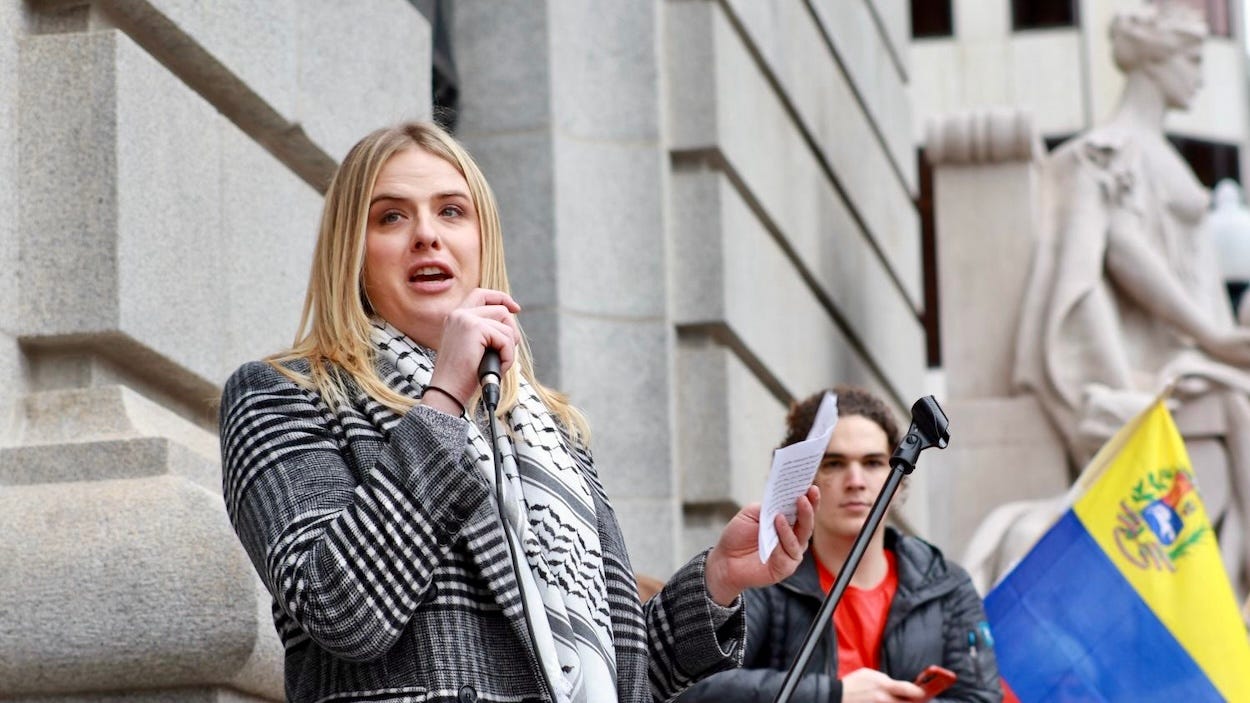
On her website, 32-year-old Navy veteran Brittany Kubicek describes herself as “an independent socialist running for the General Assembly to fight for the people of House District 5 and all of Rhode Island.” She’s an organizer with the Rhode Island Democratic Socialists of America. I’ve seen her speak at rallies many times, but because of her run for office, I had the chance to sit down and get toknow her better. As impressive a speaker as she is, she’s more impressive when you learn more about her.
Brittany Kubicek: I was born and raised in a small, 7,000-person rural community in Wisconsin, the middle of nowhere. I learned how to drive a tractor before I learned how to drive a car. I graduated from Jefferson High School in Wisconsin in 2012, and then I bummed around my hometown for a couple of years. I had been pretty good in school, but then my college plans fell through. I didn’t want a bunch of debt, so I was working at Walmart, and my parents wanted me out of the house.
I had a couple of grandparents and uncles who had served in the military in various ways, including my grandpa in World War II. At my grandfather’s behest, I went to a Navy recruiter because the Air Force recruiter was closed, but I had no intention of joining the military. I’ve never considered myself super patriotic in that way, but when you’re staring at a bunch of college debt and not being able to get out of your rural hometown - I tested high. The recruiter said, “You can qualify for this nuclear energy program thing, and we’ll give you an $11,000 bonus.”
Steve Ahlquist: For a young person in rural Wisconsin, 19 years old, that sounds like a lot.
Brittany Kubicek: Thinking about the military now, it’s effectively a poverty draft. There’s a reason they’re recruiting during lunch in my high school. There’s a reason they’re in inner cities and urban areas.
So I ended up joining the Navy. About a year later, I shipped out to boot camp in Chicago. After that, I was down in Charleston, South Carolina, for the Navy nuclear schooling, like the school building portion, where you’re learning about the actual theory of how a reactor works and stuff. After about a year and a half of that, I was sent up to upstate New York, where I did the hands-on training.
Steve Ahlquist: Is there a lot of Navy presence in Upstate New York?
Brittany Kubicek: It would surprise you. There are two Naval nuclear reactors in the middle of nowhere outside of Ballston Spa or Saratoga Springs, New York, near Albany. I was there for like eight months, getting hands-on experience after the schooling on how to run a reactor with the test reactors they have there. Then I got sent to New London, Connecticut, to USS Hartford, and that’s how I ended up in New England. I’ve been in New England for the past decade. That was, I think, 2022 or ‘23.
I was on a submarine down there running reactors for four years.
Steve Ahlquist: Did you serve on a submarine that was out in the ocean?
Brittany Kubicek: Yes. We were very active. We made many deployments to the north because our submarine was very quiet. It’s crazy looking back on that experience.
Steve Ahlquist: I have to say that I’ve gone on tours inside submarines. I get a little claustrophobic walking through a submarine. If I had to serve with, like, 40 other people or whatever the number is, I think I’d go nuts.
Brittany Kubicek: There were 140 people on the submarine, and you become really close with people. And that was like one of the best things that I got out of it, in addition to getting me out of my hometown.
I was also raised as an Evangelical Christian conservative. To this point in my life, I’ve been trying to learn more about what I learned growing up and unlearn a lot of it. In the Navy, I met people who gained citizenship by serving in the military. People who were from all sorts of different backgrounds, culturally, financially, whatever. It was a really interesting experience. You get a lot of really close friends.
We did two deployments while I was on the submarine. We went to the North Pole twice and busted through the ice and everything.
Steve Ahlquist: That’s awesome.
Brittany Kubicek: Yeah. It’s scary. It sounds like the submarine’s going to rip apart.
Steve Ahlquist: It still sounds incredible. Did you get to go outside and run around on the ice?
Brittany Kubicek: Yeah.
Steve Ahlquist: In the middle of nowhere near the North Pole, that’s cool. It sounds almost worth it...
Brittany Kubicek: My first time setting foot outside of the country was when I got out at the North Pole.
I did four years, or six years total, because of the two years of schooling in the Navy. They throw a lot of money at you as a nuclear operator to reenlist, like a lot of money. I had made a pros-and-cons list of it, and the only reason I would have stayed was the money, which didn’t seem worth it. I joined college. I joined for job training. I got that. I was ready to get out and do my thing. So in 2019, after a total of exactly 700 days underwater, I was honorably discharged from the Navy, took a job in Taunton, and I’ve been in the Rhode Island area ever since. I’ve been in New England for about a decade and in Providence for about the past five years.
I jumped around a couple of different jobs, got my mechanical engineering degree through the GI Bill, and I currently work at a manufacturing company up in Mansfield. In 2023, I bought a house in the North End, near AAA and Providence Auto Body, and I love Providence. I’ve never felt more at home. When I go on a trip, even if it’s down to Connecticut to see some Navy friends or something, and I’m coming back, and I come around the Thurbers Ave curve, and I see the bridge and then the Superman building and the skyline open up, and it’s like, “I’m home.” I love it here.
So that’s my personal and professional background on how I got to Rhode Island and Providence.
Steve Ahlquist: So Navy, college, mechanical engineering - How do you get into - I’m going to say “radical politics” if I can use that term.
Brittany Kubicek: Being raised conservative, a lot of it didn’t make sense. I read all the Ayn Rand books when I was younger. That was my political theory as a kid, and a lot of it didn’t make sense. So I started questioning it. The way I got here was by learning about history, mainly the labor struggle. There’s a podcast, and it’s not even very radical, American History Tellers. They do good stuff on all sorts of topics, like the Triangle Shirtwaist Factory fire. They talk about the Battle for Blair Mountain. They talk about May Day and stuff like that. And you realize that workers have always been oppressed in this country. It’s always been us versus them. I still remember the day and time when I was getting a beer with a friend of mine, and I looked at her and said, “I’m pretty sure I’m a socialist.”
I am a socialist. It clicked at one point while learning about history. Oh, Howard Zinn’s A People’s History of the United States. Again, not super radical.
Steve Ahlquist: But it opens your eyes.
Brittany Kubicek: My little sister is on the same path right now, so I’m trying to help her learn about this the same way I did. I graduated from college I took a year doing nothing because, when I was in the Navy, your whole life is that. You don’t have anything else. When I got out, I was working full-time and goingto school full-time, so I didn’t have a life. I spent a year doing nothing, but I needed something to keep learning and reading. A friend of mine that I work with - I was basically spitting Marxist theory at him - said, “You should go check out these people in the DSA.” He came with me to my first meeting, and I’ve been doing it ever since. I have these skills: I’m organized, I have drive, I get stuff done, and I want to use them actually to do something, actually to fight for something.
So over the past year and a half, I’ve been organizing with the DSA, and it’s been super rewarding. It’s the only thing that keeps me sane.
Steve Ahlquist: Can I ask, as a personal question, where are you religiously? You said you grew up Evangelical, past tense, not to put you on the spot.
Brittany Kubicek: It’s a good question. I am definitely not a Christian. I’ve deconstructed a lot of that evangelicalism and everything with that. I would consider myself spiritual, but I wouldn’t put a label on it. I think as humans, we’re all connected. I think we’re all part of the same thing. Even science can’t give us a great answer about how all the cells and molecules decided to form themselves into something where we’re able to have a conversation. It’s nuts. So like, no, I don’t really believe in any higher power, but I do believe in like the spirituality of humans.
Steve Ahlquist: Let’s talk about your politics. You’ve been organizing for about a year and a half. You’re not running as a Democrat, and the DSA is on the left of the Democratic Party for sure.
Brittany Kubicek: Correct. On my CF1 form, it gave me a lot of joy to check the “other” box and write in “socialist.”
Steve Ahlquist: Most candidates who might identify as “socialist” in Rhode Island run as Democrats.
So tell me why you’re running.
Brittany Kubicek: I’m running because I want to show that it’s possible to build a movement outside of the Democratic Party. Let me back up. Being raised conservative, I don’t have the rose colored glasses for the Democratic Party that a lot of people who would consider themselves liberals, or radical liberals, or Democratic socialists, might. I genuinely see it as “real change can’t come through the Democratic Party” by the definition of what the Democratic Party is. On the state level, it’s a little different here and there, but the whole “Vote blue, no matter who” thing never sat well with me. It doesn’t make sense. Why is that the only choice that you have? And then you start reading political theory and you realize, wait a second, a lot of this is by design. I’m running as an independent socialist to show that we can build a successful political movement, get into office with populist socialist policies, and stand on our own.
I want to agitate around the issues that actually matter and not have myself get absorbed into the Democratic machine because the way that the state works, once you get elected, they make all the decisions behind closed doors, more or less, and then that’s it.
I’m running as an independent to show that it’s possible. People are looking for a change. People are looking for something different. When we were knocking on doors last year to gather some data, we didn’t make this choice blindly. We went around town, all last year, to a few different districts and talked to a bunch of people. People are sick of the establishment. They’re sick of the status quo, and they want to see something different. This political moment, especially with the abhorrent approval rating of the Democratic Party on the national level, I don’t know how they’re going to recover, if they ever can.
Steve Ahlquist: I mean, Senator Reed is thinking about funding the Iran war as I speak. It’s like, Trump needs more money? Okay!
Brittany Kubicek: He’s upset that Trump didn’t go through the proper channels.
Steve Ahlquist: If Trump went through the proper channels, Democrats would have said yes. It wouldn’t have made a difference. It would have cost Trump six extra hours.
Brittany Kubicek: Exactly. And to bring it back to the state level, this is a safe blue state, but in the DSA, we see a lot of progressive politicians get into office and trend right. I have my own personal feelings about various people at the state level, but if there’s anywhere that we can be progressive and not hurt our chances against the Republicans, it’s here. Establishment Democrats can control what comes through the State House. There are conservative Democrats at the state level, basically Democrats in name only.
Steve Ahlquist: In my opinion, conservative Democrats are basically in charge of the Rhode Island Democratic Party.
Brittany Kubicek: It’s depressing to see progressive politicians get into office and then be completely sidelined by the establishment. They don’t get any say. The Speaker controls everything that goes through the State House. In fact, my opponent is the deputy majority leader...
So what’s the point? Run as a progressive Democrat, and don’t get put on any committees or run as a socialist, stand in my business, and not have to compromise my message and what I’m fighting to get on a committee in two years or something potentially...
Steve Ahlquist: My guess is you’d get on the committee, but maybe not on the best ones. My understanding of Speaker Shekarchi is that even the Republicans get a chance to put bills through. He wants everybody to at least get something they can live with passed, though I’ve never done the research to confirm that.
Let’s talk about your opponent, Representative Anthony DeSimone. His dad is the former Majority Leader under Speaker Mattiello, who famously lost his seat to Marcia Ranglin-Vassell in 2016. Once Ranglin-Vassell stepped down, his son picked up the seat and was promoted to Deputy Majority Leader three years later.
That’s being connected. He was elected in 2022 and quickly got into a leadership position.
Brittany Kubicek: I can find very little about him online.
Steve Ahlquist: Legislatively, this year, he’s signed onto three bills. He’s not the lead sponsor on any of them. [Note, this turns out to be wrong. See below for an explanation]
Brittany Kubicek: The big thing for me is that my district, especially over by Providence College, has two out-of-state companies, The 02908 Club and Strive, buying up all the housing. Providence and Rhode Island in general are among the least affordable places to live in the country. We have a massive housing crisis in Providence. My Rep sits on basically every single housing committee. He’s the deputy majority leader. He’s the guy who at least has a piece of what actually makes it to the floor.
He has two of the worst corporate landlords in the city in his district, and people cannot afford to live here.
Steve Ahlquist: Have you ever seen him at a community meeting or anything like that?
Brittany Kubicek: I haven’t seen anything like that. Our city councilor, Justin Roias, Ward 4, puts stuff all out the time. He’s pretty solid. I like him. But no, I’ve never seen as much as a mailer from DeSimone. I’ve lived here ... I wasn’t here for the 2022 election cycle, but I’ve never had anybody knock on my door for canvassing. I’ve never seen a flyer come to my mailbox or anything.
Steve Ahlquist: Interesting.
Brittany Kubicek: He ran unopposed in 2024. He’s not doing anything for the people of his district.
Steve Ahlquist: Your district is interesting because it’s had a big demographic shift. It used to be solidly blue-collar Italian, and then at some point before Ranglin-Vassell jumped in, the demographics changed. She won by doing the hard work of rallying the people who lived there, who previously felt unrepresented. I mean, that’s one of the ways to win, saying, “I can be somebody who actually represents you? “
Brittany Kubicek: Yeah, 100%.
Steve Ahlquist: Housing is a huge issue. You mentioned Strive and The 02908 Club. What should be done about them? How do we slow them down?
Brittany Kubicek: I understand that if I were elected, I’d be one of 75 representatives. That’s not a whole lot of voting power. In terms of legislation, maybe there’s the occasional thing - like Sam Bell’s bill finally makes it through and we’re able to vote on it or something like that. Great. But in terms of actual things that I’ll be able to do, it’s going to be hard. But that’s not the core focus of this campaign.
What I would love to see, and something that I want to do, especially when we’re in the areas where these companies are prevalent - around Providence College, where a lot of kids are being taken advantage of - is talk to people about tenant organizing. And that is the overarching thing for this whole campaign as well.
We’re fighting to help the working class fight for themselves, and organize in their communities, i.e., tenant organizing, community groups, and stuff like that. Also, organizing in their workplace, and if people want to join the DSA, I always love that. So in the streets and politically, that’s what we’re doing here. I’m trying to help spread the message of socialism. Nothing’s going to change just because one politician gets into office. If Alexandria Ocasio-Cortez runs in 2028 and gets elected, the core of the problem won’t go away. The way we make the problem go away is when enough of us come together and say, “We’re done,” and give people the hope and direction they need to see the power they truly have.
Steve Ahlquist: A future like that feels more likely than ever and less likely than ever at the same time.
Brittany Kubicek: The plan is that when I am elected, I’m going to try to push through things like the $30 minimum wage. I mean, it should be closer to $50 if we’re being honest.
Steve Ahlquist: But $30 is a stretch goal.
Brittany Kubicek: Exactly. But if we’re able to do it like Sam Bell does, where he’s pushing these bills and pulling back the curtain and saying, “We’re trying to do something about these issues. We’re trying to change the way things are going, and the establishment won’t let us. We can’t get this stuff through,” hopefully we will be able to run more people in the furture. Maybe we end up getting some of the more progressive people to be even more progressive.
Steve Ahlquist: And is establishing the Democratic Socialists as a political party part of it? I think the last time a third party had official recognition was the Moderate Party, but they were unable to sustain it very long.
Brittany Kubicek: You literally read my mind. That’s the other piece. We’re trying to build a party for the working class. Something that actually represents working-class people rather than nepobabies and the two-party duopoly that we have in this country.
Steve Ahlquist: If you find yourself elected, there are places where your vote would be really helpful. If there’s a close or difficult vote, people will be asking for your vote. You could vote for whatever version of Act on Climate comes up, decent housing bills, or Rhode Island Public Transit Authority (RIPTA) funding.
When you knocked on doors last year, what were you hearing from residents about their concerns?
Brittany Kubicek: Issues like housing, healthcare, energy, and infrastructure. The Washington Bridge was fresh on people’s minds. Still is. The housing stuff resonates with people. People are seeing $2,000 in monthly rent. The energy piece: We heard that people’s energy bills were $300, $400, or $500 in the winter, and they couldn’t afford healthcare costs. Rhode Islanders have over $70 million in medical debt despite Brown University Health’s near-monopoly.
Another issue people brought up was education. They see their public schools being closed and these charter schools opening. I understand why many people think charter schools, school choice, and school vouchers are a good thing. I want your kids to have the best education possible. And, materially, for the parents, the only way to do that is to send their kid to a charter school. Instead of using these vouchers and taking money from public schools, instead of school choice and taking money from public schools, if we actually fund our public schools and keep them open, instead of selling them for a dollar to some charter school corporation to come in here and make money off it.
Steve Ahlquist: What are your next steps?
Brittany Kubicek: This weekend, we’re having our first canvassing training. We’re going to meet up to go over some training, fill people in on the campaign, and discuss the issues we’ll be fighting for, as well as the ideological stuff we’ve been talking about. Then we’ll start canvassing every weekend to grow our volunteer base and get more involved in the community. I know a decent number of my neighbors around where I live, but I really don’t have much of a presence in the community. I’m going to various events around town and connecting with people to increase my presence in the district, throughout Providence, and the state. I’m going to be doing a lot of phone calls and fundraising.
Something that was a culture shock when I started doing this is that I’ve been doing activism with the DSA for the past year and a half. I’m not doing this because I want recognition; I’m doing it because I care, but there’s a certain aspect now where, when we’re going to an event, we’ve got to make sure we get pictures. We’ve got to make sure we’re posting on social media. There’s a piece of it that makes it feel performative.
Steve Ahlquist: When I first started doing this job, no one knew who I was. Then, when I started to become moderately known, I realized that when I’m driving, and somebody cuts me off, I can’t say, “Fuck you!” and flip them off, because I don’t want somebody to say, “Wow, I used to think Steve was a nice guy.” When you’re a public person, you feel more constrained. I also have to advertise myself and ask people to please send me money for what I do.
Brittany Kubicek: That’s the other piece of it, too. I’ve been telling my family and my friends, “Be ready for me coming around, rattling my tin cup.” That piece feels very foreign, and it sucks. It’s something that I think about. I have to do fundraising because we live in a capitalist society. I don’t know if you watched the show Andor. There’s that one scene where Luthen Raeil (Stellan Skarsgård) is talking about “What do I sacrifice?” It very much feels like I’m forced to use the tools of my enemy to defeat them, and, unfortunately, we need money to be able to do that and to be able to run a successful campaign.
“Calm. Kindness. Kinship. Love. I’ve given up all chance at inner peace. I’ve made my mind a sunless space. I share my dreams with ghosts. I wake up every day to an equation I wrote 15 years ago from which there’s only one conclusion: I’m damned for what I do. My anger, my ego, my unwillingness to yield, my eagerness to fight, they’ve set me on a path from which there is no escape. I yearned to be a savior against injustice without contemplating the cost and by the time I looked down there was no longer any ground beneath my feet. What is my, what is my sacrifice? I’m condemned to use the tools of my enemy to defeat them.
“I burn my decency for someone else’s future. I burn my life to make a sunrise that I know I’ll never see. And the ego that started this fight will never have a mirror or an audience or the light of gratitude. So what do I sacrifice? Everything!”
Steve Ahlquist: I think about that all the time, somewhere a kid is dying in a junkyard collecting toxic parts for my computer so that I can do this work. Every time I search, some AI somewhere consumes precious energy and water resources. Words do not absolve. It’s not enough to say there’s no ethical consumption under capitalism. That said, how else do I do this? I’m not going to be handing out flyers or standing on soapboxes. There’s no other way to be effective.
Let’s talk housing.
Brittany Kubicek: We have this massive housing shortage in the state, and we’ve seen public housing initiatives in places like Vienna. They had a similar problem, and they built a massive amount of high-quality public housing. It wasn’t these dorm-style houses. Are those really our only two choices? Either you live on the street, or you live in a dorm with 20 other people, sharing a toilet with 20 other people, or whatever? That’s unacceptable to me.
We saw it in this country in the ‘70s and ‘80s when there was a housing shortage. We built large amounts of good public housing. It drove down the overall cost of housing for everybody. And it’s the same thing for a lot of these policies. What does universal, single-payer healthcare do for us? It makes you not dependent on your job for your healthcare. It gives the workers more freedom to do what they’re passionate about. We have so many philosophy majors who are working as baristas, or who have degrees and are smart and good at what they do, yet can’t find jobs in their fields because the pay isn’t enough or whatever.
Steve Ahlquist: That’s by design.
Brittany Kubicek: Exactly. It’s all by design. Those contradictions show us the true nature of things. That’s what housing and healthcare would do for us. The $30 minimum wage, I love this one. There were some people in my Twitter comment section complaining about $30 an hour. It’s kind of funny that you’re complaining about me wanting you to make more money. I hear from conservatives who ask, “If you were able to make 30 bucks an hour flipping burgers at McDonald’s, what incentive would you have to work as an engineer?” And I’m like, “Exactly! If I can do that job for 30 bucks an hour, then if my bosses want to keep me on as an engineer, they’re going to have to pay me more money to keep me around. Otherwise, I’m going to go do the easier job.”
It’s far overdue. What do we have now, $16?
Steve Ahlquist: Which, by the way, 10 years ago, would have been unthinkable. I was advocating for a $15 minimum wage 10 years ago, and people told me I was nuts, and now we’re at $16. That’s great, but $16 isn’t close to enough.
Brittany Kubicek: The poverty line, per federal guidelines, is $15,960 for a household of one, $21,640 for a household of two, $27,320 for a household of three, and $33,000 for a household of four.
Steve Ahlquist: It’s why many of our programs kick in when you fall below double the poverty line, because the federal guidelines don’t come close to describing actual poverty in this country.
Brittany Kubicek: On energy and infrastructure, we’ve heard over and overabout utility rate increases. When utilities want to make more money, the Public Utilities Commission (PUC) handwaves increases through.
Steve Ahlquist: And there’s a revolving door of industry insiders serving on the PUC and back again.
Brittany Kubicek: That’s a local version of what happens on the federal level. These people work for regulatory commissions and then get a huge paycheck from a company.
I’m pushing for a public takeover of our energy utilities.
Steve Ahlquist: The DSA’s been on that for a while.
Brittany Kubicek: It makes sense. To live in the modern world, have your lights on, have heat in the winter, and air conditioning in the summer - we can’t keep paying out-of-state corporations. Legally, their responsibility lies with their shareholders. Rhode Island Energy is owned by “Pennsylvania” Power and Light.
Steve Ahlquist: Now, what we pay for wind energy will be going to Ørsted, a Danish multinational energy company. Ørsted does a good job; they know what they’re doing, but if we built and owned the wind turbines as a state, the money we spend on power would stay in Rhode Island, not go overseas.
Brittany Kubicek: One of the icons of the Providence skyline is the Manchester Street Generating Station. An out-of-state company owns that. What do these people care if we can’t affordably power and heat our homes? They don’t. They care about making a buck off of us, which is absolutely disgusting.
I own my home in the North End, and the only reason I’m able to be a homeowner is the same reason I have a degree: GI stuff. That’s another thing that clicked for me in terms of my political development: I joined the Navy for socialism. I joined it for housing, education, food, and a job.
Steve Ahlquist: My dad passed away in Florida last year, and he died hating socialism, having worked as a U.S. Marine and a fire chief. I was like, you only worked for the state, and you’re telling me you’re not a socialist?
Brittany Kubicek: I own my home, and I bought it with solar panels installed. I was looking into getting more solar panels installed recently, and I learned that there’s a cap on how much energy you can produce.
Steve Ahlquist: Oh yeah. I’m in the same position.
Brittany Kubicek: Rhode Island Energy has a deal worked out where your personal production cannot exceed 99% of what you consume. So at a minimum, you’re always still dependent on the power company. How does that make any sense?
Steve Ahlquist: I could fit twice as many solar panels on my roof right now. I could literally be giving power away to my neighbors who don’t have a house situated for solar. The power companies fight the bill to change that every year. Every year, that bill gets quietly squashed. Lobbyists barely even show up anymore. They talk to legislators behind the scenes and submit written testimony, if that.
Brittany Kubicek: That’s so gross. We live in Rhode Island, the Ocean State. We’re going to feel the effects of climate change.
Steve Ahlquist: We already are... Newport’s going underwater fast.
Brittany Kubicek: We need to be on the leading edge of climate resilience and offshore wind. We should be leading the charge on this. We should be self-sufficient and interconnected with each other, so we don’t need to have these fossil fuel plants all over the place.
Steve Ahlquist: Imagine if we had enough power in this state to export it. That could be money coming in that we don’t have to tax ourselves for, or build more housing, or whatever the hell we want to do with it.
There’s a future utopia there that’s within our grasp that we’re ignoring because rich people want to own everything.
Brittany Kubicek: I want to talk about public transit. When the Washington Bridge failed, it cut the state in half. Several businesses closed on the east side...
Steve Ahlquist: ...and they’re still closing.
Brittany Kubicek: They’re still closing all the time, because they can’t get the traffic. I personally view our lack of high-quality public transit infrastructure as a major reason this is so bad. Back during the Eisenhower era, they cut the interstate right through the heart of our city, which is one of the dumbest things. Then we don’t have quality public transit options. So there was literally nothing for people to do except sit in an hour-long traffic jam.
Steve Ahlquist: They could have decided to send more buses through, but they instead came up with a ferry.
Brittany Kubicek: And they were talking about those floating bridges at one point, too. Are you serious?
We have better public transit in New England than in a lot of the country, but we haven’t properly invested in it for years. We’re cutting bus routes and funding for RIPTA.
Steve Ahlquist: I also want to talk about free buses.
Brittany Kubicek: I was actually reading an article today about the Iowa City bus service that they made free. It was a dollar to ride, and they made it free. The ridership went up. Business increased downtown. They had community building and growth. It’s a no-brainer. People should be able to get around.
I saw that Helena Foulkes is proposing a millionaire’s tax. I was shocked.
Steve Ahlquist: Millionaires can afford it. They’re getting big tax cuts from Trump, on top of previous tax cuts from Trump and Bush and everyone else.
Brittany Kubicek: The common trope is that millionaires will leave the state. Massachusetts proved that false.
And millionaires aren’t spending a ton of money either. They hoard money.
It’s also about where we spend our money. If I remember right, the cost of that interchange in front of the mall was $500 million.
Steve Ahlquist: Yeah. To expand lanes ...
Brittany Kubicek: I think it made it worse. We’re spending half a billion dollars on this, and it didn’t make anything better. As long as I’ve lived in New England for the past decade, they’ve been doing construction in front of the mall.
Steve Ahlquist: I have this radical idea that we should eliminate 95 in Providence.
Brittany Kubicek: I don’t think that’s radical.
Steve Ahlquist: We should be using 295 and have a spoke system into the city. Think about what the 195 land did as far as construction projects. Now multiply that by miles, with new homes, new businesses, and reconnected neighborhoods...
Brittany Kubicek: It would be amazing.
Steve Ahlquist: When we were first building the highway system, Chicago said no to the highway system going through their city. We should be doing the same thing here.
Brittany Kubicek: The thing with a lot of this stuff is these aren’t overnight fixes. This is not something that’s going to change the world overnight. We need to work on it.
Steve Ahlquist: These are huge projects that employ a lot of people.
Brittany Kubicek: That’s the other thing. These are skilled jobs to do. The level of unemployment and homelessness in this state is: there’s plenty of work to do. We can all see it. The problem is we’re not using our labor in a way that actually benefits us.
When the Washington Bridge first failed, I saw pictures of the tie rods sheared, and they’re like, “That happened very recently. We didn’t notice it.” And I’m like, that is impossible. That could have been in my engineering textbook for shear. You could see plastic and elastic deformation, perfect shear, and rust all over it. That happened years ago; people could have died.
I want to talk about, and I know I mentioned it, how this doesn’t work without our labor. Labor is central to my political ideology as a socialist when it comes to changing the world. Again, one state rep can only do so much to make things happen. You know who’s more important than me? The person who gets you through the workday. The person you ask for help. The person who’s standing there at the counter next to you, who’s helping you not lose it on some really rude customer. That’s who matters. We need to be talking to each other. We need to be talking about how messed up this is. We need to organize together in our workplaces if we’re actually going to achieve any change. When we’re kids, we’re taught to share, we’re taught teamwork and stuff, and then you become an adult, and it’s a free-for-all.
Steve Ahlquist: That’s why we give people Ayn Rand, by the way.
Brittany Kubicek: That’s something that gives me a lot of insight into the way things are. Because of my conservative upbringing, I understand the talking points of right-wing-leaning people. I work with a lot of right-wing people. But you know what I talk to them about at work? They’ll be telling me, “Oh, this place doesn’t care about quality. All they want to see is the numbers go up on the chart.” And I’m like, “Yes.” People see it, they understand it. The reason Trump is in power right now is that he at least told people, “Your eggs are expensive.” Obviously, that was all a sham to get votes, and we are where we are right now. But what was Kamala doing? She offered nothing better than what Biden offered.
That thing that Pam Bondi said in that hearing the other day, “Why do you care? The Dow is over 50,000 right now.” That’s basically what Kamala said on the campaign trail last year. “Our economy’s never been better.”
And nothing pisses me off more than when I see influencers online making fun of Trump voters. People are looking for something different. People are looking for a change, and socialist messaging is populist. We don’t need to hide it. We don’t need to dampen it. It’s popular, and people want to see something different. They want to see something outside the status quo and the establishment. They’re hungry for it, and we’re ready to give it to them.
Steve Ahlquist: People who say socialism is a dirty word do not understand the way the young people think about socialism, I think. They see it as cooperating to get better things, whatever that looks like, as in “we’re going to work together cooperatively and make it better for everybody.”
Brittany Kubicek: I mentioned feeling weird about the fundraising and performative aspect of this. I don’t want to stop being an activist. I don’t want to stop being an organizer. I don’t plan on doing that.
If I get invited to speak at a combined PSL/DSA rally or we do something with PGA, JVP, or one of these other orgs, I will. I want to keep doing those things. I don’t want to lose that. That’s something I keep telling myself: You got here being yourself, keep doing you, keep being yourself.
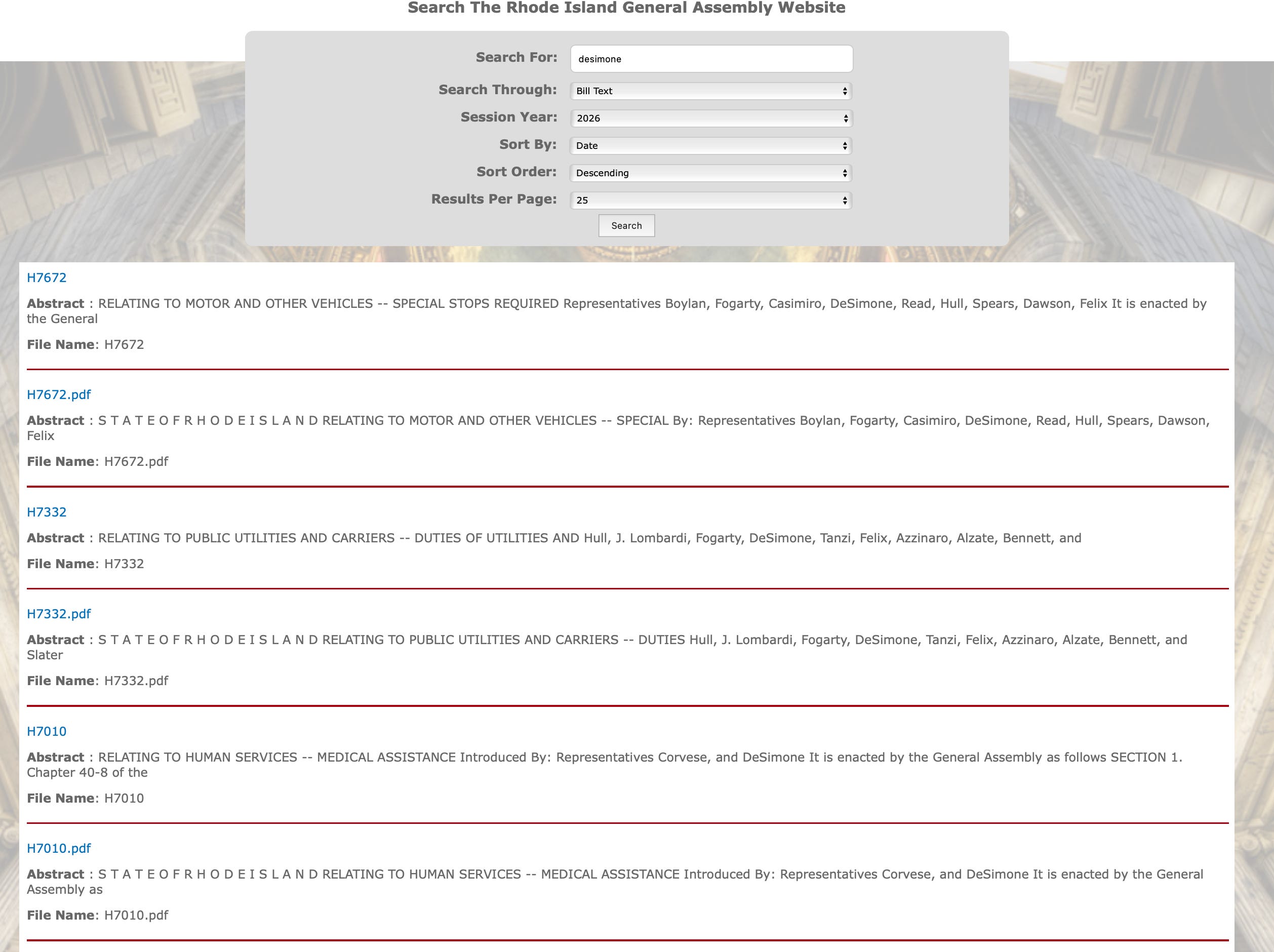
Edit: After I went to press, I was contacted by Larry Berman, Director of Communications for the Rhode Island House of Representatives. When I searched the General Assembly website, I found three bills with Representative DeSimone’s name on them, and I told Brittany Kubicek that. So the mistake was entirely mine, not hers.
Here’s the email I received from Larry Berman, presented in full:
I read your piece with Brittany Kubicek. This caught my eye about Rep. DeSimone:
Steve Ahlquist: Legislatively, this year, he’s signed onto three bills. He’s not the lead sponsor on any of them.
According to the official legislative data, he is the lead sponsor of eight bills so far this session. He is also the co-sponsor of 52 other bills.
Additionally, he will soon introduce and be the lead sponsor of a bill on student housing – he has the draft now. I will send it along to you when he officially introduces it. The bill would grant municipalities the authority, by ordinance, to require owners to obtain a license to operate a dwelling unit as student housing.
Also, just for your information, last year (2025) he introduced nine bills and four of them became law. In 2024, he introduced eight bills, and three became law. In his first year in 2023, he introduced three bills, all of which became law.
And just so you are aware, Rep. DeSimone is very active in the community. He runs a backpack drive every summer for underprivileged children in his district before the start of each school year, and helps provide gifts for children at the holidays. He also participates in the Veazie Street School winter bazaar and bicycle donations, and makes donations to the Little Leagues and other youth activities.
Here are some press releases on his successful bills:
2025:
https://www.rilegislature.gov/pressrelease/_layouts/15/ril.pressrelease.inputform/DisplayForm.aspx?List=c8baae31-3c10-431c-8dcd-9dbbe21ce3e9&ID=375858
2024:
https://www.rilegislature.gov/pressrelease/_layouts/15/ril.pressrelease.inputform/DisplayForm.aspx?List=c8baae31-3c10-431c-8dcd-9dbbe21ce3e9&ID=374732
2023:
https://www.rilegislature.gov/pressrelease/_layouts/15/ril.pressrelease.inputform/DisplayForm.aspx?List=c8baae31-3c10-431c-8dcd-9dbbe21ce3e9&ID=373831
So far this year, these are the 8 bills that he has sponsored:
House Bill No. 7300
BY DeSimone, Morales
ENTITLED, AN ACT RELATING TO ALCOHOLIC BEVERAGES -- RETAIL LICENSES (Provides that exemptions to the prohibition of liquor licenses within two hundred feet (200’) of schools or places of worship do not eliminate neighboring property owners’ remonstrance rights to object to the license.)
{LC4415/1}
01/23/2026 Introduced, referred to House Municipal Government & Housing
01/23/2026 Scheduled for hearing and/or consideration (01/27/2026)
01/27/2026 Committee recommended measure be held for further study
House Bill No. 7314
BY DeSimone, Kazarian, Potter, Voas, Cruz, Giraldo, Kislak, Solomon, McGaw, Slater
ENTITLED, AN ACT RELATING TO TAXATION -- PERSONAL INCOME TAX (Provides modifications for payments of interest on student loans shall be subtracted from federal adjusted gross income to an amount equal to the payments of interest for the satisfaction of outstanding student loans.)
{LC4416/1}
01/23/2026 Introduced, referred to House Finance
House Bill No. 7335
BY DeSimone, Fellela, Boylan, Messier, McGaw
ENTITLED, AN ACT RELATING TO BUSINESSES AND PROFESSIONS -- PSYCHOLOGISTS (Includes licensed school psychologists under the provisions of the general laws governing the regulations of psychologists and expands the licensing of school psychologists for independent practice.)
{LC4414/1}
01/28/2026 Introduced, referred to House Corporations
02/06/2026 Scheduled for hearing and/or consideration (02/11/2026)
02/11/2026 Committee recommended measure be held for further study
House Bill No. 7835
(Dept. of Business Regulation)
BY DeSimone, Baginski, Slater
ENTITLED, AN ACT RELATING TO BUSINESSES AND PROFESSIONS -- ARCHITECTS (Amends how architecture firms and individual architects are registered.)
{LC5419/1}
02/27/2026 Introduced, referred to House Corporations
House Bill No. 7840
BY DeSimone, Baginski, Slater
ENTITLED, AN ACT RELATING TO BUSINESSES AND PROFESSIONS -- REAL ESTATE BROKERS AND SALESPERSONS (Requires any person in the business of selling, assigning or buying an equitable interest in real estate without taking legal title to such property, to be licensed as a real estate broker or salesperson and to comply with the disclosure requirements.)
{LC4880/1}
02/27/2026 Introduced, referred to House Corporations
House Bill No. 7898
BY DeSimone
ENTITLED, AN ACT RELATING TO EDUCATION -- HEALTH AND SAFETY OF PUPILS (Requires the installation and use of a weapons detection system at every public entrance to any school building, gymnasium, school event facility, sporting event site and any site where a school hosts or participates in an event even if off campus.)
{LC5774/1}
02/27/2026 Introduced, referred to House Education
House Bill No. 7900
BY DeSimone, Slater, Biah
ENTITLED, AN ACT RELATING TO EDUCATION -- RESIDENCE OF CHILDREN FOR SCHOOL PURPOSES (Ensures any public school with available seats, after completion of the initial enrollment period for students, shall make all open seats available to other students residing within the same school district.)
{LC5669/1}
02/27/2026 Introduced, referred to House Education
House Bill No. 8248
BY DeSimone, Biah
ENTITLED, AN ACT RELATING TO EDUCATION -- ESTABLISHMENT OF CHARTER PUBLIC SCHOOLS (Provides educators and administrators employed in a charter public school or mayoral academy with prevailing wage and benefits oversight and recourse if found in violation of the same.)
{LC6001/1}
03/06/2026 Introduced, referred to House Labor
Total Bills: 8
I have no idea why the search function on the General Assembly website didn’t give me this information. Here’s the link to the search results:
https://billsearch.rilegislature.gov/?SearchString=desimone&SearchDirectory=%2FBilltext%2F&SessionYear=2026&Sort=Date&SortOrder=Desc&MaxRecords=25&CurrentPageIndex=0
My apologies for the error.

You really let loose on this one Steve. We got to know as much about your views as Brittany’s. But it’s a good long view of Brittany. Very little left out to the point of not even having to meet and speak with her.
Great interview Steve. Brittany is a fascinating candidate. Thanks for doing it. Enjoyed your commentary also.