
Despite widespread support, Rhode Island's Medical Aid In Dying bill may once again fail to come to a vote
"While it is too late for me to benefit... I would hope that other terminal illness sufferers in Rhode Island, who come after me, could have this option..."

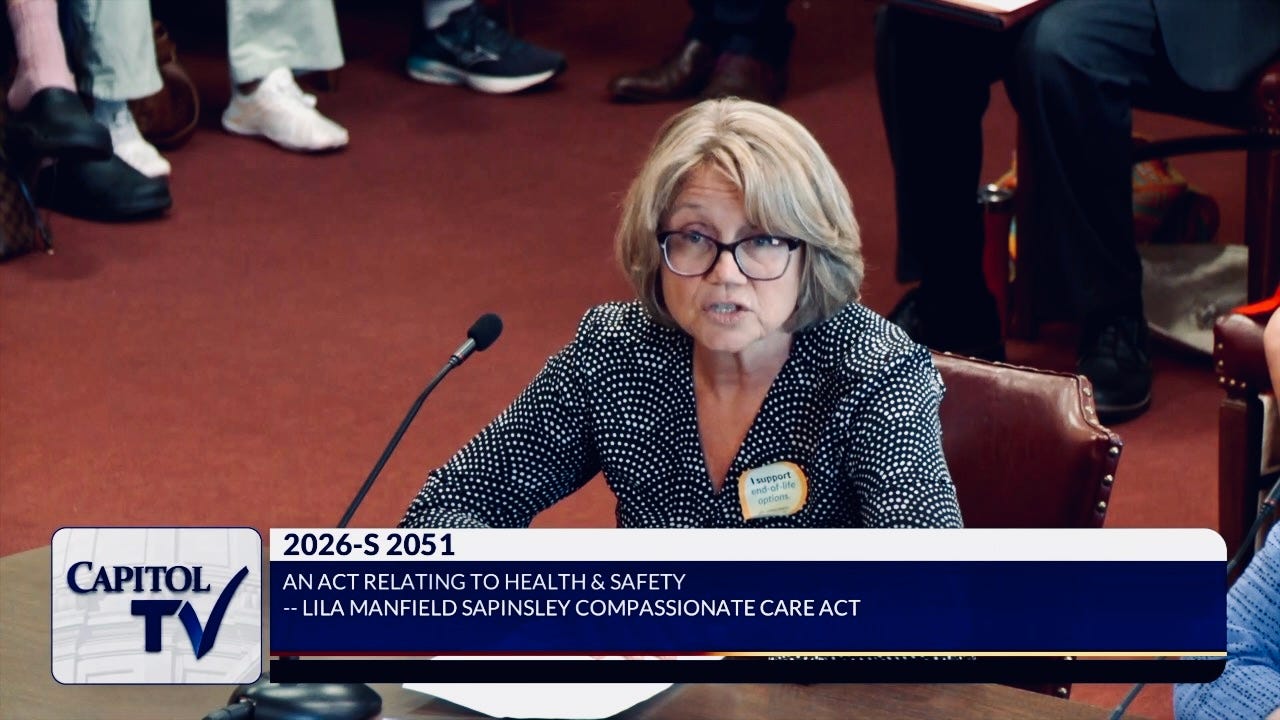
Despite some encouraging signs a few weeks ago, the Lila Manfield Sapinsly Compassionate Care Act (H7760/S2051), which would establish a process by which a terminally ill patient may choose Medical Aid In Dying (MAID) using medication prescribed by a physician, is far from certain to pass. This is a shame, because advocates, after something like 14 years of advocacy before the General Assembly, felt that they had finally made their case to a majority of lawmakers. The Act has broad, perhaps even majority, support in the General Assembly and among the public (63% of Americans and 59% of Catholic Americans support it, according to a Pew Poll). The problem is actually getting the Act to the floor of the Senate and the House for a vote.
Why? As ridiculous as it might sound, it might be because the Catholic Church opposes it, and the existence of concurrent legislation (H7200/S2616), seeking to change the statute of limitations for child sexual predators. The Catholic Church might face millions in lawsuits if the statute of limitations bill passes, and the General Assembly, some suspect, does not want to pass two bills that the church might object to.
This false dichotomy: force terminally ill people who might wish to die with dignity to suffer, or deny people raped by clergy as children the justice they deserve, is not some unavoidable trap of logic. Instead, it’s political cowardice, a failure to do what’s right because to do what’s right is hard.
Dr. Leigh Anne Hohlstein
Senate President Valerie Lawson and House Majority Leader Katherine Kazarian received the following letter from a constituent, Dr. Leigh Anne Hohlstein, a Clinical Assistant Professor at Brown University’s Warren Alpert Medical School, in late April:
“For the past 30 years,” wrote Dr. Hohlstein, “I functioned as a clinical psychologist, with a busy private practice on the East Side of Providence. Last August, I had to close my practice because I was losing my ability to speak. I have long supported Compassionate Care legislation, but I now have a personal connection to the cause. I was diagnosed with ALS in July of 2025, and I am currently facing a terrifying and painful death from this illness. I would appreciate it if you could read my story and include it in your consideration of this important legislation.”
Dr. Hohlstein continued:
“My symptoms began in the spring of 2024 and culminated in the diagnosis of ALS in July of 2025. I have a variant of ALS called Progressive Bulbar Palsy. This form of the illness first affects the nerves controlling speech and swallowing, and then eventually moves to the limbs and other parts of the body. I am extremely fortunate to have an excellent team of doctors in both Boston and Rhode Island. However, despite the full mobilization of my physicians and all their recommended medications, the disease has marched on.
“My symptoms have included a relentless cough, throat spasms that cause me to choke or gag, and a decreasing ability to swallow and control my mouth and tongue. This has led to an ever-shrinking range of foods that I can eat. At this point, I eat mostly soup and pureed food, and consequently, I’m slowly but consistently losing weight. Most difficult for me, in terms of quality of life, has been the loss of my ability to speak. Last spring, my speech was just barely slurred – most people still didn’t notice. Now my speech is unintelligible.
“Life with these ever-worsening symptoms is extremely challenging for me, but I am managing. Facing death from this illness is another story. It is terrifying.
“The most common causes of death from Progressive Bulbar Palsy are choking (saliva, as well as food, can obstruct the airway); pneumonia, caused by aspirating food or liquid; and respiratory failure. Typically, death is preceded by multiple medical crises and hospitalizations before something eventually proves to be fatal. It is hard for me to imagine enduring these crises, and impossible to imagine doing so repeatedly, without the ability to communicate.
“Knowing the likely realities of the late and end stages of my illness, it takes everything in my power to avoid succumbing to panic every day. The thought that initially brought me some comfort was the idea that Medical Aid in Dying (MAID) could be an option for me. While I know that my journey with ALS will be grueling, it was helpful for me to think that, when my pain and suffering got to be too great, I could have the option of an end to my life that was relatively peaceful. I am totally clear that I have no control over the fact that I am going to die from ALS. I just hoped that the end could be managed with a little more ease. Furthermore, I do not see the option of MAID as any form of threat to the sanctity of my life, or life in general, but instead, as an action that appreciates and respects the life that I have been given.
“Ideally, I’d like to live the rest of my life and my final days here at home in Rhode Island. I’d like to be close to my children, family, and friends, and keep my connection with my own team of doctors. Unfortunately, I can’t have the comfort of this final plan, as MAID is not currently a healthcare option in Rhode Island…
“I am now under the care of Hope/Health Hospice here in Rhode Island, and am enormously appreciative of their services. Also, I am blessed to have a truly incredible support system of loving and capable friends and family. However, none of that can change the horrible realities of the end of this illness for me. While it is too late for me to benefit from the passage of the Lila Manfield Sapinsley Compassionate Care Act, I would hope that other terminal illness sufferers in Rhode Island, who come after me, could have this option. Thank you for your consideration, and I hope that you support this very important legislation.”
“I met with Senate President Lawson on behalf of my friend Leigh Anne, and she, her chief of staff, and two of her legislative assistants very graciously spent half an hour talking with me about Medical Aid in Dying and really listened to my concerns,” said Dr. Eileen Johnson in a phone conversation with me.
Eileen told me that she is Leigh Anne’s dearest friend and healthcare proxy. At this point, her friend “can’t speak and is having significant swallowing difficulty, and that will eventually lead to breathing difficulty, which will cause her death… I have gotten really involved in this Medical Aid in Dying Act as someone who has always been an advocate, but truthfully, I am more invested now because it’s so personally meaningful to me.
“Right before I was on the phone with you,” said Eileen, “I was speaking with a doctor in Vermont because we are exploring that possibility, and I’m trying to understand how all of that works in Vermont. The doctor’s description of the process to me was so calm and peaceful that it just makes me extra mad that we can’t do it here in Rhode Island. It’s very expensive what we’re doing. The lack of Medical Aid in Dying in Rhode Island disadvantages poor people, as everything in healthcare does.”
In her written testimony to the Senate Committee, Eileen further elaborated on Vermont, writing:
“Vermont is currently doing the job that Rhode Island and other surrounding states should be doing. Vermont has allowed out-of-state residents into its program since 2023. In that time, 30% of the people who went through the program were out of state (56/190). That means 56 people left their homes to die in another state in order to access the program, which is a heartbreaking statistic…”
Eileen told me that she felt the meeting with the Senate President was very productive, which was confirmed in her mind when Senator Lawson responded to Leigh Anne’s email:
“Your message moved me more than I can express,” wrote Senator Lawson. “Thank you, from the bottom of my heart, for taking the time to reach out and share your story with us. Your words so beautifully capture the essence of this issue, and they reflect my perspective as well: that medical aid in dying is not a threat to life or its sanctity, but rather a demonstration of our appreciation and respect for the life we are given. I wholeheartedly believe that you, your loved ones, and anyone facing a similar situation should have access to this option here in Rhode Island and be able to experience as much peace and comfort as possible during such an unimaginably trying time.”
The Senate President continued:
“The Senate’s Committee on Judiciary is hearing testimony on the Lila Manfield Sapinsley Compassionate Care Act this afternoon. I have shared your email with the members of the committee, and I will be discussing the testimony they receive today with the committee’s chair, my Senate colleagues, leadership in the House of Representatives, and other stakeholders as we seek a path forward this year. As a cosponsor of this legislation, this is a priority for me, as I know it is for many other members of our chamber as well. [emphasis added]
“You and your loved ones are in my thoughts. Please know that your courage and your advocacy will help bring peace and comfort to many others.”
Certainly, Leigh Anne took great comfort in the Senate President’s words, forwarding the exchange to her friend and caregiver Eileen, saying, “I just got this lovely message from Senator Lawson.”
But a lovely message does not mean the legislation will pass. The legislation is not scheduled for a committee or floor vote this coming week, and with the end of the session just two weeks away, prospects are dimming. Communication with Senator Lawson, said Eileen, has “gone silent,” meaning that many Rhode Islanders are facing the prospect of a painful death in-state, or an expensive death in Vermont.
Religious opposition and support
The Catholic diocese claims to oppose the bill on theological grounds. Catholics consider Medical Aid in Dying to be “a rejection of God’s sovereignty and loving plan.” There is a range of religious responses to this issue, and the Catholic Church holds one view among many. Rabbi Sarah Mack, Senior Rabbi of Temple Bethel, testified that, “My community has voiced their overwhelming support of this legislation. I hear more about this bill from my congregants than any other piece of legislation, for so many have endured the anguish of watching a loved one die in pain and suffering.” Given this, one might reasonably ask why Catholic theology should be enshrined in law.
This is why, in materials distributed in Catholic church bulletins, theological arguments take a back seat to putatively secular arguments. Here’s a typical example from a Catholic church bulletin handed out two or three weeks ago:
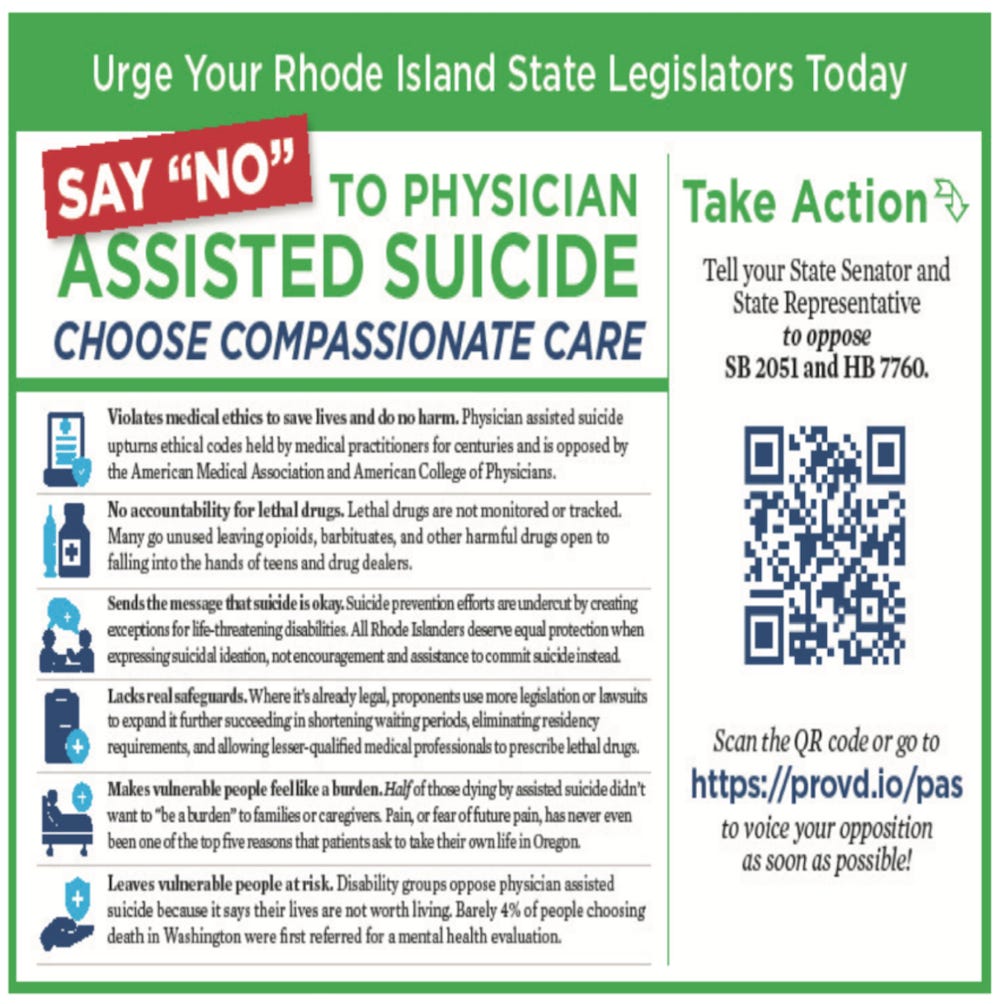
Seemingly secular, the above is full of misinformation, such as “No accountability for lethal drugs. Lethal drugs are not monitored or tracked. Many go unused, leaving opioids, barbiturates, and other harmful drugs open to falling into the hands of teens and drug dealers.”
This is fearmongering. In her written testimony, Dr. Eileen Johnson calls this out, saying, “In Vermont, there are two pharmacies that compound the medication (a process of combining several medications into one), and they deliver it directly to the patient. There is no opportunity for it to fall into the wrong hands.” In my experience, when my wife was in in-home hospice, a nurse showed up at our home almost immediately upon her death to reclaim the unused morphine and ensure that it was not misused—these ordinary and time-tested safeguards work.
Senate hearings
At the Senate Judiciary Committee meeting, Senator Meghan Kallman, who sponsored the bill, and Melissa Stacy, Regional Advocacy Director, Northeast at Compassion & Choices, a group focused on passing medical aid in dying legislation, outlined the bill’s strict eligibility requirements, safeguards, and processes, which were modeled on legislation from other states. If passed, S2051 would allow a terminally ill adult with a prognosis of six months or less to live, who was mentally capable, to request and self-administer prescribed life-ending medication.
Compelling testimony came from Michael Gates, a retired police officer who is dying from ALS, and Melissa Rigamonti, a mother with stage four colon cancer. They described the emotional toll they suffer from the loss of dignity that comes with their diseases, and their desire to protect their families from witnessing a painful decline.
“I’m asking you to pass this bill because I do not want for myself or my family a prolonged agonizing death when the outcome is already certain,” said Rigamonti. “I cannot fathom subjecting my children or my husband to what an end-of-life cancer death can look like.”
Melissa Rigamonti’s story resonated with me. My wife, Katherine, recently died from colorectal cancer. Her end, which came at home under the care of hospice, was not prolonged, but it was also, in the end, terrible. Surrounded by her children, she suffered, despite the morphine that made her vanish into unconsciousness. She was gone days before her body died.
“Patients who are dying are clear in their thinking, clearer than the rest of us can even imagine.” - Dr. Eileen Johnson
“Leigh Anne Hohlstein is my dearest friend, and I am her healthcare proxy,” said Eileen Johnson to the Senate Committee. “It’s my job to see that her wishes are followed as we navigate bulbar onset ALS. Many patients with this disease have feeding tubes and end up on ventilators to help them breathe. This is their right and, of course, their choice, but a feeding tube and artificial ventilation only prolong the inevitable and are not compatible with quality of life, so Leigh Anne will not choose these options. This leaves us with the fear of what is coming our way.
“‘Dying is hard work.’ This is the saddest thing that Leigh Anne has said to me. Well, she texted it to me because the friendliest and chattiest person on earth can no longer speak. The work of dying is made harder by Leigh Anne’s lack of control over the end of her life because she lives in the state of Rhode Island.
“I don’t want my friend to die. If there was anything in this world that I could do to make that not happen, I would do it. I don’t want any of this. I don’t want to spend my days thinking about the end of her life, and I don’t want to spend my time trying to figure out how to make you all understand how important this issue is. But this is what I’ve got, and this is what I’m doing. I’m committed to making the end of Leigh Anne’s life as easy as possible, but this is quite difficult. Her only option at this point is to engage in voluntary stopping of eating and drinking. This is where patients who are capable of eating or drinking elect not to so that they can hasten death. My guess is that Mike Gates is also in this same position. It’s horrifying to me to think that Leigh Anne and Mike would need to resort to this option, depriving themselves of food and drink and suffering so that they have some control over their lives.
“How can anyone make the case that that’s a better option than medical aid in dying? I will close by telling you that I’m a hospice volunteer. Every week, my dog and I sit by the bedside of dying patients, offering them comfort and care. Patients who are dying are clear in their thinking, clearer than the rest of us can even imagine.”
Conclusion
Leigh Anne Hohlstein lives in East Providence. Her Senator, Valerie Lawson, is the Senate President. Her Representative, Katherine Kazarian, is the House Majority Leader. They are easily the two most powerful women in the General Assembly, and Leigh Anne is their constituent, asking, as she dies, that they help to pass legislation, popular with the public, that will benefit people suffering - literally suffering - from incurable, terminal diseases.
Will they step up?
thanks Steve for posting this, it is not an easy topic.
I'm 86, and though in decent health, this is not ideological but a very real issue for me and my wife. We've lived long enough to hear of numerous end of life horrors, one of which is one of my aunts jumping out of a senior high rise when suffering from cancer and no hope. It results in fear of dying being worse than fear of death.
I know that it is unlikely we would ever actually use medical aid in dying, but it would be comforting even now to know it exists. I feel lucky to live in RI, not least because of the relative tolerance and decency of so many Catholics here, but I do wish the leading Catholic clergy were more respectful of other religious viewpoints on this - they need not use medical aid in dying, they are free to advise others not to do so, but they should not use their power to in effect prolong the suffering of those with do not have their religious views,
I wanted to testify on this bill, but the timing of a cancer treatment prevented that. I have a very rich life. My days with my wife are a daily treasure. I love my trans son and want to be here right at his side fighting all the bigotry, hatred and violence directed at these good folks who just want to left alone to be themselves. I love my Black son, and want to be at his side as all the rights that people bled and died for are being erased in The Great Racist Revival that is Trump and MAGA. I have wonderful friends, nearby and at distance, some I've known for multi-decades, some I've found this year. I have a good life. When I become terminal, would I choose to end my life? I really don't know. BUT I WOULD WANT TO HAVE THE CHOICE, and that's what this bill is about.
If it doesn't pass this year, I will testify next year.