

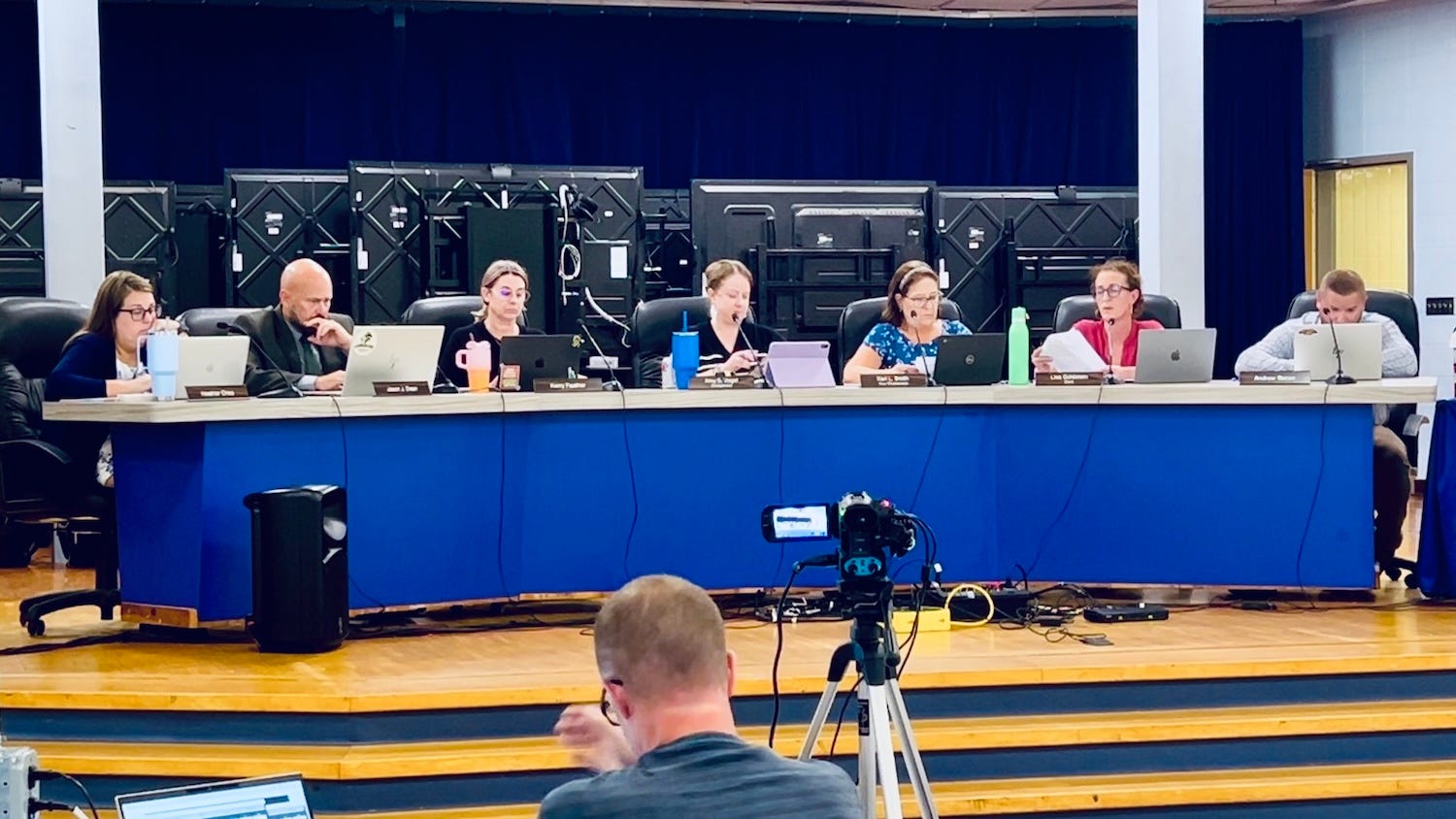
Last Tuesday, the Cumberland School Committee’s Policy Subcommittee failed to pass proposed changes to the Cumberland School District’s A-7 Transgender & Nonbinary Policy. Based on their lawyer’s reading of the U.S. Supreme Court decision Mirabelli v. Bonta, the subcommittee considered revising the policy to mandate that the school system report children who identify as transgender to their parents (as long as the child is determined to be in no danger from the parent in the event of disclosure) and that parents can force teachers to misgender students who use names or pronouns the parents object to. [See: Cumberland advances policy mandating school personnel to out transgender students to parents]
Unable to pass the policy out of the subcommittee, the proposed changes came before the full Cumberland School Committee two days later. This is how Thursday evening’s discussion on proposed changes to the Cumberland School District’s A-7 Transgender & Nonbinary Policy ended:
Committeemember Lisa Goldstein: On Tuesday night, there was a robust conversation and public commentary. I want to thank my colleagues for a respectful and thought-provoking discussion, to School Committee Attorney Stephen Adams for taking many questions and challenges to his legal advice, and to our public commenters that night and tonight, who spoke from lived experience and legal advocacy.
To give a little background, the policy came up for review in the subcommittee due to the Supreme Court’s decision in Mirabelli v. Bonta, which addressed the parental right to be informed of their child’s gender-related social transition, and the question of whether our policy complied with the law.
There was extensive discussion about the binding nature of the Supreme Court decision. Is the law settled? The question of the relevance of the Foote versus Ludlow decision in the First Circuit Court of Appeals, which ruled in favor of the school committee and its policies. And then the April 2026 U.S. Supreme Court decision not to hear the parents’ appeal. In the end, the subcommittee recognized we were at an impasse. Any actions we attempted failed, and we discussed that this would come before.
Over the past 48 hours, I’ve conducted extensive research in response to questions and discussions in the policy subcommittee. We read Mirabelli, the Foote case, and the Supreme Court decision denying a hearing on the Foote appeal, and I am left confused about the law’s clarity. For our policies to be in harmony with the law, there needs to be clarity, in my view. And when clarity is lacking, it is incumbent upon me to protect our most vulnerable students. Therefore, I move to reject the amendments in policy A7.
Chair Amy Vogel: Ms. Goldstein moves to reject changes to the A7 transgender and non-binary policy. Seconded by Ms. Feather. Discussion?
Committeemember Kerry Feather: I want to thank everybody for coming out tonight. I appreciate it.
This has been weighing on me. I said a few things the other night, and I want to expand upon them now that this is up. When this originally came up, we worked with our attorneys to put in place as many safeguards as possible. But we heard from everybody that no safeguard is enough and that these policy changes could be harmful.
I’m not convinced we’re out of compliance. We’ve heard from several attorneys, and with all due respect to ours, who is fantastic, I agree with Attorney Wood and others who have come to different conclusions. I asked the question the other night: What happens if we do nothing? It turns out that doing nothing puts us in the same position as doing something. We could be sued either way. What then is the harm in changing it?
There’s a lot of harm. We heard that tonight. We’ve had a strong policy in place for years. We’ve protected students as they discover who they are. If we change this policy, we’re no longer protecting those students. Someone said they couldn’t imagine parents not allowing their son or daughter to go by a different name or pronoun. We’ve heard them tonight. Where does that leave the student mentally? Not in a good place. I know nothing I say is going to change the minds of folks who have already made their decision, but I’m hopeful that everyone who might someday have a family member who needs protections like those Cumberland affords carefully thinks about their own.
Vice Chair Keri Smith: Our job on the school committee is not an easy one. When you look at the laws in Rhode Island and what they require of us, our core legal duties include setting educational policies, ensuring compliance with state and federal laws, and overseeing the district’s budget. I took that very seriously, and I still do. The information that we had when we came into the meeting the other evening was on Mirabelli. The changes had been discussed since March, had undergone many edits and rounds of review, and were being refined to arrive at the best solution that we believed complied with the law.
And our attorney did speak to that the other day. I’m not saying our attorney is wrong. I’m not saying our attorney is right. He was very clear about what he saw as an attorney and shared that information with us. And that’s what we took forward and discussed.
Attorney Jennifer Wood, thank you. You brought forward information we did not have, and our attorney agreed. We have spent the last 48 hours reading through the Foote v. Ludlow School Committee case and trying to understand it. And now we have the Littlejohn v. School Board of Leon County case as well.
My asking for these changes to go forward the other evening was based on the information we had and on what we felt was a solid case for following the Supreme Court’s guidance. If there are questions about that now, it is our duty to go back, look at them, consider them, and make sure we are doing the right thing.
Personal beliefs shouldn’t come into what we’re doing. We all have moral obligations to ourselves. We understand that. I don’t think one member is sitting on this board who is against the trans population, doesn’t want your protections, and doesn’t want to see you thrive. I won’t speak for everyone, but I know that I have multiple friends - regardless of what you think of me, Phoenix, I shook your hand when we all spoke, and I meant it when I said good luck in your election. I did not do that to mock somebody. I would never do that. That’s not who I am.
I recently attended the engagement of two trans friends, and it was a fabulous night. That’s my personal life. What I would do in my personal life might differ from some of my friends’, but it doesn’t stop us from working and being part of the same community and supporting each other, regardless of our beliefs.
I look at this and say, “I want to follow the law; I want to do what’s right, because that’s my duty under the Rhode Island General Law regarding school committee members.” My goal has been to follow that. Now that our own attorney has said, “I’ve spent 48 hours reading through things as well, and now we’re not as clear.” I have to consider that in how I approach this.
I’m not saying this won’t be changed. We all have to look at the laws. Now we have to look at this other new case, the Leon County case, and perhaps this is premature, but before we get the answers in such a short window of time, between Tuesday and now, have all this information presented to us, have our research done, and have our lawyer go back and do more work for us. I’m not for or against the policy at this point. I was for it the other day based on the legal information we had. We have to take a step back and wait another month before we look through this to see exactly what needs to happen.
Committeemember Jason Dean: I have two young boys, and I couldn’t imagine looking at them and thinking that I would ever not accept who they are. I’ve told them numerous times that no matter what you are, who you are, we’ll love you. I’ve forever been an ally of the communities, and I’m old. So I remember when it was, “Don’t ask, don’t tell.” That’s when I joined the military. People would ask me what I thought about that. I said, “I don’t care.”
Gay marriage, I don’t care. Trans, I don’t care. Let people be who they are. Let people transition. And although I love my kids more than anything in the world, I am not naive enough to think that everybody does, that everybody will accept their child for exactly who they are. I’m not just talking about whether they’re transgender. There are a lot of biases out there, but transgender is definitely one of them that I could see being an issue for a lot of people, whether it be based on religion or their lifestyle.
But at the same time, I spent 28 years in government, and I do not trust it. Like a lot of you people here said tonight, you do not trust the government. The schools are the government. You do not want the schools telling you how to raise your kids or keeping secrets from you about your kids. If it happened to you with your kids, I would be the first one to get between you and them and say, “That’s not right.”If somebody tried to tell the trans community how to raise their children, I would be the first one to say, “Stop that.”
I’m not willing to abandon parental rights. I know that’s not a popular opinion here, and I know it comes with a lot of anger. We had a lot of good heartfelt stories tonight, but also a lot of people who were angry about this, and I can understand that. One of the speakers said that a transgender child in an affirming household has suicide attempt levels below those of cisgender children. That is the goal. Is it going to happen in every case?
If a transgender person has suicidal ideation in high school, does the school tell the parents?
Phoenix: They have to report suicide. All you’re doing is taking people out of the closet, giving them no other opportunity to discuss it.
Committeemember Jason Dean: What I’m saying is that I am not willing to abandon parental rights to the government. That’s my opinion.
Chair Amy Vogel: Thank you all for coming. Thank you for being brave, coming to the podium, and telling your story. Listening to your stories has shown me so much that everyone needs to hear. I agree that this policy should not be amended. I don’t think we should look at it in a month. We should let the courts do what the courts do, and we’ll figure it out once it’s all settled. I don’t see any rush to do anything. And again, I thank you all for being here. Anyone else?
Okay. I am going to do a roll call vote for this. So, we’ve never done Emotion, where it’s rejecting the amendment, so I want to make sure I have this better.
The policy changes failed on a 5-2 vote, with committeemembers Jason Dean and Andrew Bacon voting no.
Ahead of the vote, dozens of people filled the cafeteria at Cumberland High School to oppose the proposed changes. A handful of people showed up in favor of the changes. Many of them spoke, and all but one spoke in opposition. The stories told were raw and real. Here’s the video. I have transcribed them, edited for clarity:
Cameron: I grew up in Cumberland. I was on the robotics team at Cumberland Hill Elementary, played saxophone in the jazz band at North Cumberland Middle School, and was a proud linebacker of the Cumberland Colts. I’m also a transgender man. I’m here to tell you a hard truth that none of these Cumberland parents ever wants to hear from their child.
I chose not to attend Cumberland High School for my own safety. Instead, I attended Beacon Charter High School, where I founded the Gay Straight Alliance and was voted prom king my senior year. There is power in a school system that creates space for its students to learn and thrive, while also embracing and creating differences. The community I found at Beacon Charter is why I’m still alive to speak to you today. It is also why I’m proud to serve as a member of their board of directors, so that I can put students’ safety first, unlike committee member Smith, who earlier this week voted to change to A7.
According to the National Institutes of Health, 82% of transgender individuals have considered ending their lives, and 40% have attempted. I’m going to repeat that. 82% of transgender individuals have considered ending their lives, and 40% have attempted.
When deciding... I’m so sorry. One more thing I’d like to say. Suicidality is the highest among trans youth, and acceptance in school and home significantly lowers these risks. When deciding policy changes, I urge you to ask yourself, “Am I putting our students first? If not, who am I prioritizing?”It is disappointing that anyone on a school committee, this school committee specifically, is more concerned with losing funds to a hypothetical lawsuit than the physical and emotional well-being of your very real students.
How can anyone here know whether a student will be safe at home after being outed? Trans youth already face higher rates of homelessness and violence, and this policy will only worsen outcomes for this already very vulnerable group.
While we’re discussing hypothetical lawsuits, shouldn’t you be worried about the cost of a failure-to-protect negligence suit if one of your students is harmed after being outed under this policy? Teachers, you have the opportunity to save lives simply by respecting their right to exist. I’m sorry that your school board is asking you to out and misgender your students, which, I can tell you from personal experience, leads to increased suicidal ideation.
Students, you are the change. Do not accept wrongdoing because the authorities say you should. Support and protect your trans peers. Organize and participate in meaningful acts of protest. Become the people you admire from your history books. Trans joy is a beautiful form of protest. It’s not our fault that our identities have been politicized. We must be kind to ourselves and each other. Look into Youth Pride Rhode Island, TGI Network, and the Trevor Project if you need support and your school system is not providing it.
I reject the advice of Steven Adams from earlier this week. Massachusetts public schools are doing right by their students. It’s no secret that their public school system vastly outpaces Rhode Island’s, including in teacher salaries. The most productive learning environment is a safe one. The best teachers are those who provide safe spaces for their students. By pushing policies that harm students and hinder your ability to teach, you’re actively driving away our most dedicated teachers. When people reflect on past human rights movements, they like to think they’ve been on the right side of history.
Now is your chance to prove it. This is the human rights issue of our lifetime. Listen to transgender voices. Committee members, will you be voting no on the proposed changes to A7, or are you willing to have students’ blood on your hands? I’ll leave you with this quote from Leo Tolstoy.
“There’s only one important time. Now.” The only important time is now because it is the only time that we have any power.
Kristen: I’m a resident of Cranston, Rhode Island. I’m a co-founder of Little Rhody Visibility Brigade, and I’m a proud graduate of Cumberland High School, class of 1992. I’m a veteran of the United States Army, a retired fellow employee, and a mother who raised a child in Rhode Island. I am also a proud member of the LGBTQ+ community here in Rhode Island.
I was completely horrified when I learned about this meeting today and the plan to put trans children in danger with this hideous proposed policy change, so I’m here to lend my voice to many others in speaking out to protect trans children in the Cumberland School District and Little Rhody.
We should all agree that, as community members, we have a responsibility to protect the children who live here. They should feel protected in their homes, schools, and throughout their communities. But we know, unfortunately, that some kids don’t feel safe in one or more of these spaces. We have some systems in place to protect them, but they don’t protect many children. We know they are imperfect and sometimes fail, but we collectively strive for improvement. But these changes are the opposite of that.
This is placing a requirement in the system that puts children at risk of harm. If a child doesn’t feel safe sharing something at home, it’s most likely for a very good reason. Moms for Liberty doesn’t care about the safety of trans children. They don’t care about science or research that defies their nonsensical beliefs. What they care about is pushing an agenda across the country that promotes disinformation and division, and puts children at risk and in harm’s way. They are an extension of a fascist regime that seeks to control what we do with our bodies and to limit our freedom of expression. They hide behind a facade of protection when what they actually seek is control. After all, people who truly want to protect children surely wouldn’t support an adjudicated rapist and accused pedophile as president, right?
We should be supporting and protecting students full stop. I am tremendously and forever grateful for the walls that CHS provided to protect me, and I hope it continues to protect its students. That the hatred and fear these proposed amendments will bring are rejected, and we accept love and understanding, because that’s what we need right now.
Rowan Hayes: I’m here tonight with The Womxn’s Project, even though I wear a few hats these days. I’m an environmental engineer 24 hours a week, which is currently my only paid role. The rest of my time goes to co-leading Indivisible Metro Rhode Island and managing social media for Metro Indivisible Rhode Island and No Kings Rhode Island, as well as volunteering with The Womxn’s Project and Planned Parenthood Rhode Island. I mention all of that not to pad my introduction, but because a vast majority of it is unpaid, and I’m here anyway, on a Thursday night, in Cumberland, after all of that, because this matters enough to show up for...
I want to tell you I’m angry, but honestly, angry isn’t the word I have left in me right now.
I’m tired, I’m devastated, and I’m scared. This week alone, ICE murdered four people, and we’re still talking about this today. We couldn’t even protest outside because the smoke from yesterday’s wildfires was too bad, so last night’s action demanding justice got postponed.
Tonight, I’d typically be down at District Park. Instead, I’m here in this auditorium asking a school committee not to force children out of the closet to their parents. That’s where we are. That’s the bar. That’s what a Rhode Island Thursday in July 2026 looks like. This committee already had this conversation on Tuesday at the subcommittee level. You heard from the clergy. You heard from the Rhode Island Center for Justice, which is asking for a thoughtful pause. You heard from parents and students about what happens when a kid’s safety is weighed against a legal risk memo written by attorneys who, by their own admission at that meeting, are reading the Supreme Court’s tea leaves.
This act is a shadow docket opinion. No full briefing, no oral argument, three justices dissented, one of them writing that the emergency docket should not overrule or revise existing law, and you are treating it like settled law that requires rewriting a policy that has protected kids in this district for a decade.
A policy where, by your own committee’s account, there were zero documented cases of a parent being kept in the dark against a student’s wishes. I don’t have the energy to re-explain, again, why outing a child to a parent who might hurt them is dangerous. It should go without saying. People are more exhausted than I said on Tuesday, and it didn’t stop you from advancing this to a full vote. So I’m going to ask you plainly, look at what is happening in this country right now, and ask yourselves if this is the thing you want your name attached to at the time. Thanks.
Kimberly Nichols: I’m a mother of two, both of whom attend Cumberland schools. If the school had to report to me that my child was going by they/them before they were ready, it would not have been good. I love both my sons, and one of them is trans.
If they did not have the support of the school and the counselors to help students feel comfortable with themselves, and they were unable to talk with them without being outed until they were ready, it would have eroded the trust that students have in the staff. And don’t tell me it’s going to be a designated person because teachers have to teach. What is this designated person asking?
I’m here to urge you to reject the proposed changes to the policy. policy active and let our students keep their dignity, and privacy choice in place.
School is supposed to be a safe place. What isn’t safe? Outing a child to their family destroys trust in the teacher, and they might only have that teacher. Students are exploring, learning, growing; they have enough to deal with as it is. In your proposal, you say you will only do this if it’s not dangerous. What do you consider, and how will you determine, what is dangerous? Will the students suffer physical abuse, alienation, verbal abuse, or get kicked out of their homes? What do you consider an acceptable loss?
We need to protect children, and sometimes families are not a safe space for transgender or non-binary children. We’ve already heard about the increased suicide rate, and if you don’t have a safe space, that goes up exponentially, by 70% in scientific studies. Is that acceptable to you? I would rather have the school district face some lawsuit about not telling the parents than lose a child.
I know my teachers, for a fact, do not have the time to indoctrinate somebody into feeling a certain way. They are trying to teach, and if they can be caring and compassionate, respectful, which is part of our school’s motto, “respectful, responsible, and ready to learn,” then why can’t we keep the dignity of these children and their privacy intact? Being transgender affects no one. It is literally an identity. It doesn’t affect their heart. It doesn’t affect their mind.
It is not a mental illness.
Speaker: I am here to share my opinion on this and hope you all take it into account when voting on this policy. When I first saw this policy, it made me think of all my friends. Transgender, non-binary, genderqueer. It made me realize how much danger and terror some of them would be in. I have a question for you all today: Would you put parental rights over a child’s safety? I do understand the point of wanting parents to be informed about their children, but all persons, including students, have the right to keep their transgender status or non-binary representation at school private, according to the current policy. Approving the policy change is not helping anyone in this situation.
Being a transgender individual is already extremely difficult. We, as a community, experience transphobia daily. Almost every transgender person, no matter their gender, has experienced transphobia in school, including me. Transphobia goes further than a mean comment or an insult. It can be extreme. It can get to the point of abuse. You see parents online stating that they beat their child if they dared to pick up a Barbie doll or wear a suit instead of a dress. There is no way to ensure the safety of a transgender child at home when parents are unsupported.
Saying you ensure safety is a lie. Policy can and will make it easier for abuse to go on behind closed doors.
I was extremely lucky to have parents and a family who accepted me for who I am. But not every person has that. When transgender youth suicide rates are already extremely high, this policy can and will make them higher. Most transgender kids already don’t trust authority because we were taught they are not our friends. This policy only proves to them that they should hide their identity because it is such a big deal to be trans.
Being transgender is as normal as being left-handed. It’s a fact of life. Although I am young, I hope you can look past that and take my input seriously. You should know what it’s like to be young and not listened to. Please understand the effect this would have on many students and families. Please protect our transgender friends and family. Please.
Tessa: I currently attend CHS and am part of the Diversity Coalition there. I found a supportive and caring community there, and many other students can say the same. I have a very supportive household, and I’m very grateful for that. However, not everyone has that. Many of my friends at the Diversity Coalition have told stories about how their parents would quite literally disown them or cut them off from communication with their friends or peers if they found out they were trans.
For them, school is a safe place to express themselves and explore their identities without fear of facing a more toxic environment back home. The revised policy does not allow that to happen. It does not matter whether the parents show support for the community; if the student feels comfortable coming out to their parents, that is their choice. Those of you who feel it’s okay to choose a student who does not affect their education: It’s not okay. Queer students should feel safe at school and be able to focus on their education without a bigoted system trying to make decisions for them. Even if it is found that the student’s home is supportive, it does not mean they should be outed to their guardians.
There is no harm being done if the parents are not told. As I’ve stated numerous times, our schools have such a supportive community where queer students can be themselves. The students should have a choice about whether and when they want to come out to their guardians. That kind of conversation can determine a person’s relationship with their family for the rest of their life.
The revision of policy A7 kills any support queer students have in school. Coming out as trans or non-binary to a staff member should continue to be considered confidential as it has been. If a student comes out to a staff member, they should be asked whether they’re comfortable coming out to their guardians or if their guardians already know. Even if the student is comfortable, it should be on their own terms.
I understand that it is a law meant to be followed, but it will only do more harm than good. It’s going to eradicate any trust that queer students have in their schools and staff members. Know that your choice could either ruin queer students’ lives or build trust in the school support system that we have.
Bill Kluth: I live in Johnston. I’m a retired Methodist minister, but more importantly, I’m the father of a transgender son. My son Leo was born in 1986. In the 80s, 90s, and 2000s, there was no cultural context for him to be open to anybody, including his mother and me. I can’t describe to you, once he came out to me in 2012, the level of physical stress, emotional anguish, and spiritual despair he went through for decades because he had nowhere to go with the truth of his life. I can share with you that his transition has been the making of him as a human being. We could not be more proud of him for the struggle that he has gone through and the humanity and compassion with which he now addresses the world around him, a world that all too often puts a target on his back, tells him that he is unworthy of love, and all too often, through vile bigotry, that he should not even exist as a human being.
This policy is a mistake. These amendments are a mistake.
Trust me, you will be exposing young people to family rejection, physical violence, emotional upheaval, and the lack of trust, as others have spoken about this evening, in ways that will harm them for the entirety of their lives. Understand this: Despite what you have heard from the most virulent, bigoted people on this subject, not a single trans person does this for a lark. Not a single trans person undergoes the emotional trauma, physical transition, and insecurity about what peers will think of them if they’re honest with themselves.
Nobody does that for fun. They do it because they have no choice. They do it because they’ve known who they are their entire lives. Their ability to find someone they can be open and honest with and find support from in situations where family may throw them out is so important. Leo would tell you that more than half of the people in the support groups he’s part of have been disowned and rejected by their families.
Reverend Heather Bales Baker: My pronouns are she, her. I serve as the pastor at Arnold Mills United Methodist Church and am the parent of two Cumberland students. As a pastor and a parent, I believe that every person is worthy of dignity, compassion, and respect. I want every child in Cumberland to know that when they are at their most vulnerable, the adults entrusted with their care, including each of you, will be courageous enough to protect them. Tonight, I ask again, please reject the proposed changes and leave the current policy affecting students who identify as transgender or non-binary as it is. Every day, students place an extraordinary amount of trust in adults.
They trust teachers, counselors, coaches, and school staff to help them learn, keep them safe, and treat them with dignity. For many, trust begins with knowing that they will be seen for who they are. I know that most parents love their children deeply, if imperfectly. I also know not every young person feels safe sharing every part of themselves at home. For some students, school may be the first place where they feel accepted enough to begin exploring who they are. Our current policy recognizes that and protects students by allowing caring professionals to use their wisdom and judgment rather than requiring a uniform response.
Please don’t weaken those protections. Please don’t replace professional judgment with mandatory disclosure, and please don’t ask our most vulnerable students to bear the cost of your decision.
Our students deserve to decide who they will share their full selves with and to have the time and space to make that decision for themselves. The current policy provides a thoughtful framework that balances student well-being, family relationships, and professional judgment. The proposed changes do not solve a problem. They create new risks for students who are already vulnerable. More than once, you as a committee have hesitated before making these changes, acknowledging that our current policy has served our students well. You have voiced your concerns about these changes, even saying that they could harm some students.
Trust your instincts. If you believe these changes could harm any student, then you have the authority and the responsibility to say no to the changes.
The question is, do you have the courage?
Please reject the proposed changes, leave the current policy as it is, and preserve the protections currently afforded to our transgender and non-binary students. Members of this community clearly stand with you in protecting the students entrusted to your care. May every student know that Cumberland remains a place where they can learn, grow, and be who they are.
Eleanor Baker: I’m here, yet again, to advocate for those who will be put in danger because of these proposed changes to policy A7. During the most recent meeting, we were reassured that the trusted adults would have the appropriate training to decide whether outing a student to their parents would be detrimental. That raised a few questions in my mind:
Where is the line? What about students who have loving and supportive parents, except in relation to a trans identity? What about the students who don’t want to leave their parents and have accepted the need to hide their identities in exchange for a safe place to stay? What about the students who don’t feel comfortable sharing intimate details with a counselor or teacher about their home life but still experience the threat of transphobia? Are these students to be denied any opportunity to be themselves, both inside and outside their homes? How are we supposed to trust the judgment of these adults when they are not living in these students’ homes, experiencing what they do every day? How are we supposed to trust the judgment of these adults when there are so many cases of bullying and abuse already happening in these schools that are still being ignored?
In a world where trans people are ostracized, harassed, bullied, assaulted, criminalized, and even murdered simply for being who they are, do you truly believe that a potential lawsuit is the worst outcome? I should hope your answer is no. Please do better. Vote no.
Joel: My wife couldn’t be here this evening, but we both feel very strongly about this, and she asked me to read something. She writes:
“I’m submitting my testimony, asking the committee not to approve the changes to the A7 transgender and non-binary reporting. This change would cause significant harm to the students of the Cumberland school system. My husband’s reading this for me, as both of us need to vocalize our views, but one of us needs to be home with our child, who is a student in the Cumberland School District. It is also important to me that, given this is a very emotionally charged issue, the facts are presented in a way that allows me to protect my mental health and clearly state my position.
“I’m approaching this from the perspective of someone with the following credentials: a bachelor’s in health sciences; postgraduate studies in special education, safe sport, and mandatory reporting; a national representative and committee member; and membership in multiple national nonprofit organizations that provide education and support for all ages.
“I’ll give some basic facts, breaking them down into terms that may be more understandable for why indifference to the issue is harmful. Gender dysphoria is not a mental disorder. This is documented in both the American Psychiatric Association’s DSM-5 and the World Health Organization’s ICD-11. Youth with gender dysphoria have higher incidences of mental health conditions, whether it be anxiety and depression, aggravation, or a history of self-harm and suicidality. Scientifically speaking, only as the onset of puberty continues to lower both AFAE and ANAE populations, will hormonal changes that can assist humans in solidifying their identity be recognized more frequently in primary and secondary school-age individuals.
“Students will look for trust, safety, respect, and acceptance. These safe spaces are often not at home, which is why we see individuals turning to educators, coaches, and other adults with whom they feel safe. Releasing information to their parents without the consent of the individuals can result in abuse, violence, bullying, an increase in mental distress, running away, and ultimately suicide attempts. According to The Trevor Project https://www.thetrevorproject.org/, almost 40% of transgender and non-binary youth who came out before age 13 experienced physical threat or harm, and a corresponding increase in suicide risk could have occurred without support.”
Speaking for myself, I don’t know how you can look at students who have been brave enough to come up here and say what they need, and then vote to change what they need when they’ve told you very clearly what that is. That’s wrong. There’s a difference between legal and illegal and right and wrong, and you have to do what’s right. That’s our history.
One of the best parts of our country’s history is doing what’s right, regardless of the consequences. And changing this policy is wrong. The one we have is the one we need.
Sayed: I’m here today because I have professional, academic, and personal connections to this potential policy change. I’m a resident of Cumberland. I have a child who’s been in the school system. I’m a decade-long educator in Rhode Island and ran the GSA (Gender and Sexuality Alliance) at my school for 10 years. I’m also a PhD in education student at URI, and my dissertation research is focused on trans youth joy, and more specifically, how schools can best support transgender and gender nonconforming students and foster spaces of joy for those students. I’m also a transgender man myself, and when I was 16 and outed as queer, I was abused and kicked out of my home.
The culmination of all these experiences is what brings me here today: to speak out against teachers being forced to out their students to students’ families. The other side of this argument says that parents should have all the information about their child. From a parent’s perspective, this brings up some strong feelings for me. I firmly believe that my children have a right to explore who they are outside of my gates. That’s called growing up. And I respect my kids’ right to privacy. I’m not the conductor of their identities. It makes me wonder whether this is an argument for parental rights or an argument for parental control over their kids’ identities.
The argument ignores some very real safety concerns. I want to prioritize sharing a piece of my dissertation findings with you all: every single one of the trans youth I interviewed named a school or a space in their school as not just safe and joyous, but potentially lifesaving. The vast majority of the youth I interviewed spoke about the relief of being able to be themselves in an environment that did not compromise their safety. Every trans youth I interviewed spoke about adults in their school who accepted them for who they were and provided a space of refuge.
These relationships enabled these students to survive and thrive in school environments. These relationships would not be possible if forced outings were written into a policy. A vote for a policy change here is a vote to take away these safe spaces. I would not want my name on record as voting to remove potentially lifesaving processes that protect where you live. Especially after they spent their Thursday night being brave enough to come up here and advocate for themselves. Which students showed up today? The ones that have the most to lose. I do not see any students advocating for this policy change. You can decide whether to ignore their words, but I would listen.
Paul Pasaba: I live in Woonsocket. I’m a Rhode Island educator teaching math and serving as coordinator of my school’s Gender and Sexuality Alliance, or GSA. I’m here today because I want to stand up for the rights of transgender and gender diverse youth. I’m not from your district, as I teach in Pawtucket. However, I am concerned about the potential change to your district’s policy regarding trans and non-binary students. As partners in a same-sex relationship, my fiancé and I have a code word that we use when we want to subtly signal to each other that we’re in a situation where we might be exposed to homophobic danger.
That’s the reality of living as an LGBTQ+ person in the U.S. Actively thinking about how, when, and where it is safe to be out, and how, when, and where it isn’t. Saying that you have to be 18 before you can make these kinds of judgments is unrealistic, a denial of what it means to grow up as a queer young person.
As a high school GSA leader, I see it as a responsibility to help students engage in these questions and figure out their own path forward. It is profoundly beautiful when a young person can be fully themselves with their parents, family, or anyone else in their lives. I encourage them to do this, but I also encourage them first to conduct an honest assessment of their safety and well-being. There’s a reason that the queer community has developed the concept of chosen family. It’s because we know that the people who will truly accept us are not always the ones connected to us by blood and circumstance.
I’ve witnessed students joyfully approaching parents, siblings, grandparents, aunts, uncles, cousins, et cetera. I’ve also been there to listen and accept it when they tell me it’s not the right time to approach certain family members. LGBTQ+ people have to develop self-preservation skills, and I know that high school students can do so.
For students who are younger than high school age, I’m honestly sympathetic to parents’ desire to be as engaged in their children’s lives as possible. However, universally mandating that educators exclude gender-diverse kids is not the answer. It will lead to abuse, self-harm, and worse. Forcing teachers to misgender students at parents’ request adds even more of a hateful and harmful edge to this already bad policy. The anti-trans laws and policies that have been gaining traction in the 2020s are built on the insulting subtext that being transgender is not so much an authentic human experience, but rather a fad, a farce, a sin, or an abomination.
These laws ignore both the individual experiences of real trans people and the scientific research that is beginning to describe the complicated interaction of biology, personal identity, and social communication that makes up what we know of as gender.
Within my community, for every positive and celebratory coming out story, there is another story of a young person being rejected, abused, kicked out of their home, or sent to abusive conversion therapy. Please reject this transphobic policy change.
Tony Ashton: I am a Pawtucket resident here to talk about the proposal to out trans kids to their parents. As I look at this audience, I see a lot of trans people, and as I look at the [school committee] - not to say that it’s looking a little cis - but, I don’t think any trans people were in the room when this policy change was proposed. I don’t think any trans people, not to make an assumption, are the ones to make this change.
This is the only time we get to use our voices, so, as someone else said, “Here I am on a Thursday evening.”I would rather be anywhere else, but we need to make sure that we are taking care of our own, and especially our trans kids.
This has never been about making sure that cis kids become trans kids. It’s about making sure that trans kids don’t become beaten kids, hurt kids, and dead kids. AI understands this feeling. I wish that everyone had a good home and that we could tell the parents. But as we heard tonight, not everyone has that. And we all know it.
I implore you to listen to trans people, because trans people were not making this decision. If you ask a trans person, across the board, we would tell you that this is horrifyingly terrible. Please listen to trans people as we all will speak tonight, and I know that it takes up a lot of time. We weren’t there to write it, and our voices need to be heard specifically on trans issues.
Leona: I went to school in Cumberland my entire life. I’m not trans or non-binary myself, but I’ve met many people at school, my friends, who are. I have multiple points on why this should not pass:
It is not only unnecessary but dangerous. It breaks trust between teachers and students. My friends have teachers they can trust to tell their problems and transition. If those teachers are forced to tell parents about that, that would be horrible for the students who have always trusted those parents and see them as their parents.
If students’ parents are not supportive and the teachers are out to get them, they have no place to express themselves. They may turn to the internet and talk to strangers online, which I know most parents are afraid of. They may also bottle up their feelings and develop an anxiety disorder or depression. I know parents want to protect their kids and know what’s happening, but if trans students get denied their privacy, it will be horrible for them and will not be any help.
Jerrilyn: I am a Cumberland parent. I found out about this late, so I don’t have eloquent remarks to share, unlike most of these impassioned people. But I did want to point out a few things:
School should be a safe place for students. This is where they find adults to talk to. I feel that I’m an accepting parent. I hope my daughter feels comfortable telling me things. But if she does not, for whatever reason, she could go to a trusted adult at the school. And if students don’t have anyone to turn to, where are they going to turn?
My other point is that RIDE (Rhode Island Department of Education) hasn’t put out a new policy yet. Their attorneys are speaking with the Rhode Island Attorney General about next steps. I don’t understand why we’re voting on something like this prematurely, without knowing what RIDE’s guidance will be. I don’t know if I’ll agree with RIDE’s guidance, but we should at least see what that is before changing this policy. The policy we have now is one that most of us in the town love and feel proud of.
Jessica: My pronouns are she/her. I’m here in opposition to the proposed amendments to A7 as a concerned resident, voter, proud member of the LGBTQIA community, and strong advocate for the rights of my transgender peers. I oppose these amendments for many reasons, but tonight I want to focus on two:
They put children at risk, and they are legally premature.
Coming out is one of the most personal things someone can do and one of the most personal decisions someone can make.
And no adult, and certainly no child,d should ever be outed without their consent. These amendments would require school staff to do exactly that. We cannot assume that every home is a safe place for that disclosure. A parent who has never shown any sign of harm may still respond in ways that endanger a child when confronted with this particular news. Rejection in these circumstances is not hypothetical; it is well documented. As many people here said today, it’s associated with homelessness, depression, and suicide among transgender youth.
Our school should never be an instrument that triggers harm. When a student confides in a trusted teacher or counselor, this policy would turn that trusted adult into a mandatory informant. Students will stop confiding in anyone, and a child with no trusted adult is the least safe child in the building.
Second, the legal justification for these amendments does not hold up, and I say that, having read the Supreme Court’s order in Mirabelli v. Bonta myself. That order does not say what this policy claims to say. It vacated the Ninth Circuit’s stay of a lower court injunction and applies only to certain objecting parents in California. That is a procedural ruling about which order remains in effect while the appeal proceeds. It is not a decision on the merits. The court did not resolve the constitutional questions, which remain pending before the Ninth Circuit.
In other words, this case is still being litigated. It concerns California’s statewide policies, and there is no federal law and no final ruling that requires anything of a Rhode Island school district. It is too soon to draw any implications from an unfinished case. Amending this policy now is noncompliant. It is a premature and harmful choice. I urge this board to reject these amendments and maintain the current policy. Our obligation is, in the meantime, clear: Keep students in Cumberland School safe, seen, and able to trust the adults around them.
Iggy: I live in Woonsocket. I’m a 38-year-old trans woman. For context, I also have two kids who are in the Attleboro school system, where antiquated, harmful rules like this don’t get passed. I’m speaking here today on behalf of a subgroup of the Providence General Assembly. We are called Trans Unity and Resistance. We created our group out of the recognition of the coordinated attacks on trans people’s ability to exist and be ourselves. We look to create a safe space where trans people and our accomplices can come together, defend trans people’s bodily autonomy and access to the necessities of life, and strive to build a better, freer world.
Rules such as the ones proposed do nothing to protect trans kids. In fact, they explicitly harm trans kids. Forcing a trans child to come out to their parents is a tremendously dangerous act, so much so that its effects can even be measured. 40% of trans people have attempted suicide. That’s two out of five trans people. 82% of trans people have seriously considered suicide. I belong to both of those groups, but I’m still here standing today speaking to y’all because I eventually got the gender-affirming care I so desperately needed. 40% of trans youth say they’ve attempted suicide in the past year. For context as to how bad that is, less than 10% of cis kids have tried to commit suicide. There is currently a push in society placing unwarranted hatred and blame on trans people, stripping us of our rights through binding legislation.
Anti-trans laws are being passed at a breakneck pace, and they cause up to a 72% increase in suicide attempts among trans youth. Trans kids are already at such a high risk of attempting suicide, and forcing trans kids to come out to their parents has an even higher risk of suicide. Fewer than one in three trans kids find their parents to be gender affirming.
The harms of forcibly outing kids don’t stop at suicide risk. Trans kids who are forcibly outed to non-affirming parents are 120% more likely to face homelessness. Trans kids face a greater risk of sexual assault in schools, and one in four trans kids has reported being sexually assaulted at school, oftentimes as a result of being forced to use the bathroom that belongs to a gender they do not identify with. Rules like this don’t stop at pronouns and gender. Next, it will be about outing any kids who come out as gay, bi, or any sexuality that isn’t straight to their parents.
Although accidentally, when I was attending Stoughton High School, the administration and the police department inadvertently outed me as bisexual to my parents, it was terrible for me. I faced constant harassment about it from my dad and felt it was an enormous violation of my privacy and autonomy. I’ll never forgive my school, the police, or my parents for the hell I went through.
This isn’t about protecting trans kids. This is about protecting the feelings of people who don’t like us or understand what we are. In 2023, New Jersey Attorney General noted that forced outing policies violated the state’s law against discrimination because they expressly target transgender, non-binary, and non-gender conforming students by singling them out for differential treatment. Since 1995, Rhode Island has had a comprehensive anti-discrimination law concerning sexual orientation in employment, housing, credit, and public accommodations, and has included sexual orientation under its equal opportunity and affirmative action law.
In 2001, Rhode Island added gender identity or expression to each of those statutory protections. So not only is the proposed rule cruel for its own sake, but it also violates the law.
JoJo: I’m a proud Rhode Island trans citizen who lives in Woonsocket. I volunteer in my community and belong to the Rhode Island Atheists, which, like me, wants you to keep your policy as it stands without amendment. Our most learned leaders and insightful teachers in history emphasize the health and development of knowing oneself. They quote:
“Knowing yourself is the beginning of all wisdom.” -Aristotle.
“The more you know yourself, the more you forgive yourself.” - Confucius, highlighting that understanding your own nature fosters companionship, compassion, and acceptance.
“The greatest thing in the world is to know how to belong to oneself.”-Michael D. Montage underlines the importance of self-possession and inner harmony.
“To know oneself is to study oneself in action with another person.”-Bruce Lee.
Lastly, “To thy own self be true.”-William Shakespeare.
Do we have a model that shows that respecting a parent’s call to dismiss that respect fosters the same? Respecting a student’s growth and self-discovery is not at odds with the mission of education in a protected environment. If a student is given no quarter to self-examine themselves and emerge in authenticity, they may grow stunted or even perish, as evidence shows.
The courts are uncertain. The fight is down the road, as your advisors have indicated. Each case carries its own context, and past cases may or may not set a precedent for future ones. Your mission is, and will always be, for the students here in the schoolyard and in the classrooms. Let the lawyers deal with the courts. The courage and sound sense you choose today may save a life. That courage starts here in our hearts, defending what we know is a good and fair policy.
Remy: I’m from Pawtucket. I don’t have a prepared statement so that I won’t be as eloquent as the other speakers tonight. I didn’t have the opportunity to grow up in a school district that supported me. I grew up in Texas. I couldn’t even imagine what that would have been like.
It never crossed my mind that something could have saved me.
It led to many difficulties. I want to be supportive of the people who have come to me, even though I’m not from here. All the speeches move me, all the speeches move me. I don’t want other kids to go through what I went through.
Attorney Jennifer Wood: I’m the director at the Rhode Island Center for Justice in Providence, and I have good news for you tonight: You can do what is right and legal by saying no to these amendments. The Cumberland School Committee was the first in the state to adopt the policy you’re considering changes to it tonight. The then-policy committee chair said that the dialogue among students, families, faculty, and school administrators reinvigorated his belief in public service. He described putting this policy in place as a proud moment.
Fast forward to March 2026, 10 years to the month from the adoption of this policy, and there is a concerted campaign of fear being waged against transgender people in our country. Cumberland does not need to expand that campaign. You are not required to do so, nor should you. You have spent a decade working to make transgender students feel safe and supported in your schools, and the law supports your continuing to do so. In A7, in 2016, you said: “all persons, including students, have the right to keep their transgender status or gender non-binary presentation private at school.”Today, you’re being asked to add that, “upon a student’s disclosure to a school employee that they want to be referred to with a name or pronouns that are inconsistent with their biological gender, the school employee must share this disclosure with the school’s designated school personnel.”
Designated school personnel are essentially a child abuse prediction committee. Such a structure is ill-advised and likely to lead to litigation rather than prevent it. When a parent asks you, “Why didn’t you tell me about my child’s pronouns?” And you say, “Your child asked me not to,” that’s one problem. When you say “We met and determined you were a likely abuser,” that’s a different problem you will be facing. The Mirabelli decision does not require you to take any action here tonight. Since March, the U.S. Supreme Court has decided three parental notification cases about transgender student status.
Three, not one. On March 2, the Mirabelli case, a preliminary decision on an injunction about a California policy challenged on religious grounds, decided that the stay on the policy, declaring it illegal, would not remain in effect. Therefore, the policy could not be enforced during the pendency of the litigation. A temporary decision. In the other two cases, policies like Cumberland’s were upheld. Policies that place student well-being first and give students the option to include their parents in understanding the gender identity they express at school when they feel safe and supported by school staff. The two cases are Little John v. Leon County School Board and the Ludlow decision in Massachusetts. It’s in the First Circuit. It’s binding on this committee. Do the right thing, follow the law, and uphold your existing policy.
Beck Farias: I work with the National Alliance of Mental Illness, and I have a master’s degree in history. I am a proud member of the transgender community. That is the first time I’ve said that out loud. I’m so sorry I had to come out to you like this. I am so proud of you all for figuring out who you are at such a young age. I’m 28, and I’m still figuring it out. I am disgusted that I had to drive up here from Bristol today. I want you to know that our state’s founder, Roger Williams, would be very disappointed that we are even having this discussion to curtail individual student liberties, our most vulnerable population.
I shouldn’t have to go around waving a flag for you to accept me as a human being. If you don’t think of me as a human being, then you probably don’t care about what I’m about to say anyway. If you have to wonder what it feels like to live in the closet, then you’ve never felt the soul-crushing pain of being forced to live as someone else.
I am doing this for my best friends, for my family, for myself, and because I care about our community. We need more celebrations of love, not policies that open the door to hate. Removing one’s ability to self-identify is reminiscent of the policy enacted by the Nazis during the persecution of gay and transgender men during the Holocaust.
We are on a slippery slope to fascism when nominative self-determination is taken away from our students. I want you to imagine how you would feel if everywhere you went, people called you the wrong name and the wrong gender. How would you feel? According to the Trevor Project, between 40 to 50% of trans and non-binary youth have seriously contemplated taking their own lives, and 10 to 20% of them attempt suicide annually, myself being one of those.
I am speaking for those of us who could not be here tonight. I hope you can hear their voices through mine. Imagine your very own son or daughter’s autonomy yanked away, opening the door for bullying, confusion, mental illness, and endless pain. You could be living with a queer person under your roof and not even know it.
Outside forces can change. Being transgender is not a disease, and it is not a choice. You can call us by the wrong name. You can try to take away our dignity of choosing a name, but you cannot erase us. We have been here since the beginning of time, and we always will be. No matter what the school board does tonight, we will continue to push back, and we will flourish.
Wendy: I live in Cumberland. I am a licensed mental health clinician with 16 years of experience. For about 10 of those years, I was an emergency services clinician, so that I would see all kinds of people on the worst day of their lives. I’ve seen all kinds of stuff, but what I have certainly seen amongst trans and queer people is the following:
Obviously, we already had somebody say that the rate of suicide attempts and suicidal ideation is very high. It’s alarmingly high. Also, trans people are way more likely to become homeless and experience physical and sexual assault. To the latter, I would like to remind people that it is not uncommon for sexual assault to be weaponized as a hate crime against trans and queer people. If you’d like to know how I know, I see those people. And unfortunately, no one in my own life has gone through that. If we are to give parents whatever information they want when it comes to kids, pronouns, sexual orientation, things that cause no harm whatsoever, you are asking for a lot of bad things to happen. You are asking for children to be abused. Because there are going to be parents who are not going to take that well and are going to become abusive towards their children in several different ways, and may even kick their child out of their home. And you are putting kids at a very, very high risk of attempting suicide.
Are you smiling, Keri? Because I don’t think this is very funny.
Vice Chair Keri Smith: I can assure you that I am not smiling. I have been listening to every one of you very carefully.
Wendy: So with all of that being said, if you are going to tell parents against the wishes of their children, you know, you potentially have some blood on your hands.
Ophelia: I live in Pawtucket, and I am speaking here as a licensed clinical social worker and a member of the World Professional Association of Transgender Health. We know what the outcome of this policy will be. It will be immense harm to some of the most vulnerable young people who have been entrusted to your school system. Data shows that older transgender high school students are at the highest risk of attempting suicide across the population. We also know that young people subjected to an unsupported family and being forced to use their incorrect name and pronouns in the school setting double the suicide risk. This policy will cause immense harm to young people.
From a more personal experience, I had the honor of working at Youth Pride in Providence. The work I did there was among the proudest and most heartbreaking of my career. I saw the follow-up of this policy: young people who, after being forcibly outed to their parents, experienced violence and homelessness. It’s awful. As it stands now, the policy aligns with RIDE standards. It’s also in alignment with the recent Ludlow decision, so you have a chance tonight to do the right and ethical thing and stand up for the young people entrusted to your care.
Phoenix: I want to make absolutely clear that this is not a nuanced issue with multiple legitimate perspectives. This is an issue of those who oppose the murder of trans children and those who are complicit in it. A meta-analysis from 2023 found that within the last month, 16% or about one in six trans people have attempted suicide. 40% considered it. A school that affirms a trans child’s pronouns and names reduces suicide attempts by 29%. An affirming parent reduces suicide rates to below cisender rates.
If you pass these policies, the blood of trans children will be on your hands. This April, I was hospitalized for a suicide attempt. The number one determinant of a trans person’s survival is having a place where they aren’t being put through hell.
When I was outed to my stepdad, we got into a screaming match. I wasn’t ready and didn’t know how to talk to him about the subject. To this day, he won’t come to Christmas or Thanksgiving if I’m there. The opportunity to handle that on my own terms was robbed from me. Do not take that away from more queer children. When my father found out that I had begun hormone replacement therapy, he and his girlfriend sat me down and screamed at me for five hours, telling me I was making a mistake, that I would regret it, that I was disrespectful to real women.
I did not have a home where it was easy or fine for me to be who I was. School was the only place where my life wasn’t intolerable suffering. Don’t take that away from more queer children. Following orders is not an acceptable answer. The authoritarians who are trying to divide us and make it so that their rules matter and our opinions don’t, want to pick us off one by one. They want to take a small group, like trans people or Jewish people, because they know that there are only a few of us. They know that most of you don’t know what it’s like to be trans, so you’re more willing to throw us under the bus first, but eventually they come for you too.
I want to make clear to the attorney who drafted this policy that you have a responsibility to do better, that when you see a note from the Supreme Court, you know what that means legally before you go and tell people that it’s in their duty and their responsibility to discriminate against trans children. And I want to make clear to Keri Smith that I find it funny that the law is incredibly important when it’s about discriminating against trans people. Still, the rules can be very flexible when it comes to your daughter needing a smaller bag, even if the law says otherwise.
I don’t consider this hypocrisy acceptable. I don’t consider this violence acceptable, and as was said earlier, all of you must vote it down, without abstentions.
Corey Forte: This got me out of the house with my 12-week-old baby. I’m here as a mother (of two children who I anticipate will be coming to Cumberland High School someday), a queer woman, and a licensed mental health counselor. My wife, who is a licensed independent clinical social worker, would also be here if she weren’t putting our four-year-old to bed.
I can’t even begin to describe the disgust I felt upon learning about this proposal and knowing, personally and professionally, the harm it would cause. As a parent, I want to know what’s happening with my kids, but I want to hear it from them. If they can’t tell me, then that’s on me. That means I have failed as a parent. I pray that when the time comes, they can come to me. But if they can’t, I need somewhere for them to go, and school is the next logical choice.
Growing up as a queer kid, I relied on school to be the safe place I could get to be me. I don’t know where I would have been without our school’s GSA or the school librarian who recommended books for me to read, so I knew that I wasn’t alone. All of that matters.
If you’re going to take that trust away, then where are these kids going to go? People have said much more eloquently, “I didn’t expect to, so I didn’t prepare any remarks.”
When a parent sends their kids to school, they’re trusting you with their safety. Neither of my children is school-age right now, but we chose Cumberland as the place to live because we had heard that this was a good school system and that we could trust this school system with our children’s safety.
I’m not as sure about that now. Not at all, and that’s pretty appalling. I can’t protect my children every minute of the day as much as I would love to, so I need you to help do that. Instead of protecting children, you’re proposing changes that would actively harm them. I kindly ask that you vote no on these proposed changes and protect children as you are supposed to.
Valerie Scott: I’m a 22-year-old transgender woman who came here to Cumberland to continue schooling after fleeing religious persecution in both my home and school in Texas. Like many other transgender people, I was born to a family that showed great vitriol when I ended up deviating from the faith that I was raised in. In an already hostile household, things only got worse whenever I was forcibly outed or my parents were met with the fact that I wanted to express myself in a way that was atypical of what their faith would suggest.
This led to me getting kicked out of my home. Following this, my sister had faced similar mistreatment, centering around abuse related to queer issues and her girlfriend, both within her school and home. The rejection of a parental figure is a kind of pain; their children often see parents as their foundation, their rock, their sense of self, and their security. If a child does not want to go to their parent about a particular issue, they likely have some justifiable reason, even if it is not articulated. Many domestic abuse cases go unreported until far later in life.
It may be that parents make choices for their minor children, but we draw the line whenever those choices directly and negatively affect the children’s well-being. The reason we don’t allow parents to abuse their children in the household verbally is that we understand that such harm to a child verbally results in physical harm. We know for a fact that how people are treated socially, including things like bullying and wide-scale rejection, leads to things like suicidality and suicidal ideation. We know that in transgender populations and transgender cases, being misgendered and rejected within the home leads to suicidality and suicidal ideation. There is no question that this policy would lead to harm. We have data on the outcomes of this.
We all know that this overly conforming policy by the Supreme Court will only lead to harm.
The Mirabelli case is still pending. The 9th Circuit is currently reviewing the injunction. It is clear that this emergency action, which includes such an injunction, is not yet forcing any change in New England. Rulings like those considering Foote and Ludlow proved this.
This change is not a forced legal policy. It is subordinate and steers to a regime that has shown little to no concern for the rule of law. I ask you today to stand with the students of Cumberland, Rhode Island, and vote no on this policy.
Matt: I am a resident of Johnston, but my daughter and her father are residents of Cumberland and go to Cumberland schools. I found out about this meeting, probably like a lot of other people here, with an email this morning that said, “Oh my god, did you see this?” I did, this is my kid-free night, and I’m here. I want to point that out. I myself am part of the LGBTQ community, if that wasn’t obvious. I use they/them pronouns. I am here today because I had great teachers. I had teachers who loved me and accepted me for who I was when I dressed in boys’ clothes and went to class, and my fifth-grade teacher decided to call me Mac.
For years, I kept that a secret from my family. I knew in my house that that wasn’t going to fly, that I was my mom’s baby girl, and it didn’t matter what I said. I waited until I was 32 to come out. And when I came out to my family, even at 32, I faced scrutiny. I was alienated. I don’t talk to four of my five siblings. If I can prevent that for one kid, the way this policy stands today, without any changes, is worth all of its weight in gold.
If only one child is harmed at home after being outed, that is not acceptable on any level.
When my daughter gets older, if she changes her mind about who she wants to be and what she feels inside, I hope she can come to me. But if she can’t, that’s on me, and I can put my ego aside for half a second and be thankful that she has teachers, counselors, and coaches on her team and in her corner. I would also like to read very quickly something that my friend, who is a teacher, said that she did not want to take up any time here:
“Children’s first teachers are their parents, and it’s incredibly rare for children to confide in teachers about their parents and seek advice without their parents’ knowledge. But children who do so are indicating with their actions that they are already not safe with their parents, and that it is the responsibility of other adults in their lives to meet the child’s needs without putting the child’s safety at risk. Children who build empathy for people different than them grow up to be community-conscious adults. The state exists to create a space for people to exercise freedom of belief and expression. If the suburbs of Rhode Island aren’t a safe place for queer children, we are sending a negative message to the rest of the queer children in the country: that we are not a safe place for them.”
Paul: I graduated from CHS about 12 years ago, and I’ve been through the whole Cumberland school system from BF Norton to McCourt and then CHS.
I apologize, I don’t have an eloquent speech prepared because I only heard about this less than 24 hours ago, and I work two full-time jobs, so I don’t have much free time to come up with a super eloquent speech. But first, I want to commend the tremendous courage of the queer community members who have spoken in defense of the humanity and dignity that this policy would affect if it were approved.
I am here to implore you to reject any amendments to the A7 policy.
Even though I’m not trans myself, I do have three best friends who are trans, and I know that if they had grown up in a school system in which this amended policy were the rule of the law, they almost certainly would have perished before meeting me. Knowing that, I hope you make the right decision and vote “no” across the board.
Further, as others have mentioned, the federal administration has been bloodthirsty in killing innocent people in the Caribbean, in Iran, and citizens within the United States. As a resident of Cumberland and a taxpayer, I don’t think it’s too much to ask that my local government not become as equally bloodthirsty as the federal government.
Dr. Luis Daniel Munoz: I’m here as an individual, but I’m a board member of the Rhode Island Coalition Against Domestic Violence. I’m also a resident of Pawtucket here in solidarity and as an accomplice to oppose what I consider oppressive policies. I was compelled to get up today, mostly for the two gentlemen who were yelling and left, because they didn’t dare to listen to everybody else.
It was Toni Morrison who said that definitions are owned by the definers, not by the defined. Those words were largely for a time in which people were enslaved. But if I were to borrow them for a moment, what we’re talking about here is systemic oppression. It’s a grassroots policy that tries to define students in a way that leaves them no autonomy to discover themselves.
You will constrain them to the definition that people who are not thinking about their well-being are ready to encapsulate. The gentleman who left yelling, and gentleman’s not the right word, but there was this coded word he used. He said, “Presenting.”In healthcare, we say “the patient presented” or “the patient’s presenting.”Amazingly, people try to use these backward ways of applying medically coded knowledge to essentially say something about people who are finding their true selves.
When he said that, I wanted to get up and say, “Do you not know that health care is a human right? That trans rights are human rights, as is the right to education in a safe space, and the ability to discover yourself. It’s in the context of knowledge, but it’s very much about discovering yourself.
It’s not history lessons or math. It’s who you are in the context of history, who you can become, and how you will engage society. The biggest offense I see here is that children will hear that this was even a discussion, that, in a time with fascism on the rise, with schools being bombed in other countries, with the U.S. complicit in those activities, our local school systems are still engaged in conversations about, “Do we want to sacrifice a few kids’ lives?”And you know, before it’s physical, the impact can be mental, too.
I didn’t want to take up space, but it was very much triggered by people who present an opinion and run away before they hear the people living their truth.
Cassie: I wasn’t going to speak because I’m from Providence. I grew up in Ohio, a place where I spent my entire life, until I was 38, in the closet. I was so deeply in the closet that I was Mr. Tumnus. https://en.wikipedia.org/wiki/Mr._Tumnus I did not have a clue who I was, and I was miserable. It would be funny if I hadn’t spent my entire life so afraid, knowing that if I came out as gay, I might be killed, harassed, or turned into Matt Shepard https://en.wikipedia.org/wiki/Matthew_Shepard.
I don’t know if you guys remember Matt Shepard. In 1998, he was dragged to death in Wyoming for being gay. That’s why I went back into the closet. Also, I was raised Catholic, so I knew I was going to hell. I couldn’t even conceive of being trans because I knew no gay people. My parents have nine and 15 siblings, respectively. Zero gay people. That doesn’t make any sense. None. Tell me that makes sense.
Tell me that makes you safe. Tell me that gives you anywhere to go with who you are and what you need to do for yourself: nothing and no one. I grew up on a farm. I could have been a farm boy, but I couldn’t do that because I couldn’t be a boy. I wasn’t allowed to be physically strong and do things. I had to be a girl, and I had to shut up and be a girl all the time. I don’t know how to tell you how that destroys you because I’m still working my way through it, because I wasn’t a person. I was a shell. I did what I was told so that I would stay alive and so that I wouldn’t be harmed.
Do you know what happens to girls? Do you know what happens to gay girls? Do you know what happens to queer people? Do you know what happens to trans women? Do you know what happens to trans boys? We don’t even exist. I never heard about a trans man before. And we’ve been here the whole time. Everyone else has said it better than I have, but I’ve spent my whole life afraid.
I had to leave Ohio. I had to leave Indiana. I can’t even go back because I can’t dress like this. They’re trying to pass a law in Ohio where, if you wear more than three pieces of clothing of the wrong gender, you’re going to jail. Do you know what happens to trans people in jail? Even worse than what happens to us out in public. It’s not safe. Please do not make these children unsafe at school.
The only reason I am here today is that there were a couple of teachers at my school. One of them was a gay man who stayed in the closet. He is 80 years old and in the closet because it’s not safe. That man saw me, and he said, “You’re not in my class, but come hide in the art room with all the other kids.”The band teacher saw me. He said, “You can’t do gay jokes. You’re going to meet gay kids in college.”Damn if he wasn’t right.
It hurts so badly to be shoved into a box that you aren’t and to be so afraid that you will die if you express any part of who you are. When I was a teenager, I asked my mother in the milk house, “Why would anyone pretend to be gay? Why would you do that? What fun is it?” That is where it starts. I couldn’t be safe in my own home. What am I supposed to do? I literally only survive because I have somewhere to hide at school. If I can’t be safe at school...? Please protect these children as you have been. Don’t change things. Save them.
Of the handful of people in favor of the policy in attendance, only one spoke publicly:
Robert Chiaradio: I am from Westerly. I’ve addressed the committee before. I have spoken to this committee and every school committee in the State of Rhode Island on this topic, and I now feel, as I have throughout this argument, that parents are the ones who make decisions for their minor children. These kids, though under your supervision during the school year for six hours a day, are not your kids. In loco parentis does not mean to cut out the parents. It doesn’t mean keep secrets from parents.
It doesn’t mean that, because a child may be uncomfortable with their parents knowing their issue, it isn’t incumbent upon the school committee or school personnel to inform them of their child’s belief or desire to be treated differently.
If a child presents this way, school personnel have one responsibility: to get on the phone and set up an immediate meeting with the parents and the student.
If it is shown that the revealing of this information reasonably assures physical harm will befall the child, that meeting should include a social worker and or the police, and other measures need to be taken.
Audience: Crosstalk
Chair Amy Vogel: Please, we all need to be respectful of everyone at the podium.
Audience: He’s not respecting anybody’s humanity.
There’s no reason to respect him. There’s no civility here.
Chair Amy Vogel: I will stop the meeting.
Audience: Good! Stop it. No more.
Chair Amy Vogel: When someone is speaking at the podium, I ask that we let them have their three minutes, and then everyone else can have theirs. That’s all I’m asking. We will not have any more shouting out. We will not have any more yelling. Please, and thank you. [To Chiaradio] We will give you back the time you took for that so that you will have your full three minutes.
Robert Chiaradio: Thank you, Madam Chair.
But rest assured, the parents and the guardians must be the first option.
I’m friends with a gentleman who, until his daughter entered middle school, expressed concern to a school staff member about how she was feeling. School personnel kept this from him and began the social transitioning process behind his back.
By the time he found out what was going on, school personnel and social workers had driven a wedge between him and his daughter and convinced the minor child that it was in her best interest to become a boy. Then, less than two years ago, this young lady had both of her perfectly healthy breasts cut off.
Audience: Ew.
Fuck you.
Why are we talking about someone’s breasts?
School Committee Attorney Stephen Adams: Guys! Stop the time. The school committee can clear the room and continue the meeting with nobody here. Nobody wants that. We want to hear from every single person. And I am aware that not everyone in this room agrees, and that some have very strong views on this topic and think that people who hold the opposite view must be terrible. But we need to get through this meeting and let all of you hear from these people.
Audience: Why are we talking about kids’ boobs?
School Committee Attorney Stephen Adams: This is a First Amendment right that all...
Audience: To talk about children’s bodies?
[Crosstalk]
School Committee Attorney Stephen Adams: We should clear the room. [To Jennifer Wood]: Can you help? Because it doesn’t help us.
I’d like to present information to the school committee so they can make a substantive decision.
School Committee Attorney Stephen Adams: If you allow people whom you disagree with to speak, it will be over quickly. Let it go for now. These people have a right to hear it as the public body making decisions. Okay? Everybody would want to have that same respect shown to them. Thank you. You have like 40 seconds left, sir.
Robert Chiaradio: I have more than 40 seconds left, I think.
Chair Amy Vogel: You have 40 seconds, and then your time is through.
Robert Chiaradio: I’ve spoken for like a minute. I get three minutes, right?
School Committee Attorney Stephen Adams: You haven’t spoken for a minute. We stopped the clock every time, sir.
Robert Chiaradio: This is ridiculous...
Predators, both within and outside the school system, know what I’m talking about and many times convince these vulnerable and confused kids to make these life-altering, non-reversible decisions. They are not your kids. Attorney Adams is correct. I read what you said. The Supreme Court is the last and highest stop. Another attorney, whom I respect greatly, said, “The Supreme Court isn’t last because it’s right. It’s right because it’s last.” This policy is the only way to comply with the new law protecting parental rights.
[Note: Chiaradio’s misquote is a slight variation of a famous maxim coined by Supreme Court Justice Robert Jackson in his 1952 concurring opinion in the case Brown v. Allen. Justice Jackson famously wrote: “We are not final because we are infallible, but we are infallible only because we are final.”]
Chair Amy Vogel: That’s three minutes...
Robert Chiaradio: With all due respect, Madam Chair, the first speaker got more time. I’m requesting another 30 seconds to finish.
Chair Amy Vogel: I hear what you’re saying. I’m going to continue with the three minutes.
Robert Chiaradio: Everyone must vote—no abstentions on this committee. Everyone must vote.
Audience: Time! [Crosstalk]
Chair Amy Vogel: This will be the last warning. If you call out or cuss, I’m gonna ask you respectfully to leave. If you choose not to leave respectfully, we’ll have someone escort you out, and I do not wanna do that. Please, if you yell out or if you cuss, you’re gonna be asked to leave. Does everyone understand?
With no more vitriolic, hateful, or misinformed speakers, the meeting proceeded without incident.
Steve, once again, you captured a very important meeting for us- most appreciative