
Bill to increase Rhode Island's minimum wage celebrated at State House
"...the federal government has given up on minimum wage in recent years. It’s still $7.25 per hour at the federal level, the same as in 2009. Thankfully, we haven’t given up on it in Rhode Island..."

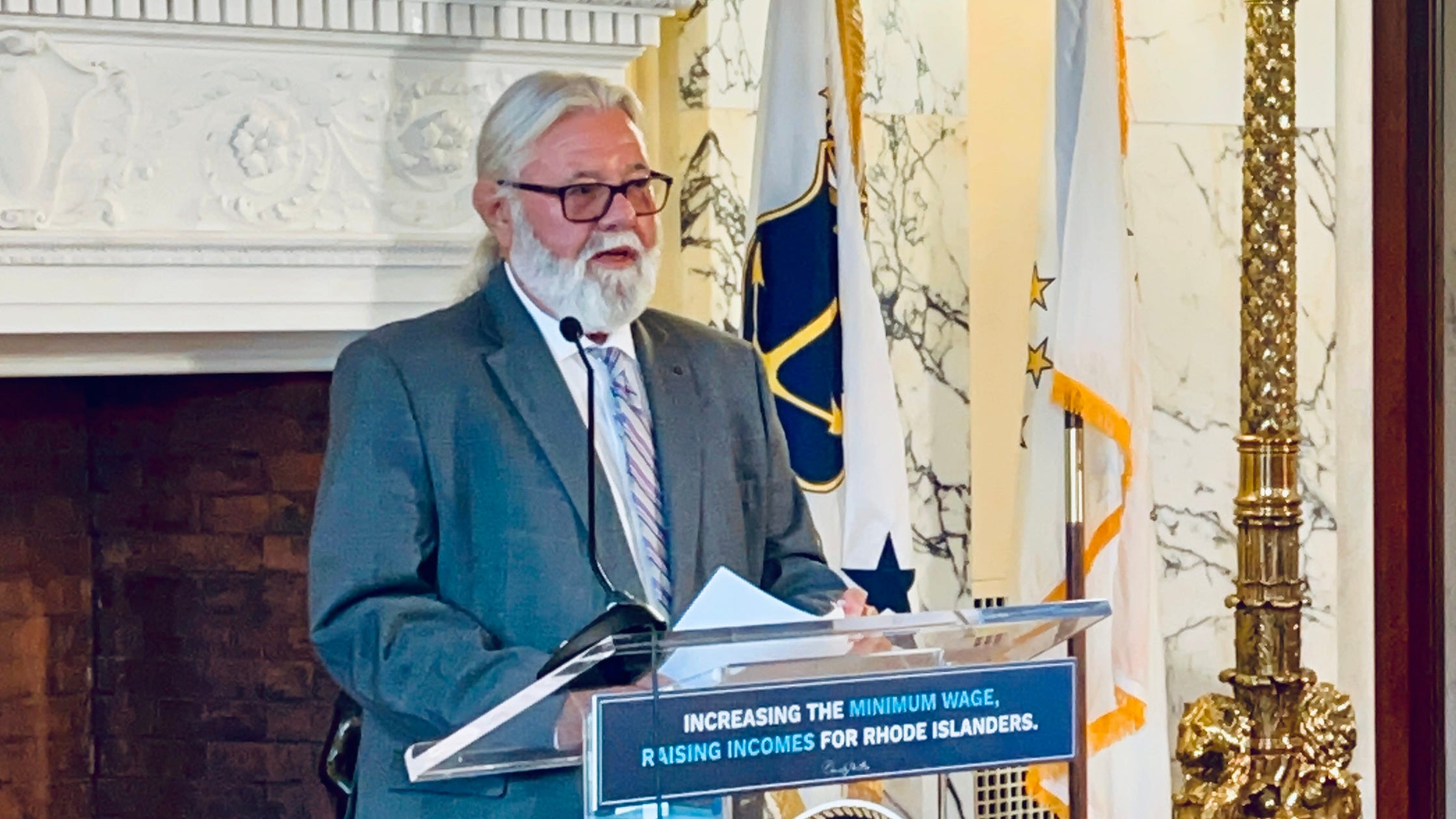
“It’s nice to see a lot of purple out there,” said Representative David Bennett (Democrat, District 20, Cranston, Warwick), noting the presence of dozens of Butler Hospital workers in their purple SEIU 1199 T-shirts at the Rhode Island State House. Butler Hospital workers are in the middle of a fight with Care New England for fair wages and a safe work environment. “I’m a former nurse,” continued Representative Bennett. “Management needs to sit down and come to reality.”
The Representative was at the State House to celebrate the passage of his minimum wage bill, which will increase Rhode Island’s minimum wage from $15 to $17 over a two-year period. The minimum wage will increase to $16 on January 1, 2026, and to $17 on January 1, 2027. On Monday, the governor staged a ceremonial bill signing. The bill was officially signed into law shortly after passage in June.
“I’ve been at this many signings since 2012, when Rhode Island’s minimum wage was $7.40,” said Representative Bennett. “One reason we come back to this issue is that the federal government has given up on minimum wage in recent years. It’s still $7.25 per hour at the federal level, the same as in 2009. Thankfully, we haven’t given up on it in Rhode Island.
“Today, we’re providing relief to workers struggling with the rising cost of living while keeping competitive with our neighboring states. Our neighbors in Connecticut have pegged their increases to inflation, but that’s harder for businesses and workers to predict. Rhode Island’s bill provides an even, predictable rise in wages that businesses can plan on years in advance.
“I plan on seeing you back here in a few years to do this again.”
Here’s the video:
The Senate companion bill was introduced by Senator John Burke (Democrat, District 9, West Warwick). “This legislation marks a step forward as we continue supporting working families and keeping our economy healthy,” said Senator Burke. “As Chair of the Senate Committee on Labor and Gaming and the Senate sponsor of this legislation, I know this will make a real difference.
“Thousands of workers across Rhode Island earn less than a livable wage. We all know costs are rising across the board. The working families that make up the backbone of our state are struggling to keep up. This will make Rhode Island more competitive, improve the quality of life for families, and is quite simply the right thing to do.”
“This is not something that gets over the finish line by the efforts of one person or one organization,” said Patrick Crowley, Secretary-Treasurer of the Rhode Island AFL-CIO. “I’d like to thank my friends at the United Way of Rhode Island, the Economic Progress Institute, and most importantly, the union members here today.
“This is a rank-and-file driven initiative,” continued Crowley. “This is about lifting wages from the bottom up. This is about ensuring that working-class Rhode Islanders earn a standard of living to not just provide for the basics, but to enjoy everything Rhode Island offers.
“This is a beautiful state. There are a lot of things to do, especially on a summer day in the middle of August, when we could all be on a beach or doing something else a lot more fun. But it’s critically important to recognize the victory before us today,” continued Crowley. “All of the members of organized labor that are here in this room, especially my siblings in 1199, who are fighting every single day for a fair contract at Butler Hospital: This is what Rhode Island looks like: Working people gathered together, fighting not just for themselves, but for every person in the state.
“About 50,000 Rhode Islanders earn minimum wage. Every dollar increase means a $2,000 increase in their salary. That’s a hundred million dollars more in the economy. That’s more money spent at the local grocery store, pizza shop, and small businesses across Rhode Island.
“We drive the economy, and when we increase the minimum wage, we make sure that this economy works for everyone,” said Crowley.
We need a living wage, but we also need a maximum wage at 10x the minimum wage.
Progress, but it's still not a living wage. Still, very glad I live in a (mostly) blue state.