
An interview with public historian Tad Stoermer about his new book, A Resistance History of the United States
"Madison and Hamilton had no damn interest whatsoever in freedom of religion, freedom of speech, freedom of assembly: none of that. And not just no interest in it, an antipathy to it..."

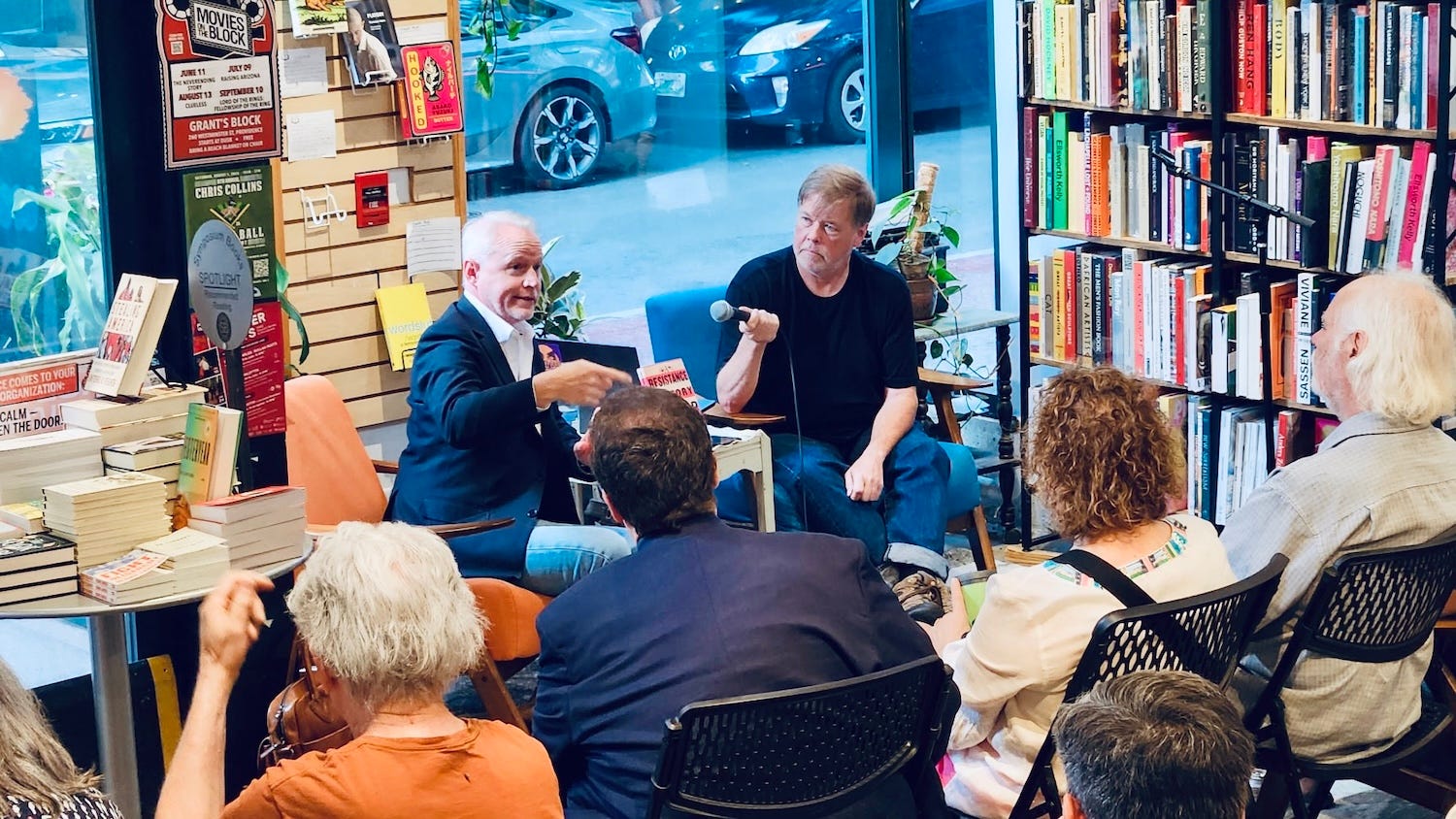
Last Thursday evening I was thrilled to host a conversation with public historian Tad Stoermer to discuss his new book, A Resistance History of the United States, described by filmmaker Ava DuVernay as a “bracing, unsentimental, and deeply necessary for this moment in American life,” Stoermer’s book counters the idea that progress is inevitable and instead examines how freedom and democracy are constructed, defended, and fought over.
Tad Stoermer is a public historian who trained at the University of Virginia, Johns Hopkins, and Harvard with a particular focus on colonial and revolutionary America. He is also a former congressional staffer and speechwriter, and he served in the U.S. Army Reserves as a reconnaissance scout. He lives in Denmark.
The interview has been edited for clarity. “Audience Member” is a catchall for all questions from people in attendance.
Steve Ahlquist: Without a lot of to-do, run us through what your book is and what you’re trying to do with it.
Tad Stoermer: We’re at a make-it-make-sense moment in this country, and in the book I’m trying to explain why the things we’re told should work are not working.
Now, there are structural explanations for that, but those structural explanations have a history because, in fact, things are working the way that they were always designed to work in terms of enabling exploitation, brutality, oppression, and exclusion by a government that was created to do that. But part of the history of why it doesn’t quite work that way is that people have been fighting against that founding vision for 250 years, making those words in 1776 mean something the writers never intended.
That difference between perception and reality is not just a cavernous gap, but it is where so many of the fights in American history have come from. It’s why, when we’re looking at things today, it doesn’t seem to make sense. Why are these things not working? Well, they are in fact working, and if we understand what it took for people to change things: the agency of individuals and individuals working collectively when they were able to have a clear vision, goal, and risk acceptance, [we come to understand] what they, in fact, have been able to achieve and flip the broader narrative.
This is history as argument, right? It’s not just history as a story. The way I look at public history is as history you can use, not because you take my word for it, but history you can use because you can look it up, you can actually see it, and it’s gonna mean what it is that we think it means. But to do that, you’ve got to make the argument. I have to make sure I have enough respect for the audience to lay it out for you, and then you’ve got to do some work on your own.
The point is to trigger in people a way of thinking that progress in American history hasn’t come from our genius for compromise. It hasn’t come from the extraordinary wisdom of the founding fathers. It has come from people who fought for it and achieved it. There are all kinds of influences against that. Progress gets rolled back, and we’ve got to understand why. There are these influences in American political culture that operate against progress; otherwise, we don’t end up with Dobbs or Calais, and we have to understand why.
Steve Ahlquist: I thought about your book in terms of religious liberty. The Founding Fathers didn’t particularly care about protecting religious liberty, for instance. It seems they were more interested in creating and protecting capitalism and their property rights. You’ll hear religious people say this is a Christian nation. You’ll hear secularists say it was not founded as a Christian nation. But through the lens of your book, it was neither. Religious liberty was an afterthought. That came with the Bill of Rights, protections added to protect people from the vision of the Founders.
Tad Stoermer: The Bill of Rights is the clearest and best example of this. We think that James Madison is the father of the Bill of Rights, and that it’s the product of compromise and discussion that resulted from the American Revolution and the pursuit of independence. It’s not that. Madison and Hamilton had no damn interest whatsoever in freedom of religion, freedom of speech, freedom of assembly: none of that. And not just no interest in it, an antipathy to it.
They were thinking it was harmful. They opposed it the whole time. When you understand that even that founding moment is grounded in resistance, protest, and persistent, visionary dissent, it changes the story of that moment.
Steve Ahlquist: In your first chapter, you talked about myth-making and how it serves the status quo, and it doesn’t actually advance true freedom. We have that today. You talked about Bacon’s Rebellion versus Metacom’s War - Bacon’s Rebellion being the myth and Metacomet’s War being the real resistance. But today myth-making is automatic, right? Think about Charlie Kirk, who’s a martyr, or the idea that Antifa is more dangerous than white supremacy. Can you talk about that a little bit and how we combat that negative myth-making?
Tad Stoermer: Do we combat it? How would we? Those are two different questions. You can always tell who’s read to the end of my book, getting through the epilogue and the conclusion, because it doesn’t have the obligatory part of every narrative, even non-fiction, that gives you hope at the end. Gives you that uplift. It always comes down to some version of, “I have faith in the human spirit.” I have faith in the human spirit, but not within this political culture. I think our political culture shackles us to what we see as what is possible.
I just came from a week in New York City, and this gets to your point about what we can do. It’s about flipping the script. It’s about changing presumptions and perceptions. Maybe because of the people I talk to in New York, there’s a different vibe there than there was the last time I was there.
There’s a different vibe because of Zohran Mamdani and because of what just happened in the congressional primary. The word people are using there is that things are “elevated.” We have been hit, every single day, with the ‘I never thought this could ever happen’ moment. It’s been all, ‘I didn’t think this crappy thing could happen, and it’s happened.’ What Mamdani and the primary were able to do, and Diana DeGette in Colorado, is say, ‘Hold on. Wait a minute. This thing that we never thought could happen, can happen.’ That’s flipping the script. That is the opening to show another way of thinking about and doing things to achieve a different outcome through a clear vision, acceptance of risk, and a willingness to move forward. That actually makes people think, ‘Hold on, the blinders we had on before kept us from seeing what is possible. What is the ceiling of change?’ Maybe that ceiling is just a fiction. And when you get people thinking like that, then you can start having a different conversation.
Steve Ahlquist: Sort of like we’re creating our own Overton window here.
Tad Stoermer: Oh God, yeah.
Steve Ahlquist: We’re doing that here in Providence with the David Morales campaign. We’re trying to get our own bit of hope here.
You see how that works, though?
Audience Member: I don’t know David Morales.
Steve Ahlquist: David Morales is running for Mayor of Providence as a very young, progressive, and interesting candidate who could really do some good for the city, I think.
Tad Stoermer: You see how that works, though. There’s a legible template for change, one based on measurable experience and evidence. You can see what worked for Mamdani. It’s a practical template. Through organizing and collective action, all of these campaigns are clear-eyed and ruthless about what they’re doing and what needs to be done.
Steve Ahlquist: You did a chapter on the Underground Railroad. You marveled at its efficiency and secrecy, and talked about how some of that secrecy is still preserved today. But if all American slavery were one retail establishment, the underground railroad would be like a small shoplifting ring stealing like 1% of the profit. When I compare that to today, and ICE, I can see all the work we’re doing to oppose ICE: people are in the street, people are being brutalized and killed, the real sacrifices that are being made; and I don’t know if we’re being as effective as the Underground Railroad was. I don’t know if I have a question; I want you to think about that, comment on it, or springboard off it.
Tad Stoermer: Yeah. Let’s take a moment for Lorenzo Salgado.
All meaningful change in American history comes from resistance, but that resistance comes with a body count. Our body count’s mounting. It’s not just Alex Pretti, although that’s important. It’s the Prairieland defendants. It’s the 15 in Minneapolis who have been arrested and charged under a fictional theory about Antifa and domestic terrorism. So when we think about the underground railroad in the context of ICE, there are all kinds of ways in which that’s a valuable conversation.
The first one is that we have to understand that resistance requires patience. When you have an abusive authority operating at scale at the national level, it controls all the levers and resources. They can deploy them through Congress, money, and the army; they’ve got it all. And they can do it through a geographic expanse. You have to get to the point where you can escalate to combat that at scale; otherwise, you’re essentially playing whack-a-mole. But I don’t want to be too glib about that. What the Underground Railroad was able to do was focus on the symptoms of the abuse. They didn’t have enough strength to operate on the source of the abuse, to combat the disease, even if they knew what the disease was. They had to focus on addressing the symptoms, which were the constant, continuous abuse. But even that took decades to evolve to the point where they could be as functional as they were.
Not only did it take decades, but it also required several pushes, such as the Fugitive Slave Act of 1850, to really energize it; it also required Canada to be a destination. I’m essentially a functionalist. Intentions are great, but I think people lie most of the time, particularly with this thing. I’d rather ask, ‘What’s happening at the end? What is the function? How is it performing?’ Then you can map the language’s intentions to see whether the action actually does what it says it will.
What’s interesting about the Underground Railroad, functionally, is that it offers another lesson in resistance: It’s never top-down. It’s not quite bottom-up: it starts with bottom-across. We don’t need to reach for other examples of effective, on-the-ground resistance. We are seeing it right now in front of us in Minneapolis, and what’s happening at Delaney Hall. The folks in Minneapolis, the folks in L.A. earlier, and the folks outside Delaney Hall are doing the work, and they’re doing it effectively. What I mean by bottom-across, and this is what the Underground Railroad was able to do in DC, is get to the point where Minneapolis is connecting with Delaney Hall, connecting with L.A., and connecting with Providence.
This is the point of the committees of correspondence during the American Revolution. They were able to connect one locality to another, to another, to another. And when you’re able to do that, you can get bottom-up. But you can’t get bottom-up because you can’t operate at scale until you get bottom-across. That’s the connective tissue that the Underground Railroad was able to put together. On a cellular level, you’re connecting one to another.
Steve Ahlquist: It’s really frustrating to do this work when you think about all the lives impacted by racist policy. You talked about the Underground Railroad taking decades to get going. Through those long decades, lives were being brutalized and destroyed.
Tad Stoermer: And this is the frustration that escalates in the 1850s among anti-slavery resisters like Henry David Thoreau. People like Thomas Wentworth Higginson, Thoreau, and Theodore Parker started to recognize that Black resistance was doing everything it possibly could and more to end slavery; operating in sophisticated, committed, and visionary ways, doing everything they possibly could, but it was never going to be enough until white, comfortable people in the middle moved. That was the only way it was ever going to happen. It was driving them up a wall, which is why that chapter is so important and the worst chapter in the book. I ripped it up five times and wrote it again and again.
Thoreau’s original title for Civil Disobedience was Resistance to Civil Government. Civil Disobedience was a title given to it by a later editor, after Thoreau died, to soften it. Part of the book is a diagnostic about what it takes to move people: Who is standing in the way? Thoreau’s frustration with those who are standing in the way: white, comfortable, northeastern liberals, and this gets to your point, who are willing to morally accept the ongoing violence, brutality, and rising body count from the exploitation of people in slavery. They were fine with that. They could somehow abstract and accommodate that. Somehow, they could price that into their conscience but distance themselves from any effort to end it that might have violent consequences.
Not violence for violence’s sake, but violence as a foreseeable outcome of direct action to stop the abuse. That violence was not okay for them. The ongoing violence against millions of people is somehow fine. That is what they were trying to target. How do we make sure we are targeting the moral comfort zone that insulates them from ongoing harm?
We see what ICE is doing all the time. To see the violence that is already part of this and to step back and say, ‘I can’t support anything that involves more sophisticated direct action because that might have a consequence I don’t like.’ That’s saying that you’re fine with these consequences.
Steve Ahlquist: My ethics or my moral view is more important than the lives of all these people.
Tad Stoermer: That’s exactly it.
Steve Ahlquist: You talk about these men who funded and supported John Brown’s attack on Harper’s Ferry. They were doing this really big thing, but it didn’t serve them personally. They were all basically destroyed by what they did. I thought it was interesting that they made this big stand because, in the end, they weren’t heroes, but ultimately, there is a line to be drawn from Harper’s Ferry to the abolition of slavery.
Tad Stoermer: What I needed to understand was what makes people accept the consequences of escalation when they are clear-eyed about those consequences. We lose a lot in the story of Harper’s Ferry and the people who supported Brown in two ways, in the way historians have been treating it:
One, historians treat these six northeast liberals as if they were wealthy people who funded John Brown. Two of them had money. Two. The other four were spending their time organizing other people. They were getting $10 here, $5 here, $20 here from 100, 200, 300 people to send a John Brown. They were recruiting their sons to go to Kansas. They were facilitating all these other people to support it. We get bogged down in thinking that change will come from a couple of big-time people doing big-time things. That’s not true in that case. The four were doing all kinds of work. They were speaking, writing, and knocking on doors about it.
But the other part is that, at Harper’s Ferry, they all of a sudden had no idea what John Brown was doing. All of a sudden, they had this idea that, oh my gosh, this could be violent. They were already sending guns to Kansas, and they knew what those guns were going to do. What I desperately wanted to understand, to the extent that I could, was how they came to that decision, and more to the point, why, because a lot of people didn’t reach that conclusion. William Lloyd Garrison didn’t. Frederick Douglass didn’t, though he agreed with it and accepted it later, but in the moment, he didn’t, partly because he thought Brown was going to fail, but we can talk about that.
I deeply wanted to understand this functional moment of resistance. It doesn’t operate at scale until comfortable people move, but for comfortable people to move, they have to realize they must risk something: Why does a comfortable person risk what they have?
Audience Member: I live in San Diego and work at a dual-language school. I have students who are missing their parents. I have students who are afraid to go to school. But what we have done there is I work with an organization called Universidad Popular https://www.unipopular.org/, which has partnered with several other organizations, and it’s just what you’re saying: bottom-across. We all get together and plan our strategies and keep each other safe. We also managed to get our elected officials on board. Let’s hope they’re still there.
Tad Stoermer: It sounds like it’s a conversation, and, having talked to a lot of you and heard about your work, it’s about having a clear idea of your shared values.
Audience Member: Our shared values are that our children should be safe and not miss their parents. End of story.
Tad Stoermer: And does it really matter how you get there? Whatever gets you to that point, whatever’s informing your need for our children to be safe: If that’s a religious point of view, great. If that’s a political point of view, great. If you have a different ideology that’s doing that work, great. But if that’s what you want to do, then who cares how you get there?
Audience Member: Exactly.
Tad Stoermer: I have a lot of these conversations about how things operate now. Now, I’m a historian, not an organizer...
Steve Ahlquist: There are a few organizers in the crowd, though.
Tad Stoermer: What has enabled resistance efforts to succeed in the past is the acceptance of risk and loss. It’s risk and loss to further something, to achieve something. You have to be laser-focused about what you want to achieve because that enables you to target resources. That enables you to target your tactics. You can, in fact, think strategically if there is one thing that you’re going after. That’s why the anti-slavery resistance is a good template to look at. They understood that because slavery was the greatest abuse, they needed to focus on that abuse. Other bad things are going on. This is part of the discussion about women’s suffrage, and that’s an awful conversation to have. We only have so many resources, which one gets the focus?
When I look at other resistance moments, what I see is: If you have one particular focus, like ICE, you focus everything on that. The American Revolution started with taxation, right? Every colony had its own thing, but that was the one thing that drove their patriot resistance in those colonies. It was that one thing they could clearly organize, speak around, and theorize around. It was the one thing.
What’s happening now is that, for the most part, while the grievance is widespread, everybody knows something’s wrong. Any right-thinking person knows something’s wrong, and you can point to 30 things that are wrong. But for people to move and organize, there has to be one thing to focus on: ICE.
That is what has motivated the greatest examples of resistance happening on the ground. And if you think about it, that is the point of greatest potential to represent this abuse of authority operating at scale. Focus on that because people can get distracted. There are all kinds of fronts we could be operating on because that’s how they operate, right? They want you to think 30, 40, or 50 things are going on.
Audience Member: They want to distract you.
Tad Stoermer: Exactly. That’s why the discipline is to focus on who is getting hurt the most right now. Who is actually bearing the brunt of the abuse? Where is that cost highest? And that, at least for past resistance movements, has been the focus that yields the greatest results, rather than a more abstract one.
Audience Member: You said that one of the problems Thoreau identifies is that people are putting their energy into their own ethics. Their own ethics might be flawed, but they’re going by that. And that’s one of the main problems with the resistance: they’re not putting others’ well-being above their ethical considerations.
The anti-slavery movement was deeply influenced by Quakers and led by them. They were, in many ways, ahead of their time. So how are you balancing that? On the one hand, the leaders, the Quakers, were the ones prioritizing their own ethics. And on the other hand, these people were unwilling to engage in violence.
Tad Stoermer: What’s the balance? I don’t know, there’s a balance. Let’s think about the Quakers. One thing that I wish I had put in the book is that the only people in 1776 who were directly acting on the language of the Declaration of Independence to end slavery were the Quakers. We have a wonderful collection of manumission statements from Quakers in Virginia in 1776, saying that because of the language in the Declaration, we’re going to free our slaves. Slavery is not consistent with the Declaration. The issue with the Quakers is that, because of their moral framework, they weren’t interested in engaging in political change. They were effective in enabling things like the Underground Railroad, raising money, moral pressure, and connecting the dots because of the way Quaker meeting networks worked. They were able to take those networks and start laying out how to go ahead and manage that for getting enslaved people out. Because they did not have, essentially, a moral theory of change that unlocked that potential to work for political change, and more to the point, structural change, it limited their capacity. That’s one of the things Thoreau and others were a little frustrated by: those folks thought what they were doing was sufficient.
And the other thing that was frustrating for Thoreau in this is that their moral framework was so strong that it enabled them to wait it out. It enabled them to believe in a moral arc, that it will be okay on the other side. It will be okay eventually. Our faith, or even our faith in how we do things, can be sufficient, so we don’t have to push to the point of rupture. We don’t have to escalate. And that’s the point Thoreau, Higginson, and others had problems with: If you don’t recognize where the actual problem lies, and if you don’t have the willingness to go ahead and address that, what you’re doing is negotiating yourself into this forever pattern of only addressing the symptoms.
This is Frederick Douglass’s problem. Douglass has been part of the moral suasion crowd for a decade. Because the Constitution is so goddamn great, the only thing we can do to end slavery is to persuade enslavers that it’s wrong. That’s William Lloyd Garrison, right? The moral suasionists can’t engage in political change and political activity because it gets their hands too dirty. Instead, we need to persuade the enslavers to end slavry.
But Douglass came to a break with that. In the 1850s, particularly after the Fugitive Slave Act, the Kansas-Nebraska Act, and the Dred Scott decision, Douglass concluded that political change was necessary and that the Constitution was a problem. But Douglass can’t quite get to the point where he understands that you can’t change the Constitution through politics, but through rupture. It’s those things, that moral framework, some of it based upon faith and some of it based upon other intellectual frameworks, that I talk about in this chapter.
And that’s why I talk about how transcendentalism and Unitarianism failed them. Transcendentalism could not handle the pressure of the toughest moral questions. It’s not complete enough to enable that. Once you get to the point of rationalism, you’re on that side of the fence and far from what drives Harriet Tubman and John Brown. This is part of the tension in the chapter. It’s not enough. They couldn’t find the right framework to fall back on. What they had to fall back on was this way of thinking that was a bit of stoicism and a bit of old-school Christian moral philosophy, which was very practical, and it still wasn’t sufficient, or even coherent. We see this time and again when we’re talking about people who are trying to understand how to accept the consequences of resistance and operating at scale.
I am positive none of those answers your question.
Audience Member: I wanted to know what your thoughts were on that, and that absolutely answered my question.
Tad Stoermer: It’s got to be about how you do it at scale and how you get people to do it at scale. The frustration, particularly with the Quakers, is that they weren’t recognized. Their theory of change was so rooted in their faith, a faith that insulated them from understanding that we need to act now. This is immediate. We can’t wait. In dealing with a lot of the folks who were in this moment of religion-based moral philosophy, there were plenty of people willing to wait that out: God is good. In the end, we’ll all be judged. We’re going to come out okay in the end.
That’s why, at the beginning of the chapter, I needed to go to the point that radicalized Higginson.
For those of you who haven’t read the book, this moment blew me away. Higginson said that he already knew what the Underground Railroad was. He needed to go above ground. He needed to see what slavery was. He needed to see what was going on because he was a comfortable white guy, outside of Boston, for most of his life. So he visited Missouri to see what’s going on. He picked up a newspaper, found a slave trader in St. Louis, and decided to visit.
While he’s there, a guy comes in, a member, I think, of the St. Louis City Council, and he says, “I want a girl. Bring me a girl.”
Just think about that for a second. That’s part of the transactional mindset.”I want a girl. Bring me a girl.”
And the trader brings out three young girls. Higginson thought they were maybe four, seven, and eleven, and they were wearing dirty pink frocks.
It’s an image that doesn’t leave him for the rest of his fucking life. These girls in dirty pink frocks stand in dirty pink dresses, and he watches as the potential purchaser looks them up and down. The slave trader said, “You can do whatever you want to with them. You can check them out any time you want to. They seem likely. They seem good. Do you want me to take off the dress? Take off the dress!”
One of the girls had a mark on her face. And the potential buyer asked, “Where did that come from?”And the trader said, something like, “She just got what was coming.”
Higginson was at a loss, looking at this. But then one of the girls started to cry. The girls were standing there and enduring this. And Higginson remembered their, not exactly their dignity, but their presence, that they were not giving in, right? But then one of them started to cry. [And - I’ve got a four-year-old child, right?] She said that she wanted her mom. And the trader said, “Your mom’s still in Virginia. You don’t have to worry about her anymore.”
Then the trader chose them, and they went off. Higginson wrote about this in a letter to his mother. And he said, “This is what we have to end now. We can’t wait another day for this.” It’s not just inhumanity. There is no vocabulary for it. We can only reduce it. We can talk about slavery as an ‘institution,’ but every time we do that, we remove the humanity from these people, which enables their oppression. Their frustration enabled people to abstract it into their moral philosophy and distance themselves from what slavery was. They could accommodate it. They could negotiate it in their own minds.
Higginson thought that you could have as many people talking about the horrors of slavery as possible. You could sell as many copies of Uncle Tom’s Cabin as possible. But unless you actually see it, you really don’t know it. You’ve got to rely on the people who do see it, who do know. The people at Delaney Hall, who are seeing this on the ground, are seeing Lorenzo Salgado’s father collapse in front of a shrine that they put up in front of the house. You see the loss right there. It is in bearing witness to that and communicating it that he was able to motivate himself more and not give in to the doubts: Maybe this isn’t the right time. Maybe we can work this out.
The older argument: Isn’t preserving the union more important than ending slavery? Is this abstraction, preserving the union, more important? This comes from the Constitutional Convention. Creating and preserving the Union is more important than ending slavery. What Higginson got to thinking about this was, “What calculus is that?”
That is a value judgment, right? Preserving the Union is so important that it is more valuable than ending slavery. Millions of people are brutalized every day, their lives are destroyed every day, for the personal private benefit of a handful of people, and that somehow is outweighed by the value of the union? But they never show their work.
The value of the union lies in these assertions. “Aren’t we the last best hope for freedom in the world? Don’t we bring democracy and light to everybody else?”Cost, cost, cost, cost. Invade Mexico? Cost, cost, cost. The value is never articulated—the math never maths. The assertions are part of the political culture that still guides what we do today. “Isn’t this so goddamn great?” Show your work. We have never shown the work. People like Howard Zinn have started to show the work. Right? There are plenty of historians who say, “Here is the work. We need to put it into that calculus.”
I throw out a lot of terms in the book, like abuse of authority, stuff like that, and I talk about why the anti-slavery resistance mattered so much in terms of setting the template for the American way of resistance and the influences that act against it. We can see that in the way we still talk about slavery in the Constitution. We continue to reduce it to a matter of property. We reduce it to being the “peculiar institution,” and do not talk enough about what was unique about the Constitution.
The innovation was baking oppression and brutality into the Constitution as a form of permanent political power, constitutionally guaranteeing slavery so that it would never end. If you take the influence of wealth and combine it, foundationally, with the influence of perpetual political power, the more enslaved people you have, the more you brutalize, the more political power you get. And that is not just undemocratic, it is anti-democratic. That means the more I do this, the more power Virginia will have over Pennsylvania, and the more power the enslavers will have. No incentive in the world can cut against those two powerful influences. None.
And we baked it into the Constitution, then made it almost impossible to change. It’s not just economics and wealth. That’s why, when I talk about it, I tend to step back from talking about it as property, because it’s about more than that. Obviously, under capitalism, political authority and power flow naturally from wealth. If you explicitly connect that with your own political authority, that is a toxic blend that spins the American public.
Audience Member: In your research on people who did count the cost, saw what was happening, and it didn’t sit well with them, have you found any patterns you can point to that helped strengthen their resolve or courage to act?
Tad Stoermer: That’s a great question. I did, and this is getting into the conversation about where they found hope and what kept them going. I get asked a lot about where “hope” fits into this, and I absolutely destroy that answer because I can’t find any discussion of the word about where hope comes from. What I find, and you used the word, is the resolve. The resolve came from the work, meaning that with a clear idea of what they wanted to achieve and an understanding of their role in achieving it, even moving a little bit was enough for them to do it the next day.
The fuel for getting up the next morning and continuing to do that came from being very clear about the goal and seeing that, even if they were moving a little bit, that was enough; it’s almost like proof of concept. If they saw that what they were doing was working, that people were getting pushed, then they could see that if you do more, you might push more, you might move more. That’s what kept them going.
I had to study resistance contexts outside the United States to identify common patterns in historical resistance dynamics, and then bring them back to the United States to see whether these dynamics operate the same way here. What was common across other kinds of resistance dynamics, like World War II Europe or Southeast Asia in the 1960s, was a clear attachment to the goal and a clear understanding that what they were doing was, in fact, moving the needle a bit. Organize better, organize more. It was doing it rather than thinking we were spinning our wheels.
The evidence shows me that if there is movement, that’s enough. That’s where we gain resolve. More push will create more movement.
Audience Member: Do you have advice for educators? I’m an 8th-grade civics and government teacher, and I feel so stifled. I feel like the access I have to history is so watered down and filtered, and I know the kids: A lot of their thinking comes from their parents, because they’re at that cusp, eighth grade going into high school. I struggle to teach it and do it the right way. I don’t know how best to influence our future generation.
Tad Stoermer: I talk to students a lot, and it’s not about the content. I will flatter myself: there’s some good history in this book. But those are examples. The more important thing is the thinking. It is about unlocking, particularly for folks in eighth grade, a way of thinking that challenges the things around them. Essentially, it is about critical thinking. And these sources are great for that: “Here is what you’re being told. Here is what the narrative is. Now, let’s break it down as a historical map. Let’s break down who’s doing it, what’s their positionality, what’s their breakdown, why are they using these particular words, and what’s the goal of this document.”
You can start doing it to almost anything around you. You can start unpacking the Declaration of Independence or John Brown’s last speech, or you can unpack the Combahee River Collective Statement, right? You unpack these things. Who’s doing it, why, and what’s their context? Getting my students to ask those questions over and over again, and then they start doing it to almost anything that comes down the path.
It became a game, a nice challenge for them. Let’s go ahead and do this all the time. Let’s ask these questions about the latest report from the White House. Because the one thing I want people to do more than anything else is ask what work something is doing. What work is the choice of those words doing? How is that impacting people? It is intentional. Why choose those words? Why choose that path? What work is it doing politically? Because they have a function. And if you break things down to what the function is and what it is supposed to do, you can go a long way toward seeing it.
Steve Ahlquist: That chapter you said you rewrote over and over - I liked that chapter a lot, and hearing you talk about it, I realized I liked that chapter because I could sense you struggling with it, working it out in real time, on the page, much as you’re doing here.
Tad Stoermer: It’s the least narrative chapter. It is more analytical because I am trying to work through it. I couldn’t figure out how to get in. In a previous version of the chapter, I had paragraphs and paragraphs on Albert Camus and Hannah Arendt. And if there is anything that would kill a narrative, it’s me writing about Camus.
Steve Ahlquist: Although Camus works as a metaphor for your effort.
Tad Stoermer: Particularly on questions of violence. I had these wonderful colleagues who were very patient with me. I was like, okay, read this version. Now read this version. Now read this version. I got some great advice from one of them, who said that one of the things he felt I did effectively was represent a person authentically in a moment. He said to go with that and let them do the work. Let Parker and Higginson, Thoreau, and Douglass do the work. These are the people who are, in fact, arguing with each other at the moment as they unpack these things. I wanted to put you into that mix and then take you through where it ended up.
Audience Member: I was wondering who you imagined your readership to be while writing this. I mean, essentially, it’s white liberals, but who else are you writing this book for? And the second part is that organizers find that what’s difficult is not just having to take risks, but the helplessness we encounter from everybody who thinks there’s nothing we can do.
Tad Stoermer: I wrote it for me. Part of it is that I have this wonderful online community that busts my ass all the time about stuff. The people the book is really resonating with are the ones you’re talking about:” Make it make sense. What can we do?” I think it’s fine as a history book, but beyond that, it’s about understanding how we got from then to now and making this make, in all this chaos, a little more sense.
It’s for those people, but also those who want to do something about it.
That’s the hinge. It’s not just for people who recognize it and want to torture themselves by trying to understand what it is and then just sit there; it’s for people who see, who want change, who want to do something with it.
And if there’s anybody else I wrote it for, it was for nobody alive. I wrote it for the people who lived and died for change and were screwed over by our history. Alice Paul should be a hero, right? How many of you know who Alice Paul is? Do women have the right to vote without Alice Paul?
Are we talking about heroes? Hero. I wrote it for people like Alice Paul. She’s in the first version of the book. The first version of the book had 21 chapters and went up to Stonewall and ACT UP, until I realized that wasn’t the book’s story. I also think about people like Nancy Dixon. To me, she’s the heart of the book. Nancy Dixon is the most important person in the book to me.
If I got everything else wrong and I got her story right, that’s fine with me. Because she represents not just what resistance was against, but also what it was for. So I wrote it for them because I felt a level of responsibility to them.
That’s why we, as historians, have a responsibility not to go further than what the record will support, but I felt more responsibility for this book because I wanted to ensure that it was representing something that could be acted on, and be reliable, in terms of people who felt hopeless, and show them the things that have worked. Maybe not things you can do, but things that have worked.
I can’t write about an orange, and then you’re looking for an apple. It has to be clear that this is one-for-one. These were people who were not extraordinary, who didn’t have extraordinary resources, and who lived in extraordinary times. I wanted to put you into their moments as much as I could without over-constructing it, because narrative in the service of history can go awry very quickly. You’ve got to pull back to make sure it’s not just recognizable but reliable. So that people who want to see what’s possible and gain an understanding can see these people, who had all of these things stacked against them. We have greater resources, and therefore we can move resistance along, and also understand that what they didn’t have and that we have is a legible resistance history of this having worked.
It requires discipline because part of the helplessness stems from not knowing where to start. Do I focus on the November election? Do I focus on voting protection? Do I focus on topping the war in Iran? Where do I start? It comes from the conversation we were having earlier, right? This is why the Ona Judge chapter was important. A lot of helplessness comes from the fact that, in terms of resistance dynamics, there has to be some patience. The court upheld the 14th Amendment. Exhale. The November elections are coming. Exhale.
There are distractions, rather than a focus on the one thing that people’s resources can be brought to bear on. If this were about stopping ICE, and not just “We’re going to pause funding on ICE,” or “We’re going to make sure that they have more training,” If you understand that’s part of the problem, you end ICE, and you end ICE everywhere. Which means you’ve got to put bodies in front of ICE everywhere, you’ve got to get in front of ICE. If that is what everybody is doing to slow these jerks down, to make the folks at the top decide they’re going to pay a price, they’re going to have to recalculate, do something else, then that’s what’s got to happen at scale. And just that.
Here’s what we’re doing in that community. Here’s where our mutual aid organizations will be focused. Here’s my role in that right now. We’re going to focus on what’s going on with ICE here. And once this is nailed down to the extent it can be, we’re going to focus on getting resources to other places. But it is focusing on that thing, and you can see how you might fit into that effort. If we’re talking about ICE and Providence, that’s the tip of that spear. That’s what energizes people. The helplessness comes from not knowing where to start, because everything operates on so many levels. We need to focus not just on something manageable and legible, but on the abuse of authority we’re talking about. Does that make sense?
Steve Ahlquist: That’s our hour. I want to say I think Ona Judge should be on the dollar bill. Thank you so much for this.
Illuminating, penetrating interview! His math is impeccable here:
"The innovation was baking oppression and brutality into the Constitution as a form of permanent political power, constitutionally guaranteeing slavery so that it would never end. If you take the influence of wealth and combine it, foundationally, with the influence of perpetual political power, the more enslaved people you have, the more you brutalize, the more political power you get. And that is not just undemocratic, it is anti-democratic. That means the more I do this, the more power Virginia will have over Pennsylvania, and the more power the enslavers will have. No incentive in the world can cut against those two powerful influences. None."
Quite a stimulating, thought provoking discussion. Was that at Books on the Square? Wish I had known...