
An interview with Libby Merrill, Ward 3 East Providence School Committee candidate
"Book bans and things like that came out of a reaction to making progress. I want to ensure that progress isn’t eroded in East Providence."

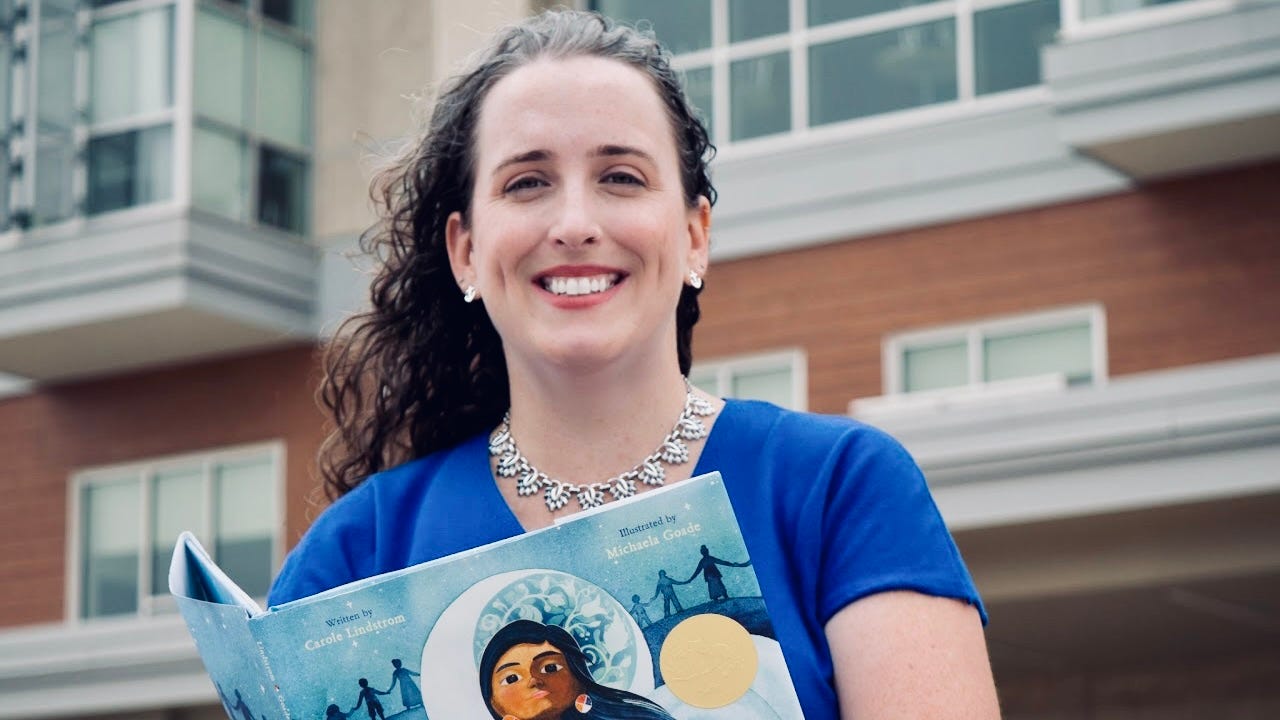
I met Libby Merrill outside the Weaver Library in East Providence, as sculptor Anthony Heinz May stood on a lift, transforming a dead Copper Beech tree into a work of art. Libby is running for a seat on the East Providence School Committee.
Steve Ahlquist: Tell me about yourself.
Libby Merrill: I’m Libby Merrill. I’m going to be Elizabeth Merrill on the ballot because that’s my full name, but I’ve always gone by Libby. I grew up in Warwick. I’ve lived in Rhode Island my whole life. I went to public schools, and I have a daughter who’s in East Providence Public Schools right now. I have been working in education for the last 20 years. I grew up in a family that valued education a lot. I come from a family that went to college, but I was also told growing up that success in life was based on hard work.
My family loved the idea of American democracy and meritocracy, and believed that we’re able to rise through hard work because that’s what our family did, and that’s what’s available to everyone. Then, when I got to college, my eyes were opened a little bit. I did a lot of service work, as it was called then. I saw a lot of smart, hardworking people in places like Appalachia, the Navajo Nation, and Boston who were struggling.
I realized that I had been misled for much of my life about what actually leads to success in the United States and how much of a true democracy we are. That got me into teaching because I thought at the time, this was the early 2000s I wanted to devote myself to children having equal access to the opportunity as I had: going to college, live a financially stable life, and not have those opportunities fall so much along racial lines and socioeconomic lines.
After I became a teacher, I realized I had been a little naive, because it takes a lot more than just getting a good teacher to have a student turn their life around.
Steve Ahlquist: Although it is a little helpful.
Libby Merrill: A little, but in the 20 years since I have learned that it’s a lot more complex and nuanced than I thought at 22. I thought, “If I can be a good teacher to the kids in my classroom, they will be able to turn around the trajectory of their families.
Over the years, I’ve become increasingly involved in various social activities beyond just being a classroom teacher. You and I have met over the years at rallies at the State House for immigration, supporting DACA, and providing more help for the unhoused population in the state. I’ve gotten more into other causes as well. That’s a little bit about me.
Steve Ahlquist: Why are you running?
Libby Merrill: And I’m running for school committee for several reasons.
One is that I have a lot of knowledge about what it means to run a school department. I work in a small charter school network and am in charge of hiring teachers, so I have a lot of experience on that side of running a school. That comes with knowing the budget, like budgeting for salaries, and all of that kind of stuff.
I also want to make sure that the school committee will protect our most vulnerable children and not discriminate against them. When I say that, I mean students with disabilities, students from immigrant families, and students who are maybe transitioning or transgender. We’re seeing a lot of attacks.
I know you’ve reported on a lot of this.
Steve Ahlquist: Transgender students are particularly vulnerable, as are students who have undocumented parents or guardians.
Libby Merrill: Five years ago, we were finally making progress on getting accurate history taught in schools. When I was teaching and when I was a student, I was taught a very narrow part of history, and history is my favorite subject. I was a history major. I remember learning about the American Revolution every year and we would go to Nathaniel Green Homestead in Warwick.
But I rarely learned about the Narraganset and that they live in our community. Schools have gotten better in that way. 2020 saw a big push for more true history, followed by immediate pushback from the right.
Steve Ahlquist: Which we’re currentlyy in the middle of…
Libby Merrill: Book bans and things like that came out of a reaction to making progress. I want to ensure that progress isn’t eroded in East Providence. My daughter has had an excellent experience in East Providence, and so have I, as a parent. Every teacher she’s had has just been fantastic. She started in pre-K and she’s going into fourth grade; and every year she comes home and says her teacher is her favorite teacher that she’s ever had, which is better than the experience I had in schools.
I’m very thankful for the experience we’ve had here. But, looking at state data, there are some discrepancies in our school department between students with disabilities and the general population in terms of performance. East Providence has been making steady positive progress over the last 15 years or so., but that hasn’t been equal for all groups. (Which is what we see everywhere.) In every school district in the country, you’re going to see that students with disabilities, students of color, and students from low-income households are not recieving what they need.
Steve Ahlquist: Academically speaking students in East Providence are struggling.
Libby Merrill: Yeah, but we are improving. We’ve recently reached the point where most of our schools are rated 3 stars out of 5.
15 years ago, this was before my time here, East Providence was in a terrible financial situation, so at one point, we had the lowest paid teachers in New England, and then they actually reduced salaries.
Steve Ahlquist: There’s never a good reason to do that.
Libby Merrill: A teacher told me that a few weeks ago, and my jaw dropped.
Steve Ahlquist: Every year a worker doesn’t have a salary increase their salary decreases. Because inflation is a relentless beast. Right now, if you’re not getting a raise, you are getting a pay cut, because the cost of everything is going up
Libby Merrill: Yes. And they actually reduced salaries.
Steve Ahlquist: That was before East Providence had a mayor. You had a city council and city manager, I believe.
Libby Merrill: Someone told me the other day that we’re the fifth largest city in the state in terms of population.
Steve Ahlquist: That sounds about right. Providence, Cranston, Warwick, Pawtucket, and East Providence. The city is dense too. You don’t have a lot of space to build….
Libby Merrill: Not necessarily. We have little pocket all over the city. The ward we’re in right now is very dense. But we do have some buildable spaces
Steve Ahlquist: What issues compel you to run? The school committee is generally focused on education and student achievement, ut what issues do you think you can make a difference on right now?
Libby Merrill: The school committee is narrowly focused on the school budget and hiring, firing, and evaluating the superintendent. They’re like a board of directors for the schools. They approve the things that the department’s directors bring to them, like the curriculum.
Steve Ahlquist: So you’re not developing curriculum.
Libby Merrill: No, and same thing with the budget, the committee is not developing the budget. They’re taking the developed budget, looking at it and doing some tweaks.
The things that I’m most interested in is protecting the experience of students and teachers from outside distractions so they can focus on learning. One of those things is making sure that students from immigrant families have access to freedom, education, and privacy, because they’re guaranteed an education no matter where they were born or what their background is.
In some districts, ICE is targeting schools. We must be doing everything we can to shelter kids and teachers from that so that families can focus on student learning and not be afraid to bring their children to school.
Also, in East Providence, as we see in much of Rhode Island and the Northeast, our population is shrinking. One of the biggest issues we’re going to face over the next decade is the continuing decline in school enrollment.
As East Providence ages up, our population has remained pretty steady, but it has fallen. Our school population has dropped over the years, and we’ve seen lots of different school buildings close. We will soon be in a position where we face hard decisions around consolidating schools and ensuring that we’re making smart decisions that put kids first. I want to make sure that there are smart people at the table making those decisions.
People have a lot of pride in living in East Providence.
Steve Ahlquist: Townie Pride.
Libby Merrill: Yes, Townie Pride, but, sometimes we hold on to nostalgia at the cost of making decisions that will best serve us in the future. That’s hard because it feels sad to let go of things as you remember them sometimes.
Steve Ahlquist: Do you have an idea of what things you want to let go of?
Libby Merrill: Good question. For example, there’s a building being used as a temporary pre-K site while a new pre-K is being built. We need a decision on when the Pre-K in the ‘27/’28 school year will move to its permanent site at Martin Middle School. We will have a decision on what to do with that building because it was closed down as an elementary school several years ago due to dropping enrollment. It’s been great to have as a temporary pre-K site, but what do we do with it now? That’s a hard decision for the community. To your point about being a pretty dense community, many people want to ensure the building doesn’t get turned into housing.
Steve Ahlquist: Something’s going to go there. If you’re worried about noise, whether it’s housing or a business or another school, the noise is pretty much the same. So my guess the objection is to the people who might be moving in.
Libby Merrill: It’s the same arguments people have everywhere: It’s going to put too much stress on our roads. It’s going to put too much stress on our schools.
Steve Ahlquist: Which is weird because you’re closing schools because there’s not enough stress on them.
Libby Merrill: Exactly.
Steve Ahlquist: So what do you need to solve that problem?
Libby Merrill: We need more school-age kids. More school-age kids would be a huge benefit to the city. We need to do what we can to attract families with kids to move here.
Steve Ahlquist: And maybe not chase them out with ICE.
Libby Merrill: So anyway, the school department will have to decide what to do with that building. Will they sell it? Will they keep it and use it for something els? I want to make sure that it is a fiscally responsible decision. If the city sells the builing, there’s going to be some by-right building allowed, depending on the zoning. No one will have a say as to what gets built there. It could be a factory, which, at least, kids no longer have to work in factories…
Libby Merrill: And public education was created so working-class families and working-class kids could be, one, educated and two, kept out of factories. And education used to be something that only the wealthy could afford.
Unfortunately, there are still situations where, becaus"Okay their financial situation, students are working instead of going to school. I work” in “New Bedford, and there “was a whole thing a few years ago where New Bedford High School were working overnight in a fish packing plant.
Steve Ahlquist: Even if the kids went to school after working they’d be exhausted.
Libby Merrill: Sorry to get us off on a tangent, I could talk about philosophies of education forever. We’re also seeing an anti-intellectual push because, financially speaking, I understand college isn’t always good...
Steve Ahlquist: Financially speaking, you mean.
Libby Merrill: Yes, taking on a life-limiting amount of debt is not going to serve anyone in the long run. We are making strides in Rhode Island for free community college, and we’ve seen positive outcomes in people’s lives, beyond financially, if they are college-educated.
Steve Ahlquist: I am sympathetic to the idea that students can learn a trade rather than go to college, but if they’re learning a trade, they’re denied a lot of other stuff. There should be some liberal arts education attached to it; you should still have exposure to history, art, science, and other things. Everyone would benefit from a better than a high school liberal arts education, and you can still be a great plumber.
Libby Merrill: I have some thoughts about that. When people say, “ollege isn’t worth it anymore,” I like to point out that the pushback against college isn’t, “More kids should go into the trades,” because that’s also higher education. If a student is going to New England Tech or something like that, that is also higher education. Kids are not opting out of the trades to go to college. That’s not true.
The reality is kids have been getting out of high school not equipped to do either and have instead had to take low-mobility, low-wage jobs with a high-turnover, and little future or opportunity for development.
Libby Merrill: Those low-mobility, low-wage jobs are important, and we need people in those jobs, but it is very hard to build a career and a life in a job like that. I come from a family where college is common. Most of my family members went to college. But if my daughter wanted to be a master electrician, that’s fantastic.
Steve Ahlquist: It’s a high paying highly skilled job.
Libby Merrill: It takes a lot of smarts and hard work.
Steve Ahlquist: And there are not enough women doing it. It’s a name-your-own-price job because when you need an electrician, you need one.
Libby Merrill: And plumbers make even more. But it’s a false dichotomy: “We need more kids in the trades”/“College isn’t worth the money.” But tradespeople often want to become business owners and start their own businesses. Having an associate’s degree in accounting, business, or management, just basic skills in that is important.
Steve Ahlquist: Before you go on to your next point, I want to note that the idea that college isn’t worth it is a byproduct of capitalism, which has made it absolutely unaffordable for the average person. If college were affordable and you could go from high school into college without it this terrible financial anchor attached for the rest of your life, it could be a liberating experience.
Libby Merrill: That segues nicely into the liberal arts conversation. I was a history major in college, and, my dad always used to say, college is not about securing a job; it’s about becoming an educated person. I went to a liberal arts college. I had to take lots of classes I wouldn’t have chosen. I went to a Catholic college, so I had to take, theology and philosophy…
Steve Ahlquist: Which are two different things.
Libby Merrill: Yes. Ethics and philosophy are religion-neutral.
I had to take all of those classes, and then I also had to take calculus, and I had to take biology and things that I wouldn’t have taken necessarily because I loved English and History, but my favorite class actually in college was a combined philosophy/theology class called The Person and Social Responsibility.
Steve Ahlquist: That makes sense. Like Dorothy Day?
Libby Merrill: Yep. We also read Augustine, Plato, and Socrates. We learned about who we are, and what it means to be human. Then we also had to do 10 hours a week of servicework,under a year-long service placement.
That’s when I was at a youth center in Boston meeting all these brilliant kids who came from families where no one in their family had gone to college, It was eye openning. The teacher was awesome too in that class. He had an unhoused person come in and talk to us. He had written a book I can’t remember. He introduced me to the idea of giving freely, as in, if you give something to an unhoused person, it doesn’t actually matter what they do with it because once it leaves your hand, it’s theirs. So give with the idea that you’re giving freely.It’s so hard for people to understand. I know. He had atheists come and talk to us, and that introduced the idea to me of treating people as if you’re an atheist. If people need me I will help them, and at the end of the day, we don’t know.
The Liberal Arts are important. I’ve worked in recruiting for about 10 years, I read resumes constantly and talk to people all the time who are looking for employment, and writing skills are important.
Steve Ahlquist: People are starting to think, “I don’t need writing skills because I have AI now.”
Libby Merrill: East Providence passed a smart AI policy this year. Our school lawyer advised the school committee on it. It distinguishes what AI can and cannot be used for. And it’s a good policy to live by, not just in school. It distinguishes what teachers can use it for and what students can use it for.
Teachers, for example, can use AI to create a question, but not to grade it…
Steve Ahlquist: Interesting.
Libby Merrill: …and students can use AI to check a paper, but not to create it.
Steve Ahlquist: As a professional writer, I use spellcheck and a grammar check. Something that makes suggestions I can accept or deny. And for a transcript, I use an online service that creates a very rough draft that’s about 90% accurate and needs a ton of rewrites to turn it into something readable.
Libby Merrill: I’ve been writing my campaign materials. It’s helped me articulate what my views are by writing them. I learn by writing and by talking. Taking the time to write them out has helped me. But then I can be long-winded, so I stick it in the cloud and say, “Make this more concise.”
Steve Ahlquist: I also use writing to organize my thoughts. Oftentimes when I’m coming to a new issue and what I want to do is I want to write down why I’m interested in this. It helps me to understand the subject better. I do hate the Google Ai search results.
Libby Merrill: I turn that off.
Steve Ahlquist: IThen again, 10 years from now, people are going to look at me like, “Why are you still doing it that way, Grandpa?”
Libby Merrill: I hope not. Reading and writing are so essential… and math, although math is not my strong suit.
Steve Ahlquist: You said calculus earlier, and I was impressed. I gave up on calculus.
Libby Merrill: Calculus beat me. I was like, “Done.” I did not do well in that class.
Steve Ahlquist: We’ve gone off on a tangent, but tangents give us a sense of each other. What else should I be asking you?
Libby Merrill: I want to discuss priorities on the school committee. As I said, making smart decisions about what will be a hard budget future for schools. And then, our school committee could be more transparent, accessible to the stakeholders in the city. This is something most school committees could do, but we need to bring in parents, teachers, and students for their input.
What that would look like to me is making meetings virtually accessible. The ACLU put out an updated article this week about remote access to public meetings and East Providence is better than a lot of cities, but it’s about midpoint. As a resident years ago, I was constantly following up with our clerk and school committee representative, asking for the text of policies, because they would print an agenda and it would say, “We’re going to be voting on the bullying policy,” and then you can’t get it; there’s no easy place to find the policy itself. The say the policy hasn’t been published yet because it hasn’t been approved.
So I kept emailing, emailing, and emailing, saying, “We’ve got to do this like city council where the packet goes out with the agenda.” The ACLU said that our packet doesn’t go out with our agenda, which is true, but it is better than it was five years ago before I was constantly bugging Jenny Furtado, who’s now my state rep…
Steve Ahlquist: I like her. Is she okay?
Libby Merrill: Yeah. She was supporting a lot bills I like, the bills to protect immigrants. She was my school committee member, and I was emailing her constantly and the clerk, Sharon Corsi, saying, “We need the text of this.” Sometimes Jenny would then send it to me, and I would say, no, it needs to be public, because parents need to be able to read it, especially because another big job of the school committee is passing policies. The policies impact the students. If we pass a policy on attendance, we should realize that up to sixth or seventh grade, it’s almost a hundred percent the parents’ responsibility. Or if we pass a dress code policy or something like that, the cost could impact the family’s finances.
And for something like the AI policy, I’m sure many families are interested.
So anyway, that was something I was pushing for all the time, and now, when they publish the agenda, they include any policies that will be voted on. And I don’t know if I was the only one asking for that or if it was a common request.
Steve Ahlquist: That still doesn’t happen in many, many municipalities and for a lot of different committees.
I believe in Massachusetts every public meeting ahs to be recorded and made available. We could do that here in Rhode Island, but some legislators complain that the cost is prohibitive. I’m sorry, but putting a cell phone on a tripod facing five people talking around a table is not prohibitively expensive. It can be done.
Libby Merrill: I went to a meeting of the policy subcommittee last year, and they were shocked that anybody was there. All those meetings are public, and the agendas are published, and I subscribe to them on the Secretary of State website. There was some policy that I wanted to see, and they were all surprised I showed up. The assistant superintendent had to check whether I was allowed in.
Steve Ahlquist: Erg. I’m sure it worked out fine but how can you run a meeting and not know the law?
Libby Merrill: It would be great to have virtual participation. All the general school committee meetings are live-streamed so that people can watch at home. But it is hard for parents with young children to participate in any public meetings because there’s no child care. You’ve seen me with my daughter at public meetings a lot. She’s very used to it, and she’s used to being in spaces like that.
Steve Ahlquist: She seems pretty self-directed.
Libby Merrill: She can handle the meetings, but I want to make the meetings more accessible for the families of current students, either by securing child care during the meetings or by another approach.
Steve Ahlquist: There was a push at the General Assembly many years ago to have childcare for the General Assembly. They set it up in a library a few times. It was never took off. The idea is that young parents maybe want to come in and speak on all thse issues, but they don’t because the have kids..
I’m very much in favor of making all that stuff more accessible. When people tell me, “That’s expensive,” I’m like, “Well, democracy isn’t supposed to be cheap.” Democracy is supposed to work, and we have to do what it takes to make it work. We have no problem saying, “Let’s send more police to the polls.” That’s not cheap either, right? If we want to do democracy, let’s do it right and have it every bit of it accessible.
Libby Merrill: Another way meetings are inaccessible is their length. Aside from the fact that it’s hard to get childcare for a parent or family member, a parent of a young child or even a teacher can’t be at a meeting for three hours on a school night. One way that that can be helped is by the committee members being prepared going into the meeting.
Steve Ahlquist: The order of the agenda items can be adjusted to serve people better. If there’s an issue a parent wants to address, maybe do that item first..
Libby Merrill: If you read the agenda, knowing something will be a hot-button issue, put it at the very beginning of the meeting. Deal with that first, then everything else can happen.
And our school committee and city council do a pretty good job of that now. I feel like they’ve consistently improved over the years.
Steve Ahlquist: At the General Assembly, they’ve weaponized the order they discuss bills to deter testimony. If there’s a large number of people wanting to testify on a bill, they move it to the end because they know most people will leave before it gets discussed. AAnd that’s a standard pattern. They won’t say that’s why they do it, but 100% it’s why they do it. And sometimes it smacks of racism, like when criminal justice bills that concern inner city communities are pushed off until after midnight.
Libby Merrill: Our city council and school committee are pretty good. If there’s a room full of people waiting to speak, they’ll bring the item to the front.
Steve Ahlquist: They should think about people with children when taking public comment. Say, “People with children, please come to the front of the line. You can speak first so you can get your kid to bed.”
Libby Merrill: That’s a good idea.
Steve Ahlquist: I’ve seen that happen at a couple of meetings.
Libby Merrill: Abby and I both testified at the Freedom to Read hearing last year in the Senate Education Committee, and we waited for two hours. She was such a champ. We sat in the room, and we watched everybody else testify.
Steve Ahlquist: So you knock on the door. A person answers. What do you say?
Libby Merrill: I say, “My name’s Libby Merrill, and I’m running for the school committee in our ward. I have a student who goes to our schools, so I care about our schools being well supported and cared for. I have also been a teacher, and I hope you’ll vote for me. I want to make sure that all of our students have access to their education and can all reach their highest potential in our schools. That means that our students in special ed are well supported and there are no barriers put in place to deny education to our vulnerable populations, like our transgender students and students from immigrant families.
Steve Ahlquist: Thank you so much.
