
AFL-CIO's Patrick Crowley and R.I.'s Senators join roundtable on Trump Administration's energy policies
"We can build a resilient economy, we can make energy affordable, we can do it while we create good jobs, and the labor movement is ready to lead the charge. Let us finish the job."

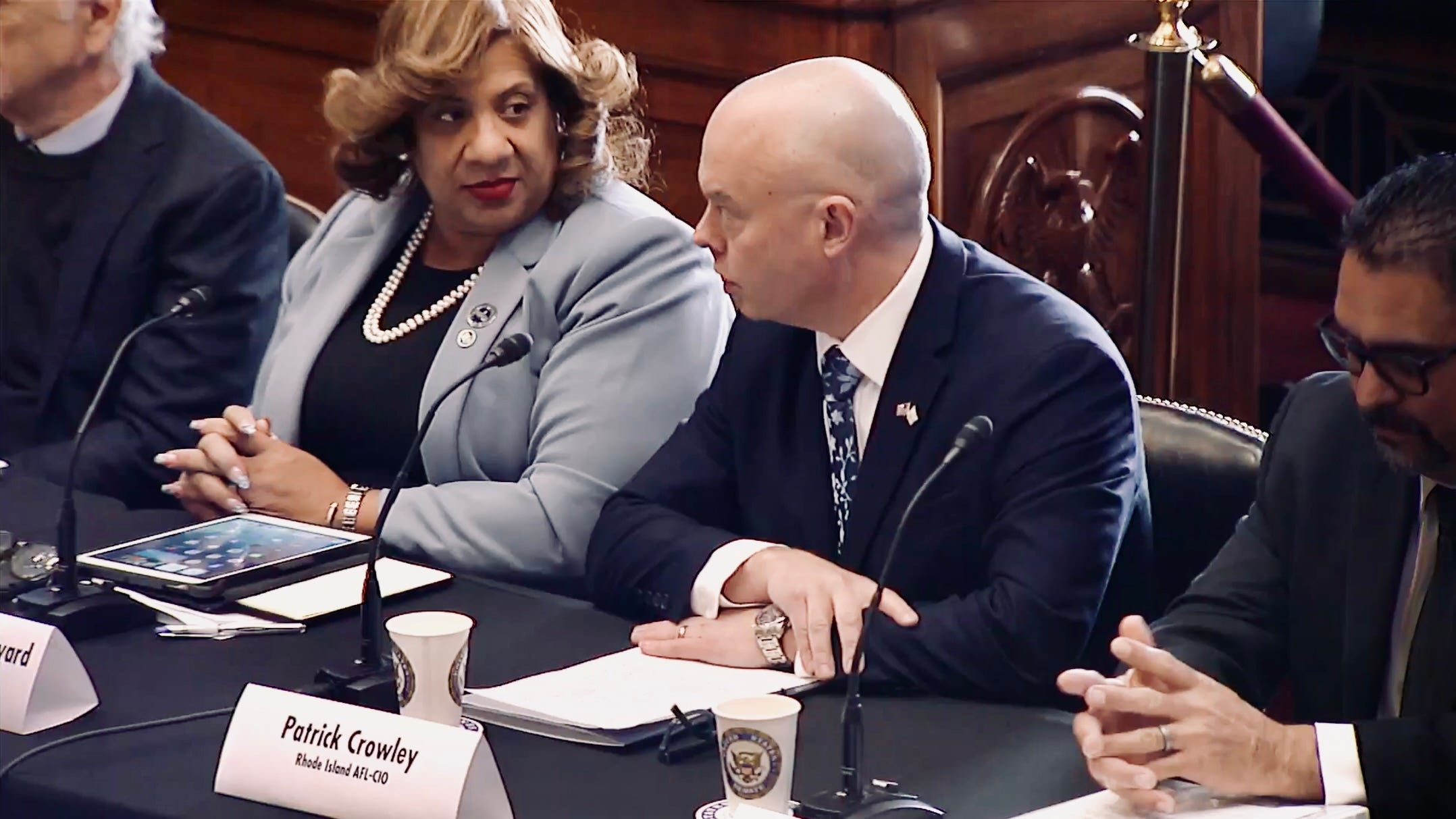
U.S. Senator Martin Heinrich (D-NM), Ranking Member of the U.S. Senate Energy and Natural Resources Committee, hosted a roundtable with elected officials, union representatives, and national and local electrification and efficiency advocates to discuss how the Trump Administration’s policies - from stalling permits of more than 500 clean energy projects to sunsetting critical investments that make energy cheaper for consumers - have raised utility costs on working families. You can watch the video here.
Rhode Island Senators Jack Reed and Sheldon Whitehouse were in attendance, as was Patrick Crowley, president of the Rhode Island AFL-CIO and co-chair of Climate Jobs Rhode Island, there to add his perspective on the Trump Administration’s multiple shutdowns of Revolution Wind and other offshore wind energy projects. [See: “This is bullshit.” Labor & political leaders oppose Trump’s Revolution Wind stop-work order and Trump Administration once more attempts to shut down offshore wind energy projects.]
Here’s a partial transcript:
Senator Heinrich: We’re here today to discuss the energy affordability crisis that is unfolding before us. There’s a lot in the news, but this is what people feel every day, and it is a crisis, unfortunately, created almost entirely by this administration. President Trump said he would cut electricity prices in half, but electricity prices have risen 13% nationwide since he took office just over a year ago. Instead of saving money, hardworking Americans around the country, and certainly in my home state of New Mexico, are wondering how they’re going to keep the lights on and the heat running this year. Simultaneously, energy demand is growing nationwide at a rate not seen in recent history.
Grid Strategies, a power sector consulting firm, predicts that electricity demand will grow 32% by 2030, just four to five years from now. At a time when we need the cheapest electrons on the grid, the president is taking every opportunity to stop electrons from reaching the grid altogether. The bottom line is that the Trump Administration is failing the American people.
First, they have instituted, and the public does not well understand this, a de facto ban on new wind and solar projects on federal land, stalling 22 gigawatts, the equivalent of power in two New York cities, from coming onto the grid, and 500 projects totaling 116 gigawatts of capacity are at risk of not being built. Right before Christmas, the administration stopped leases for five large-scale offshore wind projects, putting thousands of people out of work, like literally, “Sorry, you don’t need to show up for work tomorrow.” These projects would’ve provided almost six gigawatts of needed electricity to power over two and a half million homes. For perspective, that’s like taking six nuclear power plants off the grid. These actions mean that more than half of all new power plants under construction in the United States through 2030 may not come online.
Second, they’re raising residential gas prices by wholesale green-lighting of liquified natural gas exports under President Trump. The Department of Energy has authorized more than 13.8 billion cubic feet of LNG exports every day, more than the volume exported today by the world’s second-largest LNG supplier. This is a simple story of supply and demand. With such enormous LNG exports, there is less supply available to the U.S. Between quarter one of 2022 and quarter three of 2025, residential gas prices more than doubled.
Third, the Trump Administration is forcing old, retired coal plants to keep operating under the guise of reliability. As of today, the administration has delayed the retirement of at least six fossil-fueled units, and if it continues to prevent these expensive plans from closing, it will cost Americans an additional $6 billion a year. One of these is the 63-year-old JH Campbell coal-fired power plant in Michigan scheduled for retirement. The Trump Administration has ordered the plant to stay open. Consumers Energy reports that keeping the plant running for just five months will cost at least $80 million, or about $600,000 a day. This is in addition to the investments consumers have already made to replace the power the plant generated, after Consumers Energy and local regulators found that replacing the plant with natural gas, solar, and battery resources could save customers $600 million. The bottom line is this: they’re choosing to keep very expensive coal plants on the grid, and consumers are getting charged twice, once for the investments in more affordable energy sources that they’ve already paid for, and again, in the expensive maintenance fees to keep the Campbell plant open unnecessarily. Overall, Grid Strategies found that keeping aging coal-fired plants open could add nearly $6 billion in costs for U.S. consumers by the end of 2028.
There are better, more affordable ways to make our grid more efficient, less expensive, and to ensure we have the power we need. Today, we have an esteemed panel of guests who will outline how President Trump’s failures are hurting everyday Americans and what can be done to reduce electricity prices.
Mark Wolfe, Executive Director of the National Energy Assistance Directors Association and Co-Director of the Center on Energy Policy and Poverty: I’d like to thank the members of the panel for your strong support of the Low Income Home Energy Assistance (LIHEAP) program. It was a tough year. The administration wanted to kill the program, and remarkably, we’re on target with last year’s funding. The administration provided advanced funding at the same level as in prior years. It was a remarkable outcome.
I work directly with energy assistance directors in every state, and what we’re seeing is unprecedented hardship. As electricity and natural gas prices continue to rise faster than inflation, more families are at risk of falling behind on their utility bills and facing the shutoff of service. Today, one in six households is behind on utility bills, owing utilities a total of about $23 billion.
Our organization estimates up to four million households face utility shutoffs in 2025, nearly half a million more than in 2024. Low- and moderate-income families now spend 6-10% of their income on energy, three to five times the share spent by higher-income households. When energy costs rise, families are forced to choose between keeping the lights on, buying groceries, paying rent, or filling prescriptions. This winter follows one of the most expensive summers on record for home cooling, driven by rising electric prices and hotter temperatures. Meanwhile, President Trump is weakening the safety net. LIHEAP funding has fallen by more than a third since 2023, reaching only 17% of eligible households. Even as the need continues to grow, the administration has repeatedly threatened to fire all federal LIHEAP staff at HHS on April 1st, proposing to eliminate the program’s funding in fiscal year 2026. Fortunately, Congress rejected that recommendation.
Even though funds were released, major challenges remain. Federal LIHEAP staff have not been rehired, leaving states to operate without federal training or guidance and increasing the risk of future funding delays.
The drivers of higher prices are structural and widespread. Electricity prices are rising due to higher financing costs, aging grid infrastructure, growing data center demand, and higher natural gas prices. Natural gas prices have surged over the past year, in part because expanding exports increasingly tie U.S. prices to global markets. The current policy mix has benefited fuel producers and large industrial energy users while leaving households more exposed to rising and volatile electricity costs.
We urge Congress to strengthen the program. While LIHEAP provides critical assistance, it currently places no requirements on utilities to prevent shutoffs or offer discounted rates, even as it now delivers roughly $4 billion a year that helps offset bad debt, reduce collection pressures, and keep people connected to the utility system. We also urge Congress to expand weatherization and energy-efficiency investments and to ensure that meaningful affordability protections are included. When utilities seek rate increases, America can modernize its energy system and move towards cleaner power without forcing families to choose between heat, food, rent, and medicine.
Mayor Shawyn Patterson-Howard, Mt. Vernon, NY: Mount Vernon is a first-tier suburb nestled between the Bronx, Pelham, and Yonkers, and it is the second most densely populated city in New York state. Whether on a fixed income or part of a working family, our residents deserve predictable and affordable energy. Energy costs are devastating families. Electricity and gas prices in Westchester are among the highest in the nation. Ms. Pettiford, one of our long-term residents, recently faced a $1,100 utility bill. Her actual usage charges were under $350, but delivery charges exceeded $775. Families like hers are forced to make impossible choices between staying warm, putting food on the table, or maintaining their homes.
This is not just a household challenge, it’s a community-wide crisis. This crisis also affects municipal budgets, and when energy costs are unpredictable, we must hold back funds for youth, seniors, education, and public safety initiatives.
I recently joined a consortium of 40 municipalities across Westchester to challenge Con Edison’s proposed rate increases of up to 13% for electricity and 18% for gas. Over three years, we negotiated a settlement with 2.8% and 2% annual increases, still above inflation, but the revenue must now be reinvested in county infrastructure and operations. Mount Vernon is taking bold local action. We’re partnering with Ice Air, a local manufacturer and environmental leaders of color, to expand energy-efficient heat pump installation and train a local workforce. To support these projects, we are collaborating with Con Edison to create a geothermal network that will deliver efficient heating and cooling to thousands of homes and businesses, not just to individual customers. We’re working with Royal Power Energy to advance plug-level electricity management and cleaner energy generation. Together, these pre-programs create a full-stack energy efficiency model from the grid to the plug.
We’re reducing waste, cutting costs, and protecting the environment. Unfortunately, spiking energy costs force impossible choices, and every dollar saved on energy costs is a dollar that keeps food on the table, supports local businesses, saves for a child’s education, or goes toward home energy costs. Stability isn’t just a utility issue; it ripples throughout our local economy and strengthens families.
I urge you to support common-sense clean energy solutions that protect families, strengthen communities, and reduce reliance on fossil fuels. By backing these initiatives, you can help families not only cover utilities but also feed their families and plan for the future, while ensuring affordable energy and reducing harmful emissions. Energy stability isn’t just a utility issue; it’s an economic, public health, and moral imperative.
Patrick Crowley: I represent 80,000 working-class Rhode Islanders, many of whom have been hurt by federal actions against job-creating clean energy projects like the 704 megawatt Revolution Wind. While I’m happy to say my members are back to work, I’m afraid the damage has been done. Working-class families in Rhode Island are struggling with rising, expensive energy bills as demand increases, and too many Rhode Islanders, too many Americans, are still struggling to make a good living and support their families. As costs surge, the Rhode Island labor movement is leading the way in addressing these intertwined issues.
For the past 10 years, we’ve worked to bring offshore wind to the Northeast. It’s a domestic source of new energy to meet rising demand, and it’s bringing thousands of high-quality union jobs to the communities where my members live and work. That should be uncontroversial. Yet the Trump administration has issued not one but two stop-work orders on the Revolution Wind project, which was 85% complete and ready to power 350,000 homes. Losing Revolution Wind and the other offshore wind projects would be devastating to our grid and energy prices.
ISO New England, our regional grid operator, stated that the first shutdown of Revolution Wind will occur, saying that delaying the project will increase the risk to grid stability. Losing Revolution Wind for good would be devastating to workers who are counting on offshore wind for good jobs to support their families. Workers like Kaiden Pimentel and Antonio Gianfrancesco, members of Laborers Local 271, and Nick Reynolds, who paints and coats turbines as a member of the International Union of Painters and Allied Trades. Tom Kilday, an apprentice electrician with IBEW Local 99, has been working on Revolution Wind for the past year. And when asked about the shutdown, said, “It’s like running a marathon and getting tripped a hundred feet from the finish line.”
If I can offer you one takeaway to consider today, it is this: We can build a resilient economy, we can make energy affordable, we can do it while we create good jobs, and the labor movement is ready to lead the charge. Let us finish the job. We need your help to make this a reality. Thank you.
Alfonso “Fonze” Martinez, Business Manager of IBEW Local Union 611. We have roughly 3000 members. Most of those members know me as Fonze. I’m a proud 33-year member of the IBEW, and my position in the union, and therefore the energy industry, has been vast. I’m both a journeyman lineman and a journeyman wireman, meaning I have built big buildings, operated and maintained big power lines, and built big power lines. I have the frontline experience in America’s energy industries. IBEW Local Union 611 supported the infrastructure and energy legislation that became law in 2021 and 2022 because, for the first time, these laws put members on a level playing field in the renewable energy industry and more broadly invested heavily in modernizing the power grid. The IBEW works in all forms of power generation, but until the Inflation Reduction Act (IRA), the renewable sector was, to put it mildly, less union-friendly.
However, thanks to the work of Senator Heinrich and other senators in this room, the IRA made it more costly for developers and project owners to avoid hiring union labor. When the president’s big, beautiful bill rolls back clean energy tax credits, and Trump’s Administration cancels hundreds of billions in energy projects, the opportunities in these sectors will dry up for union members. Already, my local union has seen the Kit Carson Battery Storage project in Taos canceled by this administration’s Department of Energy, putting over 60 of my members out of work, and freezing millions of dollars in funding for the P&M Virtual Power Plant project for purely political reasons.
What this means for our local economy, on top of putting people directly out of work, is that a steady pipeline of highly skilled workers can’t be built without project certainty. We can’t bring in and train apprentices. Our model is earn while you learn. If we don’t have work for these apprentices, we can’t bring them in, so contracting the pipeline for these jobs reverberates across our industry.
The jobs lost and opportunities lost represent a real cost to the IBEW. Still, they will also hurt all families in New Mexico, killing new generation for no good reason, won’t stop the big energy users from growing, and we don’t want to stop the growth we want to build to meet that new demand. If we don’t build more generation, the data centers have the money to pay higher taxes; we won’t. Our neighbors won’t. And I’m left asking: Why are we killing these projects?
Scott Libby, owner of Royal River Heat Pumps: We exclusively provide and install heat pumps. This is year number 41 for me in the HVAC trade. I’ve worked with gas and oil, and I’ve realized my customers prefer heat pumps. They’re clean, quiet, and efficient. I’ve built a company with close to 40 employees, representing 40 families and over 80 children. There are 754 registered vendors in Maine providing heat pumps. With the loss of the tax credit, we’ve seen heat pump adoption decline. Maine has led the adoption of heat pumps over the years. Royal River Heat Pumps has installed 10,000 heat pumps. We represent a small fraction of the work being done in Maine. The number completed represents only a very small percentage of what needs to be done.
We have seen how these systems have transformed energy use and home comfort in the coldest climates. Our customers love them because they’re clean, quiet, and improve their indoor air quality. They offer year-round comfort, and in most cases, they save energy costs, especially if you’re switching from oil, propane, or electric heat. I’ve heard families say that this is the first time they’ve been warm in the winter and not afraid to look for the next electric bill. But we’re also seeing affordability pressures not because the technology is failing, but because of structural issues. Maine’s electricity prices are rising, driven largely by natural gas exports that push up wholesale prices across New England. Gas prices are up 60% on that chart. It’s the largest spike in decades, and like many small business owners, I’m dealing with higher equipment input costs, copper shortages driven by data center demand, and rising healthcare premiums.
My employees receive 100% of the cost of medical, dental, vision, long-term/short-term disability, and life insurance. I’m seeing those prices skyrocket, but this isn’t the time to retreat. As we work to reduce electricity costs, we should double down on efficiency and electrification. Maine is showing how our state’s new energy efficiency plan focuses on weatherization and beneficial electrification to reduce household bills, invests in market transformation to build momentum, grow the workforce, and drive down installation costs. It uses smart tools, such as demand response, to more efficiently spread fixed grid costs and lower costs for everyone. If Maine can make it work, it can work anywhere. Let’s make sure every household, not just the wealthiest, can afford the benefits of these systems.
Ari Matusiak, Founder & CEO of Rewiring America: On my way in this morning, I asked AI a question: How much will tech companies spend over the next five years to procure energy so it can keep answering my questions? Its response was several hundred billion dollars, maybe a trillion dollars for energy procurement, not the bills that the data centers will pay for their energy bills, but to get that electricity. That makes sense, as the projected procurement is expected to be between 100 and 200 gigawatts to support these data centers nationwide. That is one of the factors driving rising electricity rates because we’re not building enough new power or bringing it online, and system demand is higher. There has been extensive discussion on this, and one proposed solution is a strong one: not having ratepayers pay for the electricity that data centers need.
But the dynamic here is a little more nuanced: if we tell large loads like data centers to pay their own way, that doesn’t lower anyone’s bills; it just slows the rate of increase. But there’s an amazing opportunity in front of us that creates a win-win for your constituents and our communities. It turns out that households can furnish 50-100% of the energy that these data centers need. Installing solar batteries and heat pumps in people’s homes creates enough grid capacity for the electricity that the data centers themselves need. If tech companies are going to spend several hundred billion to a trillion dollars to find that energy, they could allocate a significant portion of that to investing in all of us and in households to purchase these machines to lower their bills immediately.
It turns out that when you install rooftop solar, battery storage, and heat pumps in your home, your bills go down. They go down by $1,800 a year on average. That happens right away, not five or six years from now, when the grid catches up to all the demand it needs to meet. Part of why I’m raising this is that I think this is an opportunity for real federal leadership, and it manifests in three ways: One, we need to come back to the investments you all led that helped households make these investments in the first place. Senator Heinrich, your rebate program was a hallmark of the legislation that passed several years ago, but only 13 states currently have such programs. Those dollars need to be released.
Second, there is an opportunity to invest in standardized virtual power plant programs for households, enabling them to become a real asset to the grid and be compensated for their support.
Third, we can require that large data centers and other loads prioritize households as the first source of energy, so that families, communities, and the power grid can all benefit.
Paula Glover, President of the Alliance to Save Energy: The electricity system is under historic pressure nationwide. Utilities are facing rapid low growth driven by data centers, AI, and electrification, and new manufacturing demand is rising much faster than new generation and transmission can be built, creating a widening gap between near-term needs and long-term infrastructure timelines. When that gap widens, the cost of new infrastructure often falls on families and small business owners, many of whom are already struggling with rising energy bills. The good news is this rising demand does not have to mean rising electricity prices; energy efficiency, flexible demand, distributed energy resources, and virtual power plants are real, proven solutions.
They can be deployed faster and at lower costs than traditional infrastructure, serving as a practical bridge while the new generation and transmission come online. Energy efficiency protects affordability in two ways. At the system level, it lowers peak demand, helping utilities avoid or defer the most expensive investments that drive customer-level rates. It directly reduces energy use and bills, especially through foundational measures such as weatherization, which are critical for households with the highest energy burdens. At the Alliance, we’ve been working with utilities, regulators, and large customers on a framework called Bring Your Own Distributed Capacity (BYODC) because we love a good acronym.
The idea is straightforward. When large energy users add load, they help fund incremental efficiency and demand-side resources that deliver real, verifiable grid capacity. This approach gives utilities faster capacity relief, strengthens reliability, supports economic growth, and helps protect customers from unnecessary cost increases. Yet today, demand-side solutions remain dramatically underutilized. They’re not consistently treated as capacity, planning, or interconnection despite their speed and cost advantages. We don’t need a one-size-fits-all mandate. What we need is national leadership that helps states and utilities fully use the tools they already have, through clear measurement and accreditation, rapid deployment of home energy, rebates, and scalable pathways for virtual power plants.
This is a rare moment. The choices we make now can protect families’ strength and reliability and ensure affordability as demand grows. Demand side solutions are the fastest path to affordability, the smartest path to reliability, and the most cost-effective way to meet the energy future ahead.
U.S. Senator Reed: Can you tell us again about the impact of stopping the wind project in terms of labor in Rhode Island and across the country, in terms of other energy-saving projects?
Patrick Crowley: The impact has been pretty dramatic. It’s as if the Trump Administration has put a “Closed for Business” sign on the northeast coast of the United States. I mean, you’ve got to imagine that these projects are not like having two buddies come over on a Saturday afternoon to build a deck on the back of your house. These are multi-billion-dollar, multi-trade, intricate projects. They require years of planning, and developers interested in this type of project building have opportunities elsewhere around the world.
My biggest concern is that by sowing confusion in this marketplace, these developers will look elsewhere. That’s going to leave my members in Rhode Island out in the cold, but you’re right, Senator, this isn’t a Rhode Island-specific thing. We have a chance to be an energy producer for the entire country, right off the coast of New England, and to think that we’d give up a domestic source of energy that is not only going to be less expensive - the Revolution Wind Project has a 20-year fixed purchase price agreement at less than 10 cents a kilowatt. By comparison, just the other day, the grid was paying 70 cents a kilowatt. Why would we not have a cleaner, cheaper, and safer domestic source of energy that’s going to employ thousands upon thousands of union members up and down the East Coast and elsewhere across the country? It makes no economic sense.
U.S. Senator Reed [To Ari Matusiak]: What about rebates to consumers? Is that part of your vision?
Ari Matusiak: You and Senator Heinrich led the rebate program in the Inflation Reduction Act, and states like Rhode Island and many others now have their own rebate programs. This is important for reducing front-end costs. When you combine it with other sources of capital, like, for instance, if we have tech companies supporting those costs to help homeowners make these installations, you can cut the front-end cost by over 60-70%. It’s an important part of the equation, and we need more of it.
U.S. Senator Peter Welch (D-VT): The thing that’s so frustrating is that everything you’re proposing is practical and within reach. So what’s the problem? It really is astonishing. We’ll get Sheldon and Martin going on their tirade about the fossil fuel companies, but did you say 10 cents? It’s cheap. It’s affordable. It drives down costs. That is amazing. Who’d want that?
This idea of having localized demand side management, which is an asset, is there; it’s built, and you can employ that. What is the holdback on us doing it? I know it doesn’t fit the generation model. For decades, power producers and utilities were generally given a return on investment. Hence, the more they invested in big expenditure projects, the higher the total gross return they would get. Obviously, that’s an incentive not put up rooftop solar. It’s an incentive to do a big coal or gas plant. What do you think is the holdback on us being able to take advantage of what is right there in all of our communities?
Ari Matusiak: It’s a mindset shift. Historically, we think about households as the end of the line, passive energy consumers, but if we thought about households as energy infrastructure, it would change how we approach the problem. A large tech company coming to town to build a data center is not going to knock on your door and ask, “Have you thought about getting a heat pump?”
Senator Welch: Hw would you implement that?
Ari Matusiak: This becomes a programmatic strategy in which you bring together the utility, a local set of implementers, and hyperscaler support to secure funding. What we’re seeing in places like Maine, where Scott has been doing a great job installing a lot of heat pumps, is that when you put a program together, and you say, “We have a goal, we’re going to try to get to a hundred thousand heat pumps in the state, people rally around that, and they get organized. What’s beautiful about this approach is that it gives the whole ecosystem, from contractors to local community leaders, a target and the resources to support 20,000 households in receiving upgrades. That allows us to start to play through.
Senator Welch: And energy efficiency. Senator Padilla left, but he told me that California reduced electricity costs, and it’s not demand; it’s utilization driven by efficiency. That can be done at the household or business level. We’ve got efficiency utilities in Vermont, but could you elaborate on that a bit?
Paula Glover: What you’re speaking to is that efficiency allows people to install measures in their own homes, apartments, and businesses that will enable them to save energy. The challenge we face is that some enabling steps must be taken for certain customers. If you think about the customers that Mark serves, before you can get to efficiency, you probably have some things that have to do with weatherization, or even before weatherization. We’re facing challenges in figuring out how to support households across demographics in adopting these programs. The beauty of rebates, tax credits, and weatherization is that each program can address the problem from a different angle.
What Rewiring America and Ari are suggesting is that we must address this multi-layered problem. Depending on the customer you’re dealing with, it may be heat pumps, insulation, or something else, but ultimately, I think it serves two purposes: one, it reduces household bills. Efficiency makes energy more affordable and increases grid capacity, but it also introduces challenges in how you manage it. It creates space, particularly at a time when we are discussing permitting reform. It’s not going to happen tomorrow, and we have a challenge that needs to be addressed tomorrow, so how do you address this near term, even while you’re looking for a longer-term solution?
Senator Whitehouse: I’m hoping we can get back to work on permitting reform soon, once we have a response from the Trump Administration on when their nonsense will end. I’m delighted to welcome Pat Crowley here, who’s been such an effective leader against the Trump Administration’s illegal, irrational, and mean-spirited attack on offshore wind jobs.
We know renewable energy is more cost-effective. How do we know that? We know this from sworn pleadings filed in the offshore wind cases by attorneys general, which allege hundreds of millions of dollars in customer savings, supported by affidavits.
We know that, under written contracts, Revolution Wind electrons are priced at 9.9 cents per kilowatt-hour, compared to an 18-cent-per-kilowatt-hour grid. 9.9 is less than 18. We ought to be able to agree on that.
We know that from the technical experts who run the grids, the ISO operators who call up offshore wind, solar, and wind before they call up fossil fuel, because it’s cheaper, and that’s how the grid works. Technicians know renewables are cheaper, and we have seen this firsthand. We reviewed Texas and the Texas grid. Supply costs have fallen significantly on the Texas grid as renewables have come online. There’s been an explosion of solar and wind in Texas, and as a result of that, at a fixed level of demand, the cost has gone down by two-thirds. Two-thirds in cost reduction because all of that less expensive power came on.
Peter made a very good point: This makes no sense. How does this make sense? It makes sense once you understand the political context we’re operating in. It makes sense once you understand that the fossil fuel industry contributed hundreds of millions of dollars to Donald Trump and that by deliberately hobbling, interfering with, blocking, and slowing down cheap clean energy, they drive grids across the country up the stack to more expensive fossil fuel plants. Those more expensive fossil-fuel plants result in higher prices for consumers. Consumers have to pay more, and that extra money goes to the fuel dealers and the operators of those fossil fuel plants that would otherwise be sitting idle because they’re too expensive, inefficient, and polluting to run. It is a direct transfer of millions and millions of dollars out of the pockets of rate payers and customers to the big fossil fuel donors of Trump.
It’s not just a cost, it’s a scheme. This is being done deliberately. This is on purpose. This is to raise their electric utility costs, on purpose, so that the extra money can go to Trump’s big fossil fuel donors. Consumers deserve to be mad about this. They’re already frustrated with the cost, and we understand there’s a corruption element; it gets even worse.
U.S. Senator Mazie Hirono (D-HI): You all know that Hawaii has among the highest, if not the highest, energy costs in the country because we were pretty much 100% reliant on importing fossil fuels for electricity. We also have, as a result of the ongoing cost of energy in Hawaii, one of the strongest goals: to achieve 100% renewable energy by 2045.
This regime’s ‘drill baby, drill’ orientation is not helping Hawaii get to its goals. We face major challenges. We are interested in households and homeowners to help them manage energy costs. You talked about households as part of the grid. We have a high level of solar in Hawaii, which helps our electric company. Still, you mentioned that some states create an environment where households can be part of the energy infrastructure. Can you explain what kinds of laws in these states result in households being part of the infrastructure?
Ari Matusiak: The rules across states vary widely. In some states, it’s easier to put rooftop solar on your house. In some states, it’s easy to attach a battery; in others, it’s more difficult. Some states have virtual power plants that enable you to combine households and use them to offset grid costs and pay households for doing so. In other states, it doesn’t get recognized. I think part of the opportunity for federal leadership is to create a framework that standardizes this approach and reframes households as part of the energy infrastructure, rather than passive energy consumers. If we take that seriously, we will view households as a source of investment for the grid to access.
Senator Hirono: I like that approach. My question is: how does a state like Hawaii, which is not connected to any other grid and, in fact, each island has its own grid, implement that?
Ari Matusiak: One of the main things to do is to make electricity as cheaply as possible. The way to do that is to lower the cost of rooftop solar and storage. In countries like Australia, the cost of solar is less than $1 per watt, and in the United States, it can be $4 to $5 per watt for households. That’s not because the technology in Australia is better than here; it’s because we add so many costs on top of that to make it more expensive. That’s the way that a state like Hawaii can lower costs. Remove soft costs from the mix, such as permitting fees and other expenses that increase household costs. As soon as you make the cost of that electricity cheap for the families, their bills go down by quite a lot, and the grid becomes more resilient as a result.
Senator Hirono: Paula, on the demand side, how do you encourage households to reduce their energy use?
Paula Glover: Unfortunately, many of the programs that the one big beautiful built took away would’ve encouraged households to do that. But there are many things, like weatherization, that they handle at the state level. Our state regulators are allowing utilities to offer a variety of programs in addition to home rebate programs and other options customers can adopt. These things really help customers reduce their bills. The biggest challenge we have is information and understanding. We are talking about investment, so Ari is right. If you install a heat pump, your bill will go down, but you must first have the funds to install it, and rebates are designed to help customers pay for these upgrades. When you eliminate rebates, it becomes more difficult to achieve the outcomes we want.
Senator Hirono: Since the federal government has pretty much eliminated all support for low-income people and also the rebate programs, it’s left to the states to figure things out on how to incentivize the kind of programs you’re talking about. I’m not sure anyone can explain what each state is doing on the demand side. It would be helpful to learn from other states’ approaches.
Patrick Crowley: Senator, if I could amplify one part of Paula’s answer. One of the things the big, beautiful bill eliminated was the Solar for All program, which would’ve been instrumental to what Ari and Paula are discussing. Forty percent of Rhode Island’s population is renters. They don’t have the ability, on their own, to put a solar panel on their house. They need to get their landlord to do it. The Solar for All program was specifically targeted at low-income households, marginalized communities, and renters. Those communities needed that program to build the domestic infrastructure Ari’s talking about, so they could increase the demand side Paula is talking about. The Trump Administration unilaterally cut the Solar for All program. I was talking with some of my colleagues here this morning: there are places in this country that don’t have power. We had the opportunity not just to provide electricity to these folks, but to actually build a power source that would create the space to do all the things Ari and Paula were talking about. I mean, it is counterfactual.
Mark Wolfe: Until recently, people who struggled to pay their energy bills were primarily in the bottom 20% of the income distribution in the United States. But we’re now seeing this as an opportunity to revisit how to improve efficiency. We’re now seeing people with moderate incomes, between 20 and 40% of their income, struggling to pay their bills. We’ve never seen those families before. Electricity was affordable for a long time, from 2015 to 2021; prices pretty much kept up with inflation. It was affordable. But since 2021, prices have gone up faster than inflation. What we’re seeing is that people who could afford their energy bills didn’t come in to ask for LIHEAP assistance. We never saw people at the top of the eligibility because they could afford it. Now we’re seeing them. The dynamics are changing: when you look ahead over the next couple of years, this isn’t a volatile change like electricity prices going down next year. There’s enormous pressure to keep prices moving up.
We’re looking at programs like LIHEAP that were designed for a different period. As we move forward, we need to consider how we support families and address extreme summer temperatures.
Rising electricity prices don’t just hurt families in the winter. We’re now seeing record prices in the summer. There’s like an institutional change going on that the programs we have in place aren’t really set up for. The Administration pulled back programs that would help address rising prices, such as Solar for All. Luckily, LIHEAP is still in place. The administration wanted to kill it, but it’s still here. But it hasn’t kept up with inflation.
We’re seeing a change. We need a new lens for the next period. The old lens is gone. The era of cheap energy, cheap electricity, and abundant fossil fuels is over. We need to think more aggressively about efficiency and renewables.
Mayor Patterson-Howard: Right now, Congress is considering probably the biggest bipartisan housing support bill ever. As we move forward with housing development, we know the country is three to four million housing units short. We encourage Congress to incentivize lead certification, solar, heat pumps, and other measures to improve the energy efficiency of these housing projects. This will support people across the entire income range. While we’re working to increase electrification, expand the grid, and make it more durable, we also want to ensure we’re building housing for the future that accounts for rising heat and energy costs.
In Mount Vernon, we built one of the biggest passive housing projects in North America. It opened in 2023, and the building’s residents pay 50% less than those in surrounding buildings. While their rents might be higher, their energy costs are lower. People need stabilization. They need predictability. That is going to help. It will also help governments: when energy rates are more predictable due to a better grid, we won’t have to raise property taxes because our energy costs as a government are out of control. We can maintain our spending level and reinvest those funds in clean energy projects, education, housing, and public safety.
Scott Libby: As we move toward heat pumps and electric heating, we need to consider weatherization. That’s part of saving kilowatt hours. We also need to consider time-of-day pricing, as electricity costs peak at certain times. We can shave the peaks and spread demand overnight, when power is the cheapest. That’s something the utilities have resisted. I’m old enough to remember when the phone company offered cheaper phone calls after nine o’clock, and I remember watching my watch and making that phone call. That proves that people will respond to price signals. Why can’t we do that with electricity and shave that expensive peak? There’s no cost to those kinds of things.
Secondly, the major challenge facing our consumers is the grid. It used to be that transmission and distribution were 30 or 40% of the electric bill. Now it’s over 50% and in some cases even higher. And that’s going to get worse because everybody’s worried about AI, data centers, and additional demand. We have to address the incentives utilities have to build infrastructure. There is no incentive for a utility to invest in grid-enhancing technologies and reconductoring before it builds new lines and poles. That’s a state issue. It’s PUC by PUC. They have to issue a certificate of convenience and necessity. My feeling is they should say, “We’re not going to look at your proposal until you show us what you’ve done, and then we’ll talk about what you have to build,” because I think there’s a huge opportunity there to avoid what is coming at us, which could be catastrophic increases in terms of additional grid support.
We’re at the point of this meeting where everything’s been said, but not everybody has said it, so I’m going to say a few things. Again, solar and wind are the cheapest energy sources today. Onshore, onshore wind and solar are 3 cents a kilowatt hour, 3 cents a kilowatt hour. I get a weekly report on the cost of various energy sources. Solar and wind are always the lowest. And now, of course, the wrap is intermittent, and you need a backup. Well, storage has come down in price dramatically over the last five or seven years, and it’s going to continue to come back. And there are additional storage options. My dream for 25 years has been that Hydro-Quebec will be the battery for New England.
That you have renewable storage that could serve as a backup for wind and solar. And finally, offshore wind. I said 25 years ago that the Gulf of Maine was the Saudi Arabia of wind. The capacity factor for a wind project onshore, which I developed in Maine some years ago, was about 35-40%. The capacity factor offshore is 55%. That’s a huge difference. And the wind blows hard out there, as anybody who lives near the central coast can tell you. Many things can be done, but they need to be done in a coordinated and thoughtful way. Unfortunately, the administration is pulling back on all of these things. And I think it’s important that the American people know that rising electricity prices aren’t inevitable. They can be avoided, but this administration is facilitating those who raise prices rather than ameliorating them. They own the increase in your electric bill because it can be avoided through a whole series of things that require concerted action.
Paula Glove: Anything that we can do to help customers not use as much as we’re using now, including our businesses, I think we should be doing that first…
Venmo: @Steven-Ahlquist-2
Cash App: $SteveAhlquist
PayPal: atomicsteve@gmail.com
among the vicious things Trump and his regime have done, one of the stupidest with long term damage is the opposition to off-shore wind and solar-for-all, they help meet our energy demand with relatively low environmental impact, help provide good jobs, and help low income people meet utility bills. It was no secret that Trump was going to do such things, so it is hard for me not to get angry at those who got him elected.
By the way, his "pause" on the project rebuilding the the Hudson River rail tunnels may stop work on that project - again, a loss of environmental quality especially as Amtrak and commuter trains using the tunnels are already electrified, it is a loss of good jobs, and a loss of mobility if NY and New England are cut off the rest of the Northeast Corridor. All because Trump hates Democratic cities, energy efficient travel using less oil, and Union labor on the railroads.
One good thing is this broad coalition on this panel including elected officials, businesses, and labor - we should appreciate that after some years of occasional friction dividing labor and environmental interests, RI AFL-CIO head Patrick Crowley seems highly dedicated to seeing the common interests of both groups and working together. Bravo!
Trump is a criminal, crimes against humanity and ecocide